Corsair NIGHTSABRE WIRELESS: Specs, Features, Pros & Cons
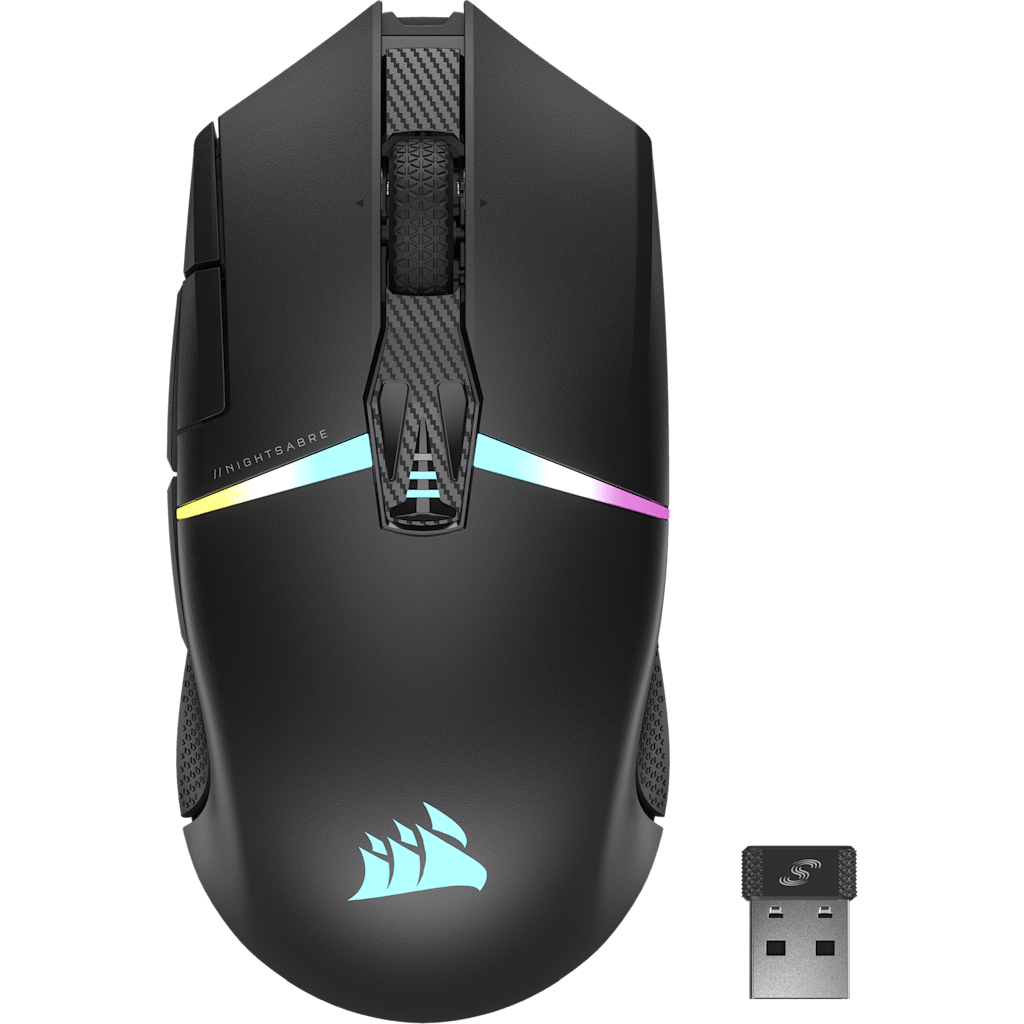
Corsair gave the NIGHTSABRE WIRELESS lighting, eleven buttons and three ways to connect, and the battery pays for all three. It is the wireless gaming mouse in Corsair's range that tries to carry everything at once, with a cable, a dongle and Bluetooth all available and the controls to match.
The body is described as symmetrical and lands at a middle weight, heavy next to competitive shells and light next to older gaming mice. Inside are Corsair's Marksman sensor and optical switches rated for a longer life than the typical mouse's, onboard memory for profiles and software for remapping, so the long button list can hold shortcuts for a spreadsheet as easily as abilities for a game. Quick charging is the feature that makes the rest workable. The rated endurance is short, so the mouse will spend more time on its cable than most wireless rivals, and a fast top-up turns that from a chore into a short pause. Bluetooth covers a work laptop, the cable covers a flat battery, and the dongle covers games.
What it gives up is lightness and endurance. Competitive players who chase the lowest possible weight have lighter options, including Corsair's own M75 AIR, and anyone who wants to charge a mouse once a month will find the battery rating too short. Left-handers should read the button layout closely before trusting the symmetrical label.
The buyer who fits it best keeps one mouse for everything and moves between a gaming PC and a laptop without carrying a dongle around. For that person the spread of features carries more weight than any single figure, and the NIGHTSABRE has no obvious hole in the list.
Category strengths
Where the Corsair NIGHTSABRE WIRELESS beats the median
- More buttons ?11 vs 6 (median)
- More connection options ?
- Has RGB lighting ?
- A higher switch lifespan ?100 million clicks vs 80 million clicks (median)
- A slightly higher max sensitivity ?26,000 DPI vs 25,600 DPI (median)
Where the Corsair NIGHTSABRE WIRELESS trails the median
- Much shorter battery life ?65 h vs 150 h (median)
- A heavier build ?98 g vs 89 g (median)
How this VS Score was computed
Score 58: each known spec is measured against the median of all mice (81 products), then weighted; 50 means level with that median. In classes of six or more, a value beyond the class’s 10th–90th percentile range counts as that limit, so one extreme product cannot set the scale. 70% of the scoreable weight could be used; unknown values, features not applicable to this class and proxies (battery capacity where a rated life exists) add or remove nothing.
| Specification | This product | Cohort median | Score weight | Points moved |
|---|---|---|---|---|
| Buttons | 11 | 6 | 0.6 | +25.2 |
| Connection | 3 | 2 | 0.8 | +20.0 |
| Battery life | 65 — capped at the class’s lower range (75) | 150 | 0.8 | −20.0 |
| USB-C charging | Yes | 67% of the class have it | 0.3 | +15.0 |
| Quick charge | Yes | 55% of the class have it | 0.3 | +15.0 |
| RGB lighting | Yes | 46% of the class have it | 0.2 | +10.0 |
| Weight | 98 | 89 | 1 | −5.0 |
| Switch lifespan | 100 | 80 | 0.2 | +2.6 |
| Max sensitivity | 26,000 | 25,600 | 1 | +1.0 |
| Max tracking speed | 650 | 650 | 0.8 | +0.0 |
| Max acceleration | 50 | 50 | 0.4 | +0.0 |
| Polling rate | 1,000 | 1,000 | 0.8 | +0.0 |
| Wireless polling rate | 1,000 | 1,000 | 0.5 | +0.0 |
Not scored: Adjustable lift-off distance (unknown: not scored); Grip styles (unknown: not scored); Horizontal scrolling (unknown: not scored); Free-spin scroll wheel (unknown: not scored); Click latency (unknown: not scored); Debounce adjustment (unknown: not scored); Battery capacity (unknown: not scored); Wireless charging (unknown: not scored); Onboard memory (standard for the class (86% have it)); Software customization (standard for the class (97% have it)); Adjustable weights (unknown: not scored).
Editor’s note
The NIGHTSABRE is Corsair's mainstream wireless gaming mouse, and it makes its case on balance, with no single figure out in front. The Marksman 26K sensor tracks to 650 IPS and 50G, the optical switches are rated at 100 million clicks, and there are 11 programmable buttons, more than most symmetrical mice offer without becoming an MMO grid.
On weight it sits in the middle of the market. That is heavier than the 55-65 g mice competitive players now favor, and lighter than the older generation it replaced. In the hand it is unremarkable, which is the intention.
Connectivity is triple-mode: sub-1 ms SLIPSTREAM 2.4 GHz, Bluetooth, and USB-C wired. Battery life is quoted between 65 and 100 hours depending on how you use it, and fast charging gives roughly 20 hours from a 15-minute top-up, which in practice means it is never out of action. Five onboard profiles and seven RGB zones are configured through iCUE.
Two things to check. Corsair's own materials disagree slightly about the battery figures and about whether the mouse weighs 98 g or 99 g, so treat both as approximate. And the shape is described as symmetrical, but the buttons are all on the left, so left-handed players should not read "symmetrical" as "ambidextrous".
Buy it if you want a well-equipped wireless mouse with plenty of buttons and no significant weakness. Skip it if you play competitively and want the lightest thing available, or if you do not already use iCUE.
Specifications
Quality bars show where each figure sits between the lowest and highest of the 81 mice this VS Score is measured against.
Sensor & tracking
Design & handling
Switches & latency
Connectivity
Battery
Features
Sources and verification
Where the specifications come from
- Official product pagecorsair.com
- Independent testingrtings.com
Verification
- First published
- Specifications last checked
- Sheet completeness
- 24 of 34 specifications verified; the rest show as Unknown and are never estimated or scored
- Page type
- Product specification page — Compiled from the manufacturer’s published specifications and the cited sources; this is not a hands-on test.
- Basis
- Research-based: specifications and editorial text were compiled from the documents listed here and the manufacturer’s published data. We have not tested this unit ourselves; where independent measurements are mentioned they belong to the linked publication.
Mice with similar specs to the Corsair NIGHTSABRE WIRELESS
Ratings & reviews
No reviews yet. Be the first to share your experience.
The bottom line
The Corsair NIGHTSABRE WIRELESS earns a VS Score of 58, above the median of the 81 mice it is measured against (a score of 50 is level with that median).
- Who it’s for
- Someone who wants one well-equipped wireless gaming mouse with plenty of buttons, Bluetooth for a second machine and no single weak spot.
- Who should look elsewhere
- Left-handers, despite the symmetrical label, and competitive players chasing the lightest shell.
- The trade-off that matters
- Battery life is short for a wireless mouse, though quick charging softens the blow. Expect to plug it in more often than most rivals.
- The main alternative
- Corsair M75 AIR: Corsair's far lighter wireless option, if you want fewer buttons and less weight
The VS Score is calculated from the weighted specifications above, each measured against the median of comparable mice — a shortlisting guide, not a substitute for your own priorities. See how we score.