Corsair M75 AIR: Specs, Features, Pros & Cons
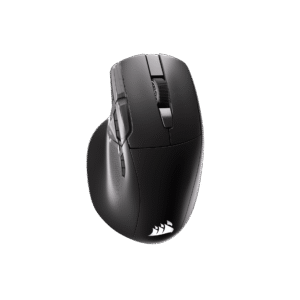
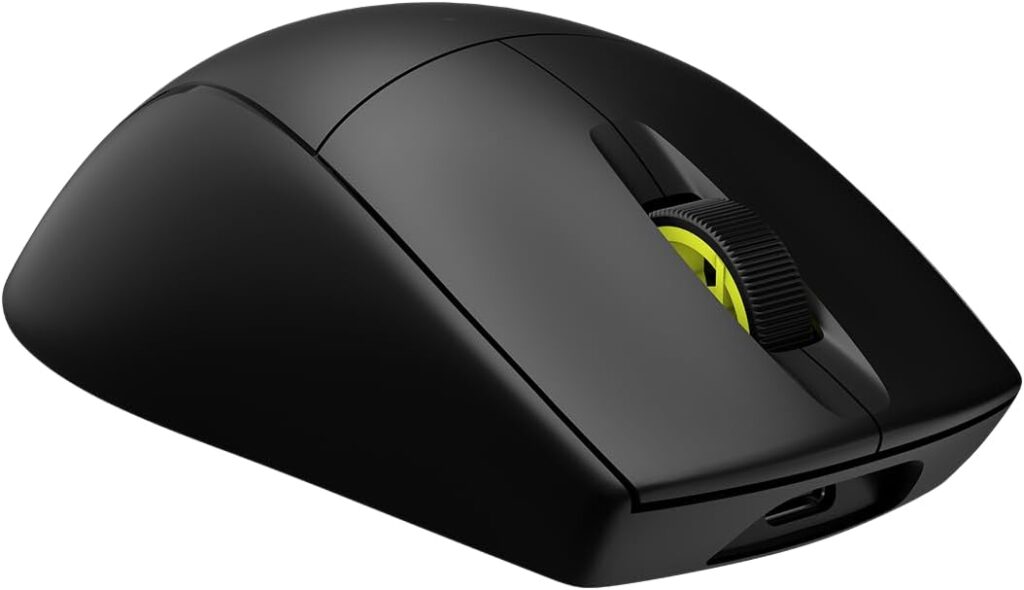
Two radios and no lighting sum up the M75 AIR. Corsair fitted a wireless dongle for games and Bluetooth for a laptop or a second computer, then left out every light and extra control that would add grams to a shell meant for aiming from the arm.
The body is ambidextrous with five buttons, a size and layout that sit best under a claw or fingertip grip. Inside is Corsair's own Marksman optical sensor, rated for 50 G of acceleration, with optical switches, PTFE feet and a USB-C port for charging. Onboard memory keeps the settings in the mouse itself, so a sensitivity profile tuned on the gaming PC is still there when the mouse goes into a bag and gets paired to a laptop. That decides who it suits. Someone who plays shooters at home and works somewhere else can carry one light mouse between the two desks, pair it to both, and leave the cable behind.
The trims are easy to list. The battery is small, so this is a mouse you charge on a routine and never forget for a month. There are fewer buttons than on the typical mouse here, which leaves little room for binds in games that want a row of abilities under the thumb. And the report rate is the standard one.
None of that touches the shape or the sensor, which carry the case for buying it. Its feature list reads like a record of things removed, and each removal is one a player chasing a light, calm shell would make on purpose. The one extra Corsair kept, Bluetooth, is what lets it work as more than a single-desk mouse.
Category strengths
Where the Corsair M75 AIR beats the median
- A lighter build ?60.5 g vs 89 g (median)
- A higher switch lifespan ?100 million clicks vs 80 million clicks (median)
- A slightly higher max sensitivity ?26,000 DPI vs 25,600 DPI (median)
Where the Corsair M75 AIR trails the median
- Shorter battery life ?100 h vs 150 h (median)
- Fewer buttons ?5 vs 6 (median)
How this VS Score was computed
Score 52: each known spec is measured against the median of all mice (81 products), then weighted; 50 means level with that median. In classes of six or more, a value beyond the class’s 10th–90th percentile range counts as that limit, so one extreme product cannot set the scale. 63% of the scoreable weight could be used; unknown values, features not applicable to this class and proxies (battery capacity where a rated life exists) add or remove nothing.
| Specification | This product | Cohort median | Score weight | Points moved |
|---|---|---|---|---|
| Weight | 60.5 | 89 | 1 | +24.0 |
| USB-C charging | Yes | 67% of the class have it | 0.3 | +15.0 |
| Battery life | 100 | 150 | 0.8 | −13.6 |
| RGB lighting | No | 46% of the class have it | 0.2 | −9.6 |
| Buttons | 5 | 6 | 0.6 | −4.8 |
| Switch lifespan | 100 | 80 | 0.2 | +2.6 |
| Max sensitivity | 26,000 | 25,600 | 1 | +1.0 |
| Max tracking speed | 650 | 650 | 0.8 | +0.0 |
| Max acceleration | 50 | 50 | 0.4 | +0.0 |
| Polling rate | 1,000 | 1,000 | 0.8 | +0.0 |
| Connection | 2 | 2 | 0.8 | +0.0 |
Not scored: Adjustable lift-off distance (unknown: not scored); Grip styles (unknown: not scored); Horizontal scrolling (unknown: not scored); Free-spin scroll wheel (unknown: not scored); Click latency (unknown: not scored); Debounce adjustment (unknown: not scored); Wireless polling rate (unknown: not scored); Battery capacity (unknown: not scored); Quick charge (unknown: not scored); Wireless charging (unknown: not scored); Onboard memory (standard for the class (86% have it)); Software customization (standard for the class (97% have it)); Adjustable weights (unknown: not scored).
Editor’s note
The M75 AIR weighs 60.5 g, and in a wireless mouse that is the specification everything else is arranged around.
Getting under about 65 g without a cable means removing material from the shell, using a small battery and doing without extras. That is why there is no RGB lighting here, and why the button count stops at five. What you feel in return is a mouse that changes direction with almost no inertia, which is the point for anyone playing shooters at low sensitivity where aiming is done from the arm.
Corsair has not skimped where it counts. The Marksman optical sensor runs to 26,000 DPI with 650 IPS of tracking speed, the switches are optical and rated to 100 million clicks, the feet are PTFE, and battery life is a quoted 100 hours over 2.4 GHz with Bluetooth also available. It charges over USB-C.
The shape is ambidextrous at 128 mm long, which suits a claw or fingertip grip better than a large palm grip.
Polling runs at 1,000 Hz rather than the 4,000 or 8,000 Hz on more expensive competitive mice. The difference is fractions of a millisecond that almost nobody perceives, but it is the specification a buyer at this level often shops on.
Buy it if you want a light wireless mouse with long battery life and no interest in lighting. Buy something heavier if you rest your palm and prefer a mouse that feels planted.
Specifications
Quality bars show where each figure sits between the lowest and highest of the 81 mice this VS Score is measured against.
Sensor & tracking
Design & handling
Switches & latency
Connectivity
Battery
Features
Sources and verification
Where the specifications come from
- Official product pagecorsair.com
- Independent testingrtings.com
Verification
- First published
- Specifications last checked
- Sheet completeness
- 22 of 34 specifications verified; the rest show as Unknown and are never estimated or scored
- Page type
- Product specification page — Compiled from the manufacturer’s published specifications and the cited sources; this is not a hands-on test.
- Basis
- Research-based: specifications and editorial text were compiled from the documents listed here and the manufacturer’s published data. We have not tested this unit ourselves; where independent measurements are mentioned they belong to the linked publication.
Mice with similar specs to the Corsair M75 AIR
Ratings & reviews
No reviews yet. Be the first to share your experience.
The bottom line
The Corsair M75 AIR earns a VS Score of 52, above the median of the 81 mice it is measured against (a score of 50 is level with that median).
- Who it’s for
- A shooter player aiming from the arm at low sensitivity who wants a light wireless mouse and has no use for lighting.
- Who should look elsewhere
- Palm grippers who like a planted feel, and anyone who needs more than a couple of side buttons.
- The trade-off that matters
- Polling stops at the ordinary rate. Few can feel the gap, but anyone comparing spec sheets will see faster figures on rivals of the same weight.
- The main alternative
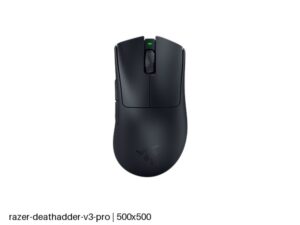
- Razer Viper V3 Pro: a similar light symmetrical shell with much faster wireless polling
The VS Score is calculated from the weighted specifications above, each measured against the median of comparable mice — a shortlisting guide, not a substitute for your own priorities. See how we score.