Dyson announced three new HushJet air purifiers at its Unveiled event in Berlin on September 3, 2026. Two of them carry Formaldehyde in the name, and Dyson says they do not just capture that gas but destroy it. That wording is not marketing shorthand. It describes a different piece of chemistry from the carbon filter in most machines, and it changes how the filter ages.
What Dyson announced
The lineup is the HushJet Big plus Quiet Cool Pure plus Formaldehyde, the HushJet Cool Pure plus Formaldehyde, and the HushJet Hot Cool Pure plus. The first is aimed at large connected spaces, and the last is a three-in-one that purifies, heats and cools.
Dyson has not published prices on its own launch page, which currently offers sign-up links instead. UK reporting at the announcement put two of the models at £549.99, with October and December 2026 on-sale dates. Treat those figures as provisional until Dyson lists them, and expect regional pricing to differ.
Capture and destroy are two different jobs
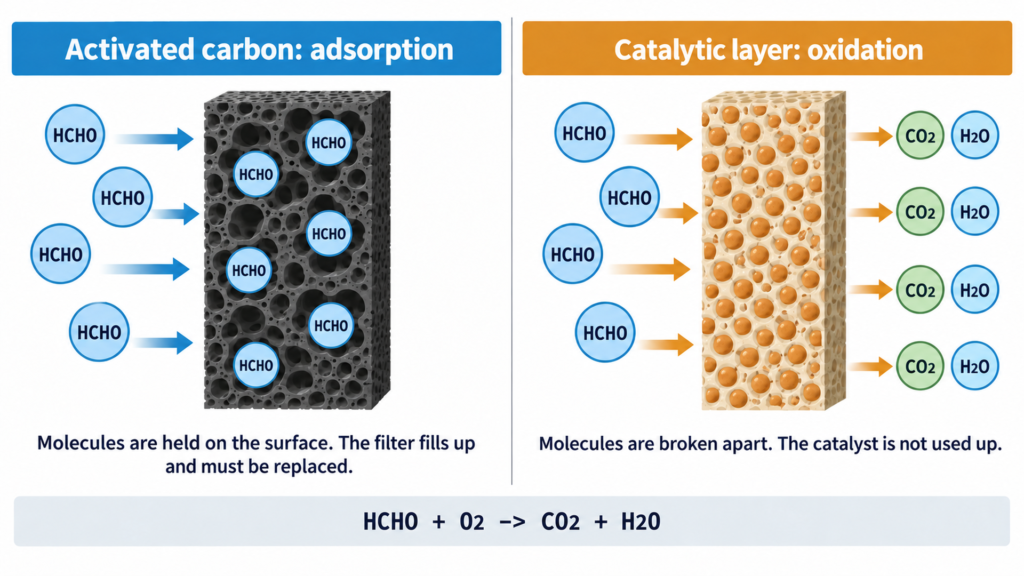
A standard purifier handles particles and gases in separate stages. A HEPA layer traps particles by physically catching them in a dense mat of fibers. Activated carbon handles gases by adsorption, which means gas molecules stick to the enormous internal surface area of the carbon.
Adsorption has a catch. The carbon fills up. Once the surface is saturated, the filter stops removing gas, and under heat or changing humidity a loaded carbon filter can release some of what it holds back into the room. That is why carbon filters carry replacement intervals.
A catalytic filter works differently. Instead of holding the molecule, it breaks it apart. For formaldehyde the reaction is simple to write down:
HCHO + O2 becomes CO2 + H2O
Formaldehyde plus oxygen becomes carbon dioxide and water, in quantities far too small to matter in a room. The catalyst speeds the reaction up but is not consumed by it, so the layer keeps working without filling up. Dyson describes the equivalent stage on its earlier machines as selective catalytic oxidation, and the same principle applies here.
Reading the headline numbers properly
Dyson says the new purifiers capture 99.999 percent of particles as small as 0.01 microns. The footnote matters more than the figure. That result comes from testing to Korea Air Cleaning Association standard SPS-KACA-002-132 in modified form, in a 30 cubic meter chamber under controlled conditions. Dyson states that actual performance may vary.
A sealed 30 cubic meter chamber is roughly a small bedroom with no furniture, no open door and no people moving around. Real rooms leak air, generate dust and change temperature. So read the number as evidence of how fine the filter media is, with little to say about your living room.
The airflow claim is more concrete. Dyson quotes up to 334 liters per second of purified air for the Big plus Quiet model. Convert that to something comparable and it becomes clearer:
334 liters per second x 3600 seconds = 1,202,400 liters per hour, which is about 1,200 cubic meters per hour
That is where the 1,200 cubic meter figure in some coverage comes from. It is the same number in different units, not a second specification. In a 30 square meter room with a 2.5 meter ceiling, so 75 cubic meters of air, 1,200 cubic meters per hour works out at roughly 16 air changes per hour on maximum. You are unlikely to run a purifier flat out for long, because that is also its loudest setting.
Dyson’s multi-room claim comes with its own footnote. The company describes a simulation of two rooms connected by an open door, validated with physical testing. That is a reasonable method, but the result describes a modeled pair of rooms, which may not resemble your floor plan.
The number Dyson still does not publish
The gap in Dyson’s specification sheets has not closed. Our own listing for the previous generation Dyson Purifier Big+Quiet Formaldehyde BP04 records no CADR, no rated coverage area, no decibel table and no power figure, because Dyson does not publish them.
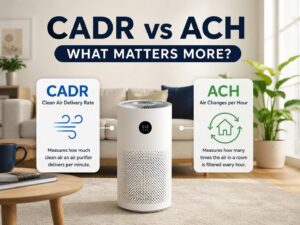
CADR, or clean air delivery rate, is the standard that lets you compare purifiers directly. It combines airflow with filter efficiency against specific pollutants and is measured under a published test method. Raw airflow is not the same thing, since air that moves through a machine without being fully cleaned still counts towards liters per second.
Dyson does quote 24 decibels in Sleep mode for the new HushJet models. That is quiet. Still, a single figure at the lowest setting tells you nothing about noise at the output level you would need in a large room, which is the comparison that matters when you shop for a large room.
Do you need formaldehyde filtration at all?
Formaldehyde is a volatile organic compound released by pressed-wood furniture, some adhesives, laminate flooring, certain paints and a range of household products. The International Agency for Research on Cancer classifies it as carcinogenic to humans, so reducing long-term exposure is a reasonable goal.
Two practical points shape the buying decision. Emissions are highest when materials are new and fall over months and years, so a newly furnished or newly renovated home has the strongest case. And ventilation remains the cheapest control. Opening windows lowers indoor VOC levels quickly and costs nothing.
A catalytic formaldehyde stage makes most sense in a home with new pressed-wood furniture, poor ventilation, or a resident who is home all day. It makes less sense in an older, well-aired home where the main complaint is pollen or pet dander, because a good HEPA and carbon machine with published CADR figures will cost considerably less.
The practical verdict
The chemistry Dyson is selling is real, and a catalytic layer that does not saturate is a genuine advantage over carbon alone for this one gas. But the announcement is still a specification sheet with the most comparable number missing. If you are choosing between a HushJet and a cheaper purifier with published CADR and coverage ratings, you are weighing a documented performance figure against a filtration feature you have to take on trust. Decide which of those matters more in your room before the October and December launch dates arrive.