How much should you spend on an air purifier? For most homes, the right answer is usually between $150 and $350 for one good room purifier. A small bedroom can cost less. A large living room, pet-heavy space, or smoke-prone area can cost more.
That price range buys enough cleaning power without paying for features you will barely use. Still, the number on the box does not tell the full story. A cheap air purifier can work well in a small room. A premium model can still disappoint in a large open space.
The real value comes from room size, CADR rating, filter cost, noise level, and how often you plan to run it. Once those basics are right, smart controls and design extras become easier to judge.
Start With the Room Size
The first step is simple: measure the room. Air purifiers clean the air in the space where they sit. One small unit in a hallway will not clean three bedrooms well. One weak purifier in a large living room will run loudly and still feel underpowered.
For a small bedroom, office, or nursery, a compact purifier can be enough. For a medium bedroom or standard living room, you need more airflow. For open-plan spaces, basements, large kitchens, or homes with pets, you should budget for a stronger model.
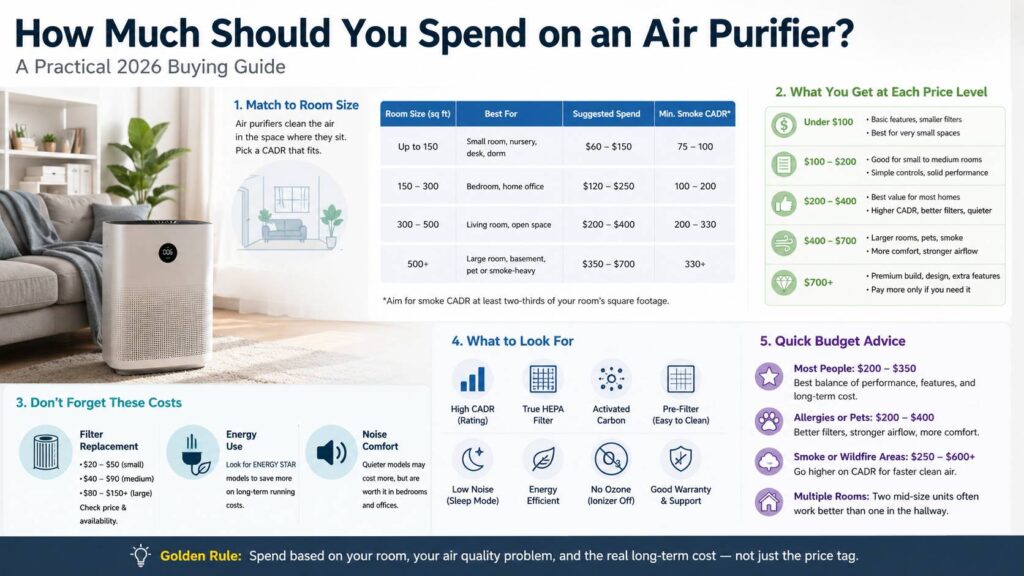
A practical price guide looks like this:
- Small room up to about 150 square feet: $60 to $150
- Bedroom or home office around 150 to 300 square feet: $120 to $250
- Medium living room around 300 to 500 square feet: $200 to $400
- Large room over 500 square feet: $350 to $700
- Whole-home air cleaning through HVAC: often $500 to $2,000 or more installed
The best value sits in the $180 to $300 range. At that level, you can usually get stronger airflow, better noise control, wider filter availability, and fewer cheap parts.
What You Get at Each Price Level
Air purifiers under $100 can help, but only in small rooms. They often use smaller filters, lower-power fans, basic controls, and limited odor protection. They can work near a desk or beside a bed, but they rarely make sense for a living room.
The $100 to $200 range is better for small bedrooms and home offices. Many units in this price band include a particle filter, sleep mode, timer, and simple fan controls. Some skip Wi-Fi and air quality sensors. In a bedroom or home office, that is fine.
The $200 to $400 range is the best fit for a main purifier. Purifiers here usually offer higher CADR ratings, larger filters, lower noise on medium speed, and better build quality. A model in this range can handle a bedroom, office, or normal living room with fewer compromises.
The $400 to $700 range makes sense for large rooms, pets, smoke, or buyers who want quieter performance. You are paying for stronger airflow, a larger filter surface, and better comfort at lower fan speeds.
Above $700, look closely before buying. Some premium purifiers are excellent. Others charge a lot for design, app features, heating, cooling, or display screens. Those extras can feel nice, but they do not replace strong airflow and proper filtration.
CADR Matters More Than Big Coverage Claims
CADR stands for Clean Air Delivery Rate. It tells you how much filtered air the purifier can push back into the room. A higher CADR means faster cleaning or better coverage in a larger space.
Look for CADR ratings for smoke, dust, and pollen. Smoke CADR is the number I would check first. Tiny smoke particles are harder to capture, so this number gives a more useful view of real cleaning power.
A simple rule works well: the smoke CADR should be at least two-thirds of the room’s square footage.
For example:
- Room size: 300 square feet
- Minimum smoke CADR target: about 200
- Better target for faster cleaning: 250 to 300
For wildfire smoke, heavy cooking smoke, or high pollution days, aim higher. A purifier with weak CADR will not clean fast enough, no matter how nice it looks.
This is one of the biggest traps in air purifier shopping. Some boxes claim huge coverage numbers based on very slow air changes. The room may technically get cleaned, but not fast enough for dust, smoke, or allergy relief.
Do You Need a True HEPA Filter?
For dust, pollen, pet dander, mold spores, and smoke particles, choose a purifier with a strong particle filter. Many brands use terms like True HEPA, HEPA-type, H13 HEPA, HEPA-grade, or medical-grade HEPA. The labels can get messy.
In real use, a good CADR rating and a sealed filter design matter more than fancy wording. A purifier with a strong fan and a well-built filter path will usually beat a weak unit with impressive marketing language.
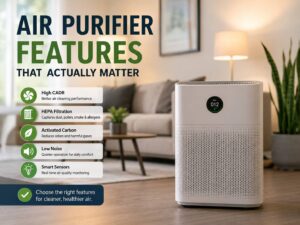
A good air purifier should include:
- A particle filter for dust, pollen, dander, and smoke particles
- A washable or easy-clean pre-filter for hair and larger dust
- Activated carbon for odors
- Clear filter replacement details
- Replacement filters that are easy to find
For allergies, pets, dust, and daily indoor air quality, this setup is enough.
Filter Replacement Cost Can Change the Real Price
The upfront price is only part of the cost. Filters are the long-term expense. A purifier that looks cheap on day one can cost more after one or two years.
Small purifier filters often cost $20 to $50 each. Medium purifier filters often cost $40 to $90. Large purifier filters can cost $80 to $150 or more. Some brands use one combined filter. Others split the pre-filter, particle filter, and carbon filter.
Before buying, check these details:
- How often the filter needs replacement
- The price of official filters
- Whether trusted third-party filters exist
- Whether filters are easy to buy
- Whether the carbon layer looks thin or substantial
- Whether the pre-filter can be cleaned
A $180 purifier with $120 yearly filters may not be a better deal than a $260 purifier with $60 yearly filters. For that reason, filter cost should sit near the top of your buying checklist.
Think About Running Costs Too
Air purifiers work best when they run often. That means power use matters. Many room purifiers do not use much electricity on low or medium speed, but weaker units may need high speed more often.
A good purifier should clean the room on a medium setting without sounding like a small fan heater. For bedrooms, this matters a lot. A unit that only feels useful on turbo mode will become annoying fast.
Energy-saving models can cut running costs over time. They are a better fit for people who run a purifier every day, especially during pollen season, dusty weather, or wildfire smoke events.
In daily use, a simple routine works well. Run the purifier on medium during the day. Use sleep mode at night. Raise the fan speed for cooking smoke, cleaning, pet activity, or high pollen days.
Spend More for Bedroom Comfort
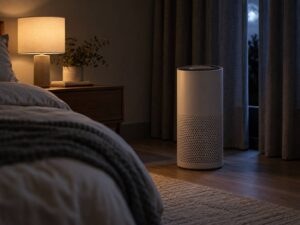
Noise can ruin an air purifier purchase. Check the noise level as well as the coverage. Otherwise the purifier can end up next to the bed, glowing like a router and humming too loudly to ignore.
For a bedroom, spending $150 to $300 is usually smarter than buying the cheapest model. Larger models can run at lower fan speeds and still clean the room well. That makes them quieter in daily use.
Look for these bedroom-friendly details:
- Low noise on sleep mode
- Dim or fully dark display option
- No loud button sounds
- No bright air quality ring at night
- Enough CADR to work below turbo mode
- Stable fan sound without rattles
This is where real-life use matters. A purifier can have great specs and still annoy you at night. Comfort is part of value, not a luxury.
Are Smart Features Worth Paying For?
Smart features can be useful, but they should not lead the purchase. Wi-Fi, app control, schedules, air quality history, and voice assistant support can make daily use easier. Still, they do not clean the air by themselves.
Pay for smart features only after the core specs are right. CADR, filter cost, noise, energy use, and filter availability matter more.
Some people love app controls. Others set the purifier once and never open the app again. For a closer comparison, this guide on smart air purifier vs basic air purifier breaks down where the extra features actually help.
Smart sensors can be helpful too, but they are not perfect. Most built-in sensors read air near the machine, not the full room. Some react quickly to cooking smoke. Others react slowly to dust. Treat them as a guide, not a lab test.
Be Careful With Ionizers and Ozone Claims
Some air purifiers include ionizers, UV lights, plasma modes, or ozone-style cleaning claims. For most homes, a fan-and-filter purifier is the safer and simpler choice.
Ozone can irritate the lungs and create indoor air concerns. Any feature that produces ozone or markets ozone as a benefit deserves caution. Homes with children, older adults, pets, asthma, or breathing sensitivity should be extra careful.
The best choice is boring but reliable: strong mechanical filtration, good CADR, no ozone claims, and easy filter replacement.
How Much Should Allergy Sufferers Spend?
For allergies, plan to spend around $150 to $350 per room. The goal is not to buy the most expensive purifier. The goal is to clean the right room with enough airflow.
Start with the bedroom. People spend many hours there, and cleaner nighttime air can make the purchase feel more useful. After that, add a purifier to the living room or home office.
An air purifier can help with pollen, dust, dander, and airborne particles. It works better with good habits:
- Vacuum often
- Wash bedding often
- Keep windows closed on high pollen days
- Clean the pre-filter
- Replace filters on schedule
- Keep the purifier away from curtains and walls
A purifier is part of the plan. It does not replace cleaning, ventilation, humidity control, or removing the source of the problem.
How Much Should Pet Owners Spend?
Pet owners should budget a little more. Hair clogs pre-filters. Dander floats through the room. Odors need carbon. A tiny purifier will fill up faster in a home with dogs, cats, litter boxes, or pet beds.
A good pet-home budget is usually $200 to $400 for a main room and $150 to $250 for a bedroom. Choose a model with an easy-clean pre-filter. That single detail can save time and keep airflow stronger.
For odor control, manage expectations. A particle filter can capture dander and dust. It will not remove every smell. Activated carbon helps, but thin carbon sheets have limits. For litter box odor or cooking smells, pick a purifier with a larger carbon filter and keep the room clean.
How Much Should You Spend for Smoke or Wildfire Season?
For smoke, expect to spend more. Fine smoke particles need strong filtration and high airflow. A smoke-focused purifier often costs $250 to $600, depending on room size.
For wildfire smoke, the smoke CADR should be close to the room’s square footage. A 300-square-foot room is better served by a purifier near 300 smoke CADR during smoke events. A weaker purifier can still help, but it will clean more slowly.
During smoke events, keep windows and doors closed. Run the purifier longer. Avoid adding new particles indoors through frying, candles, smoking, or heavy cleaning sprays.
Is a Cheap Air Purifier Worth It?
A cheap air purifier can be worth it for a small bedroom, office desk area, nursery corner, or occasional use. It is not the best pick for large spaces, heavy odors, wildfire smoke, or multiple pets.
A low-cost unit makes sense when:
- The room is small
- You only need basic dust and pollen help
- CADR is listed clearly
- Filters are affordable
- Replacement filters are easy to find
- The unit does not use ozone-style marketing
Skip models with vague coverage claims, unknown filter availability, or no clear CADR rating. The lowest price can become expensive once the filter disappears from stores.
Is an Expensive Air Purifier Worth It?
An expensive air purifier can be worth it for large rooms, smoke, pets, allergies, and quiet operation. It can also make sense in a living room where design matters.
That said, a high price does not prove better cleaning. Some premium models cost more for looks, displays, app extras, heating, or cooling. Those features can be useful, but only after the air-cleaning basics are strong.
Pay more for airflow, filter quality, low noise, and lower yearly filter cost. Do not pay more for vague wellness claims.
One Large Purifier or Two Smaller Ones?
For one open room, a large purifier can work well. For separate rooms, two smaller purifiers often make more sense. Air does not move freely through closed doors and hallways.
A $500 purifier in the hallway will not clean three bedrooms well. Two $200 purifiers placed in the rooms you use most can feel much better.
A sensible order looks like this:
- Bedroom first
- Living room second
- Home office third
- Kitchen area only for cooking odor concerns
This gives better value than trying to clean the whole home with one machine.
Best Budget for Most People
Most buyers should spend $200 to $350 on a main air purifier. This range gives a strong balance of cleaning power, comfort, filter availability, and long-term cost.
For a bedroom, $150 to $250 is often enough. For a large living room, $300 to $500 is more realistic. For pets, allergies, or smoke, avoid the weakest models. They may save money at checkout, but they often run louder and clean slower.
The smartest air purifier is not the most expensive one. It is the one that fits your room, runs quietly enough that you keep using it, and has filters you can afford to replace.
For a wider look at value, health use cases, and common buying mistakes, read this guide on are air purifiers worth buying in 2026.
Final Buying Checklist
Before you spend money, check these points:
- Room size in square feet
- Smoke CADR rating
- Filter type
- Filter replacement price
- Noise on low and medium speed
- Energy rating
- Ozone or ionizer features
- Pre-filter cleaning
- Warranty length
- Replacement filter availability
A good air purifier should feel simple. You turn it on, it runs quietly, the room feels fresher, and maintenance stays easy. That is worth paying for. Fancy extras can wait.