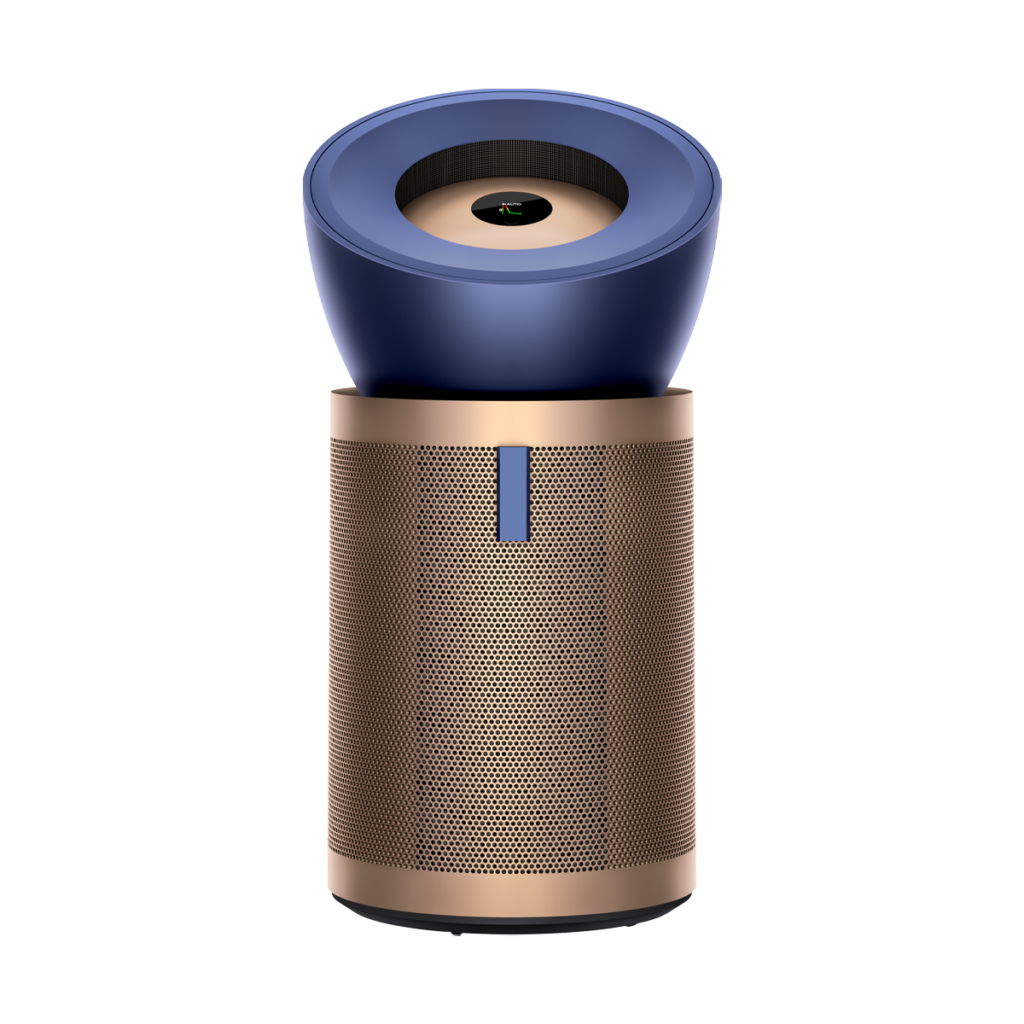
Dyson Purifier Big+Quiet Formaldehyde BP04: Specs & Verdict
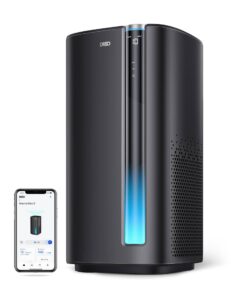
Dyson built a brand on the hole in the middle of a fan, and this machine does not have one. The Big+Quiet is a barrel: large, heavy, conventionally shaped, because the bladeless ring that made Dyson recognizable is not the best way to push a lot of air across a big room. A company abandoning its own most famous design element is worth noticing, and it tells you what this product is for.
It is for large open spaces, and the engineering points that way. The outlet can be aimed at several angles or diffused into the room, and the acoustic design is what Dyson leans on hardest, describing this as its quietest machine relative to the air it moves. The filtration is about as elaborate as home purifiers get: hospital-grade particle filtration, a carbon layer formulated for nitrogen dioxide instead of general odor, and a catalytic stage that breaks formaldehyde down continuously instead of merely collecting it. Its sensors add carbon dioxide, which almost nothing else monitors at any price and which is useful to know in a sealed modern room.
Then there is the problem, which is that essentially none of this can be verified from outside. Dyson publishes no clean-air delivery rate, no certified room size, no noise table and no power figure, on a product whose entire argument is that it moves more air more quietly than anything else. Competitors at half the price publish measured, certified numbers.
You are buying chemistry and engineering on reputation alone. For some buyers that is enough, as long as it is a conscious choice.
Category strengths
Where the Dyson Purifier Big+Quiet Formaldehyde BP04 beats the median
- A much higher filter life ?60 months vs 12 months (median)
Where the Dyson Purifier Big+Quiet Formaldehyde BP04 trails the median
- A much heavier build ?11.9 kg vs 5.26 kg (median)
How this VS Score was computed
Score 89: each known spec is measured against the median of all air purifiers (41 products), then weighted; 50 means level with that median. In classes of six or more, a value beyond the class’s 10th–90th percentile range counts as that limit, so one extreme product cannot set the scale. 26% of the scoreable weight could be used; unknown values, features not applicable to this class and proxies (battery capacity where a rated life exists) add or remove nothing.
| Specification | This product | Cohort median | Score weight | Points moved |
|---|---|---|---|---|
| True HEPA filter | Yes | 61% of the class have it | 1.5 | +75.0 |
| Filter life | 60 | 12 | 1 | +50.0 |
| App control | Yes | 70% of the class have it | 0.5 | +25.0 |
| Voice assistant | Yes | 64% of the class have it | 0.3 | +15.0 |
| Weight | 11.9 — capped at the class’s upper range (7.8) | 5.26 | 0.3 | −4.8 |
| Filtration stages | 3 | 3 | 0.5 | +0.0 |
Not scored: CADR (smoke) (unknown: not scored); Coverage area (unknown: not scored); Air changes per hour (unknown: not scored); Activated carbon filter (standard for the class (100% have it)); Washable pre-filter (unknown: not scored); Min noise level (unknown: not scored); Max noise level (unknown: not scored); Power consumption (unknown: not scored); Sleep mode (standard for the class (95% have it)); Air quality sensor (standard for the class (93% have it)); Auto mode (standard for the class (90% have it)); Filter replacement indicator (standard for the class (97% have it)); Timer (standard for the class (88% have it)).
Editor’s note
The BP04 is Dyson's biggest, most serious air purifier, a 26-pound barrel that gives up the iconic bladeless ring entirely because moving serious air matters more than looking like a Dyson. It projects purified air over 32 feet, adjusts its outlet between three angles plus a Breeze mode, and is, by Dyson's own account, its quietest machine relative to output, with a night mode 50% quieter than any of its towers.
The filtration stack is the real flagship material. Three stages: an H13-grade HEPA filter rated for five years of replacements (Dyson claims the media itself lasts up to eleven), an exclusive K-Carbon filter impregnated with potassium carbonate that adsorbs three times the NO2 of its standard carbon and lasts two years, and a selective catalytic oxidation layer that destroys formaldehyde continuously. The sensor suite is equally unusual: alongside particles and gases it monitors CO2 (a rarity) and will tell you when a room needs a window opened. Control runs through the remote, the MyDyson app and voice assistants.
What is missing is what is always missing with Dyson: numbers. No CADR, no room-size rating, no decibel table, no wattage, on a machine whose entire argument is moving more air more quietly than anything else in the house. Our specification table reflects only what Dyson states.
And then there is the price. At list it sits against Blueair's 211i Max and Signature, which cost roughly half and come with published figures. The Dyson case rests on the formaldehyde chemistry, the CO2 sensing, the five-year filter, and the engineering polish. For a large open-plan space with a real budget, it is an impressive machine that asks you to take its word for it.
Specifications
Quality bars show where each figure sits between the lowest and highest of the 41 air purifiers this VS Score is measured against.
Performance
Filtration
Noise & power
Design
Smart features
Sources and verification
Where the specifications come from
- Official product pagedyson.com
- Support and firmware documentationdyson.com
- Independent testingrtings.com
Verification
- First published
- Specifications last checked
- Sheet completeness
- 15 of 22 specifications verified; the rest show as Unknown and are never estimated or scored
- Page type
- Product specification page — Compiled from the manufacturer’s published specifications and the cited sources; this is not a hands-on test.
- Basis
- Research-based: specifications and editorial text were compiled from the documents listed here and the manufacturer’s published data. We have not tested this unit ourselves; where independent measurements are mentioned they belong to the linked publication.
Air Purifiers with similar specs to the Dyson Purifier Big+Quiet Formaldehyde BP04
Ratings & reviews
No reviews yet. Be the first to share your experience.
The bottom line
The Dyson Purifier Big+Quiet Formaldehyde BP04 earns a VS Score of 89 on the 26% of specifications we could compare like for like — an indication, not a ranking.
- Who it’s for
- Large open-plan spaces with a real budget: H13 plus NO2-hungry K-Carbon plus continuous formaldehyde destruction, CO2 alerts, and quiet big-room airflow.
- Who should look elsewhere
- Value buyers, because Blueair and Levoit cover similar floor area for half the money with published CADR figures, which Dyson still refuses to provide.
- The trade-off that matters
- Some of the most advanced filtration chemistry in a home purifier, sold entirely on Dyson's word: not one comparable performance number is published.
- The main alternative
- Blueair Blue Pure 211i Max delivers documented 674 sq ft performance for about half the price. The Dyson's case is formaldehyde, CO2 sensing and engineering.
The VS Score is calculated from the weighted specifications above, each measured against the median of comparable air purifiers — a shortlisting guide, not a substitute for your own priorities. See how we score.