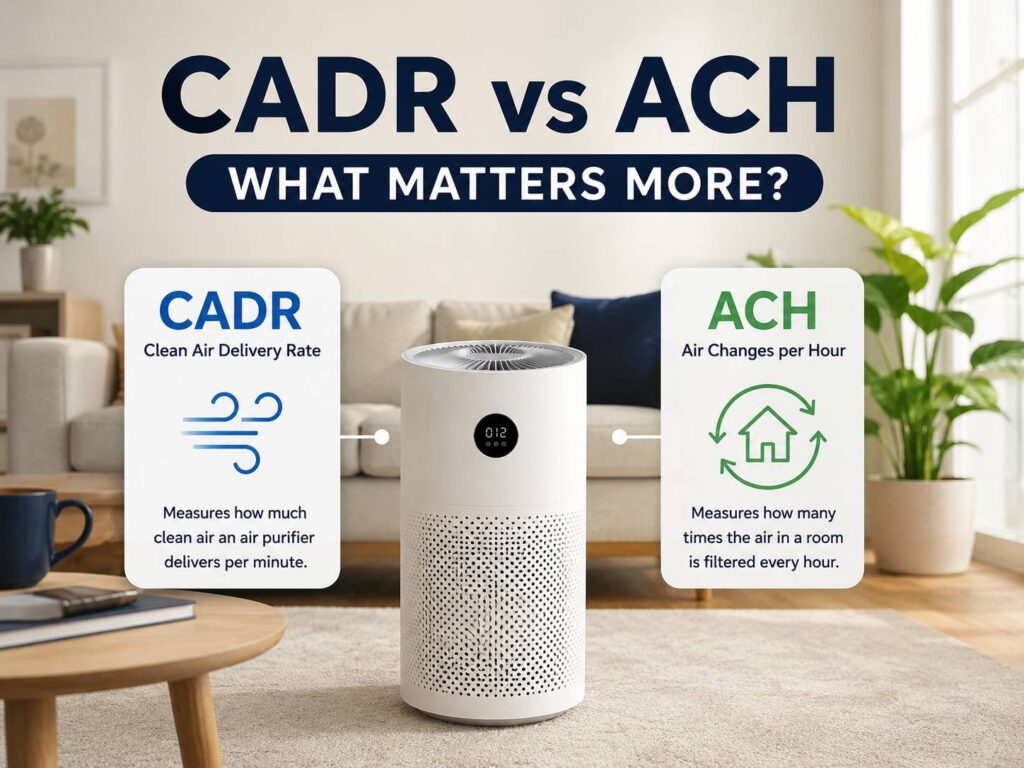
Buying an air purifier sounds easy at first. Then you start reading product pages, and everything gets messy. One brand talks about CADR. Another pushes ACH. A third one promises huge room coverage, yet the small print makes that claim feel less useful.
So, which one matters more: CADR or ACH?
The honest answer is simple. CADR helps you compare air purifiers. ACH helps you check whether a purifier fits your room.
Both numbers matter, but they do different jobs. A high CADR tells you the purifier can move and clean more air. A strong ACH result tells you that clean air can cycle through your actual space enough times per hour.
That difference matters a lot. Choosing an air purifier on square footage alone is a common trap. That can lead to weak performance, louder fan settings, and filters that seem to do less than expected.
This guide explains CADR vs ACH in plain language, with real examples, simple formulas, and buying advice that makes sense for normal homes.
What CADR Means
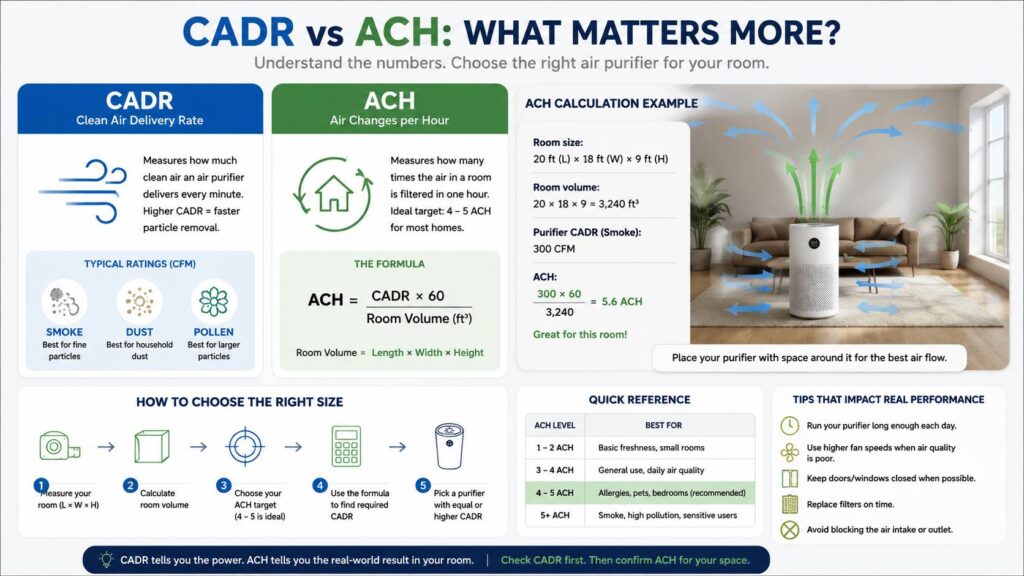
CADR stands for Clean Air Delivery Rate. It tells you how much clean air an air purifier can deliver every minute.
Most CADR ratings are shown in CFM, or cubic feet per minute. A higher number means the purifier can clean more air in less time.
Air purifiers often show three CADR ratings:
- Smoke CADR
- Dust CADR
- Pollen CADR
Smoke CADR is usually the number I check first. Smoke particles are smaller than dust and pollen, so this rating gives a better idea of how well the purifier handles fine particles.
Dust CADR helps with regular household dust. Pollen CADR matters for seasonal allergies. For many buyers, a balanced purifier with strong numbers across all three is the safest pick.
CADR works well for comparing two air purifiers. A model with 300 CADR can clean more air than a model with 150 CADR. That part is easy.
The tricky part is room size. CADR does not know your ceiling height, room shape, open doors, pets, cooking habits, or fan-speed preference. For that part, you need ACH.
What ACH Means
ACH stands for Air Changes per Hour. It tells you how many times the purifier can cycle the full air volume of a room in one hour.
For example, 5 ACH means the purifier can clean the room’s air volume about five times per hour. 2 ACH means it can do that about twice per hour.
This number matters more once you know where the purifier will sit. A purifier can have a good CADR and still feel weak in a large room.
Here is the basic formula:
ACH = CADR × 60 ÷ room volume
Room volume means:
Room length × room width × ceiling height
Now let’s use a simple bedroom example.
A room is 12 feet long, 12 feet wide, and 8 feet tall.
Room volume:
12 × 12 × 8 = 1,152 cubic feet
The purifier has a CADR of 150 CFM.
ACH calculation:
150 × 60 ÷ 1,152 = 7.8 ACH
That is strong for a bedroom. The purifier has enough power to clean the air several times per hour.
Now place the same purifier in a larger living room.
The living room is 20 feet long, 18 feet wide, and 9 feet tall.
Room volume:
20 × 18 × 9 = 3,240 cubic feet
ACH calculation:
150 × 60 ÷ 3,240 = 2.8 ACH
Same purifier. Same CADR. Much weaker result.
That is why ACH matters. It turns the CADR number into something useful for your room.
CADR vs ACH: Which One Matters More?
CADR matters more before you buy. ACH matters more after you match the purifier to a room.
Think of CADR as the purifier’s cleaning power. Think of ACH as the real result inside your space.
A high CADR gives you more headroom. That helps in bedrooms, offices, living rooms, pet areas, and homes near traffic or smoke. At the same time, ACH shows whether that power is enough for your room size.
The best buying process starts with CADR, then checks ACH.
Start with the purifier’s smoke CADR. Then calculate how many air changes per hour it can deliver in your room. After that, check noise levels, filter cost, and energy use.
That process helps you avoid inflated room-coverage claims. It also makes it easier to compare brands that use different marketing language.
The Easy Rule for Air Purifier Room Size
For most homes, aim for about 4 to 5 air changes per hour.
That range works well for bedrooms, home offices, nurseries, and smaller living rooms. It gives the purifier enough cleaning power for dust, pollen, pet dander, and fine particles.
A quick sizing rule is:
Minimum CADR ≈ room square footage × 0.65
This shortcut assumes an 8-foot ceiling and a target close to 5 ACH.
Here are simple examples:
- 100 sq. ft. room: about 65 CADR
- 200 sq. ft. room: about 130 CADR
- 300 sq. ft. room: about 195 CADR
- 400 sq. ft. room: about 260 CADR
- 500 sq. ft. room: about 325 CADR
- 600 sq. ft. room: about 390 CADR
That shortcut is helpful for quick shopping. Still, a taller ceiling changes the math. Open rooms need more power too. Pets, smoke, and heavy dust can raise the CADR target as well.
For a deeper buying walkthrough, this guide on how to choose the right air purifier covers the other details that matter, such as filter type, room use, and running costs.
Why “Room Coverage” Can Mislead Buyers
Room coverage claims can look impressive. A purifier box may say it covers 1,000 square feet, 1,500 square feet, or more.
That number does not always mean strong cleaning.
Some brands base room coverage on one air change per hour. Others use two. Better sizing guides usually target around 4 to 5 ACH for stronger daily performance.
This is a common issue buyers run into. A purifier may claim a huge room size, but it only cleans that room slowly. In real use, that can feel disappointing.
For allergies, smoke, and pet dander, low ACH is not ideal. Particles keep entering the air. The purifier has to pull them through the filter often enough to make a real difference.
So, do not buy from the room-coverage claim alone. Look for CADR. Then calculate ACH.
A brand that hides CADR deserves extra caution. It may still sell a decent purifier, but the missing number makes fair comparison harder.
Fan Speed Changes the Real Result
Most CADR ratings come from the purifier’s highest fan speed.
That detail matters.
High speed gives the best airflow, but it can sound loud. In a bedroom, office, or nursery, you will likely switch to medium, low, or sleep mode. Once the fan speed drops, the real clean air delivery drops too.
So, a purifier that barely meets your CADR target on high speed may feel weak on quiet mode.
That is one reason I prefer sizing up. A slightly stronger purifier can run at medium speed and still clean the room well. A smaller purifier may need turbo mode too often.
This becomes clear at night. A quiet purifier that stays on for eight hours usually gives a better experience than a loud purifier that gets switched off after 30 minutes.
CADR vs ACH for Allergies
Allergy buyers should care about both numbers.
Pollen CADR and dust CADR help compare air purifiers. ACH shows whether the purifier can cycle enough air in the room. For allergy season, bedrooms are often the best place to start.
A closed bedroom is easier to clean than a large open-plan area. The purifier has less air to manage, and it can work more steadily through the night.
For better allergy control, aim for around 4 to 5 ACH in the bedroom. Size up if the purifier will run on lower fan speeds. Keep the door closed where practical, and place the unit where air can move freely.
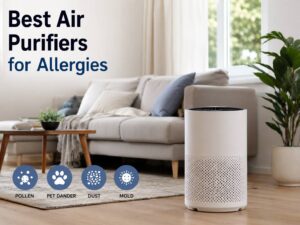
People dealing with pollen, dust, and pet dander can compare stronger options in this guide to the best air purifiers for allergies in 2026.
CADR vs ACH for Smoke and PM2.5
Smoke and fine particles need a stronger setup.
In this case, smoke CADR should be the first number you check. Fine particles are harder to deal with than large pollen particles. A purifier needs both good filtration and enough airflow.
Low ACH can struggle during smoke events. The purifier may clean some air, but particles keep building up faster than the machine can remove them.
For wildfire smoke, cooking smoke, traffic pollution, or PM2.5 problems, extra CADR is worth paying for. A stronger purifier gives more room to run at a quieter speed and still maintain useful air changes.
For best results, use the purifier in a closed room. Keep windows shut during bad outdoor air days. Replace filters on time. A clogged filter lowers airflow, and lower airflow means weaker real-world CADR.
CADR vs ACH for Pets
Pet homes need more cleaning power than many product pages suggest.
Pet dander, hair, dust, and odor create a mixed air-quality problem. CADR helps with airborne particles. A washable or removable pre-filter helps catch larger hair before it reaches the main filter.
Activated carbon can help with mild pet smells, but the carbon layer needs enough material to matter. Thin carbon sheets do not do much for stronger odors.
For pets, I would size up. Filters load faster in homes with shedding animals. Extra CADR helps the purifier keep working well between filter changes.
Placement matters too. Do not hide the purifier behind a sofa, curtain, or cabinet. Blocked vents reduce airflow and make the CADR rating less meaningful.
Common CADR and ACH Mistakes
These sizing mistakes are easy to make.
They buy by square footage only. That is the big one. Room coverage can hide a low ACH target.
They ignore ceiling height. A 300 sq. ft. room with an 8-foot ceiling is not the same as a 300 sq. ft. room with a 10-foot ceiling.
They run sleep mode all day. Sleep mode is quiet, but it usually moves much less air.
They place the purifier in a bad spot. A purifier needs open space around the intake and outlet.
They expect particle CADR to solve odors. CADR is mainly about particles. Odors and gases need a strong carbon filter.
They forget filter cost. A cheap purifier can become expensive if filters cost too much or need frequent replacement.
These issues sound small, but they affect real performance every day.
How to Calculate the CADR You Need
Here is the simple formula:
Required CADR = target ACH × room volume ÷ 60
Let’s use a 300 sq. ft. room with an 8-foot ceiling.
Room volume:
300 × 8 = 2,400 cubic feet
Target ACH:
5
Required CADR:
5 × 2,400 ÷ 60 = 200 CADR
So, for this room, a purifier with about 200 CFM CADR is a sensible minimum.
Now take a 500 sq. ft. room with an 8-foot ceiling.
Room volume:
500 × 8 = 4,000 cubic feet
Required CADR:
5 × 4,000 ÷ 60 = 333 CADR
That means a purifier around 330 CFM is a better fit.
Now raise the ceiling to 10 feet.
Room volume:
500 × 10 = 5,000 cubic feet
Required CADR:
5 × 5,000 ÷ 60 = 417 CADR
That one ceiling change raises the target by 84 CADR. Square footage alone would miss that.
What About Energy Use?
Air purifiers work best when they run often. So energy use matters.
A purifier with strong CADR and reasonable power draw is better for daily use. A weak purifier may use less electricity per hour, but it can take longer to clean the room. A very powerful unit may clean fast, but it can cost more to run at high speed.
The better balance is simple: choose enough CADR for your room, then run the purifier at a comfortable fan speed.
Filter price matters too. Some cheap air purifiers use costly replacement filters. Others have filters that clog quickly in dusty or pet-heavy homes.
Before buying, check the filter price and replacement schedule. That tells you more about long-term cost than the sale price alone.
Best Buying Advice: Use CADR First, Then ACH
Here is the buying process I trust most:
- Measure your room.
- Check ceiling height.
- Calculate room volume.
- Pick a target of about 4 to 5 ACH.
- Calculate the CADR you need.
- Compare smoke CADR first.
- Check dust and pollen CADR next.
- Look at noise on medium speed, not only high speed.
- Check filter cost.
- Size up for pets, smoke, open rooms, and tall ceilings.
This method takes a few minutes, but it prevents most bad purchases.
It also makes product claims easier to judge. A purifier that looks powerful in marketing may not deliver enough ACH in your room. A smaller model may be perfect for a bedroom but weak in an open living area.
Final Verdict: CADR or ACH?
CADR and ACH are connected, not rivals.
CADR tells you how much clean air the purifier can deliver. ACH tells you how often that clean air can cycle through your room.
For shopping, CADR matters more. For real room sizing, ACH matters more.
My practical opinion is this: do not buy an air purifier without checking both. Start with smoke CADR, calculate ACH for your room, then choose a model with enough extra power to run quietly.
For most homes, aim for around 4 to 5 ACH. Size up for allergies, pets, smoke, high ceilings, and open layouts.
That simple rule gives you a better chance of buying an air purifier that feels strong in real use, not just impressive on the box.