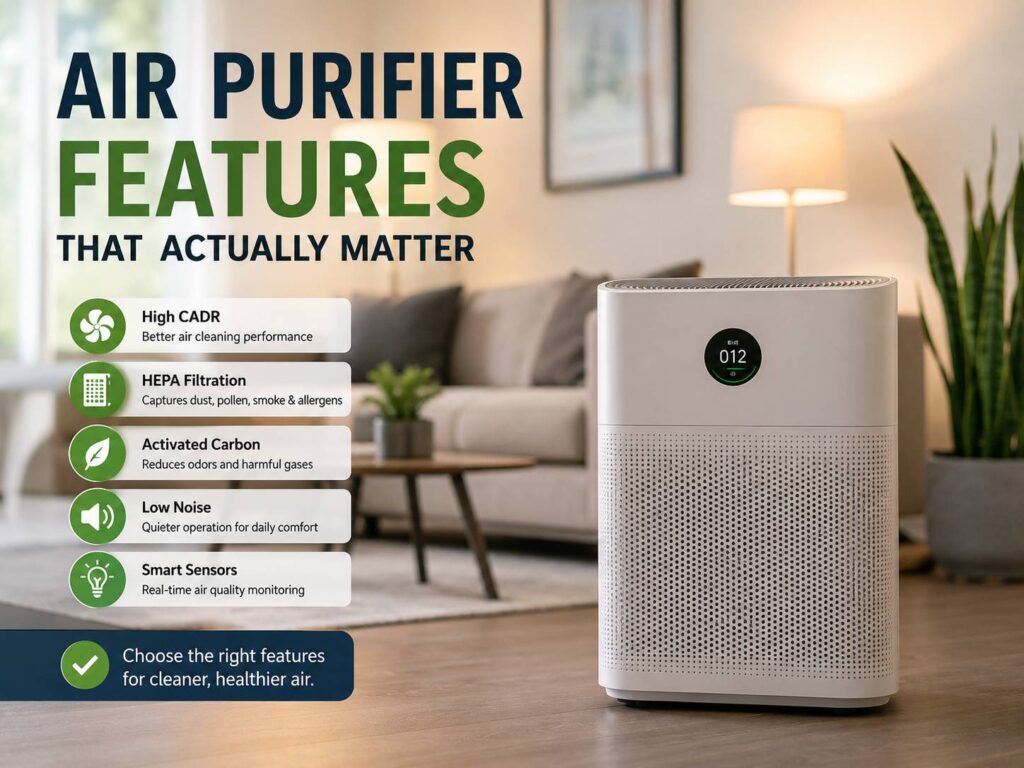
Air purifiers look simple from the outside. You plug one in, press a button, and expect cleaner air. Then you start comparing models, and suddenly every box talks about CADR, HEPA filters, carbon layers, UV light, smart sensors, ionizers, sleep mode, app control, room coverage, filter alerts, and ozone-free cleaning.
It gets confusing fast.
The good news is that only a handful of air purifier features really matter for most homes. Some features make a real difference. Others help only in certain situations. A few sound impressive but do very little in normal daily use.
This guide breaks down the features that deserve your attention, the ones that need extra caution, and the extras you should not pay too much for. If you are still deciding whether the category makes sense for your home, this guide pairs well with our breakdown on are air purifiers worth buying in 2026.
Start With What You Want the Air Purifier to Fix
Before you look at specs, think about the problem in your room.
Dust, pollen, pet dander, smoke, cooking particles, mold spores, and fine outdoor pollution are particle problems. For them, airflow and a strong particle filter matter most.
Other people care more about smells. That includes pet odor, cooking odor, smoke smell, cleaning product fumes, or new furniture smells. These need a proper activated carbon filter. A basic dust filter will not do much for odors.
Do not expect one purifier to fix everything. An air purifier can reduce airborne particles, but it will not clean dusty shelves, remove mold from walls, stop smoke from entering through windows, or replace good ventilation.
So, the first real buying step is simple: match the purifier to the problem. If dust and allergies bother you, focus on particle filtration. If smells are the issue, look harder at carbon. If you want both, choose a model that handles both well.
CADR Matters More Than Big Room Claims
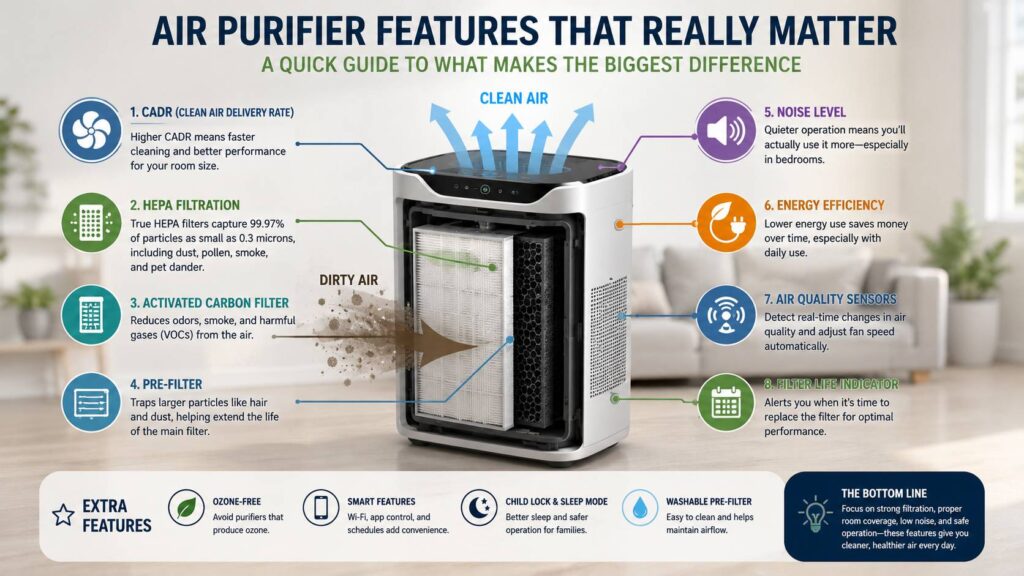
CADR stands for Clean Air Delivery Rate. It measures how much clean air the purifier can deliver. In plain terms, it tells you how powerful the unit is at cleaning the air.
This number matters more than a big “covers up to 1,000 square feet” claim on the box. Some brands use generous room-size claims that sound better than they feel in real life. A purifier can technically affect air in a large room, but it may clean that room too slowly to be useful.
Look for CADR ratings for smoke, dust, and pollen. Smoke CADR is especially useful, since smoke particles are very small. If a purifier has a strong smoke CADR, it usually handles fine particles better than a weak model.
A practical rule works well: choose a purifier with a CADR equal to at least two-thirds of the room’s square footage. For a 300-square-foot room, look for around 200 CADR or more. For smoke, pets, heavy dust, or pollen season, more airflow is better.
My honest opinion: CADR is not exciting, but it is one of the most useful numbers on the spec sheet. A simple purifier with strong CADR often beats a fancy model with weak airflow.
Room Size Needs More Than a Quick Guess
Room size claims can trick people. A purifier might say it works in a large living room, but that does not mean it will clean that room several times per hour.
Air changes per hour tell you how many times the purifier can cycle the air in a room. More air changes mean faster cleaning. Bedrooms, nurseries, home offices, allergy rooms, and pet rooms benefit from stronger air circulation.
Ceiling height matters too. Many room estimates assume standard 8-foot ceilings. A room with tall ceilings has more air to clean. Open layouts create another challenge, since air spreads across a larger area.
This is a common issue people run into: they buy one small purifier for a big open living space. Then they run it on low speed and feel no real change. The unit is not always bad. It is just too small for the job.
For better results, size the purifier for the room where it will actually run. Two medium purifiers can work better than one underpowered unit moved around all day.
HEPA Filtration Is Still the Main Feature for Particles
A strong particle filter is the heart of a good air purifier. For dust, pollen, pet dander, fine smoke particles, and many airborne allergens, HEPA-style filtration is the feature that does the hard work.
You will see different labels, such as True HEPA, HEPA-type, HEPA-grade, H13 HEPA, and high-efficiency filter. These terms can get messy. The key point is this: the filter must capture fine particles, and the purifier must move enough air through it.
A dense filter with a weak fan will not clean a room well. A powerful fan with a poor filter will not capture enough fine particles. The best models balance both.
For allergy-prone homes, pet owners, and people near traffic or smoke, filter quality should sit near the top of the list. This is not the area where I would cut corners.
Activated Carbon Helps With Smells, But Not All Carbon Filters Are Equal
Activated carbon filters help reduce odors and some gases. They can help with cooking smells, pet odors, smoke smell, and certain household fumes.
Still, carbon filters vary a lot. Some purifiers use only a thin carbon sheet. That type can help a little with light odors, but it may lose strength fast. Other purifiers use a thicker carbon layer with more carbon material. Those usually perform better for real odor problems.
This is where marketing can get slippery. A brand may list “carbon filter” as a feature, but give no detail about the amount of carbon inside. Without that detail, you cannot compare odor performance very well.
My practical view: pay attention to carbon if your home has smells. For dust and pollen alone, spend more attention on CADR and particle filtration. For smoke odor, cooking odor, pets, or VOC concerns, choose a purifier with a more serious carbon stage.
Ozone-Free Operation Should Be Non-Negotiable
Air purifiers should make indoor air cleaner, not harsher to breathe. For that reason, ozone-free operation matters.
Some devices use ionizers, plasma systems, or other electronic cleaning features. These can sound advanced, but they deserve caution. Certain electronic air cleaners can create ozone as a byproduct. Ozone can irritate the lungs, and that makes it a poor match for bedrooms, nurseries, asthma-prone homes, and daily indoor use.
A strong mechanical filter does not need ozone to clean particles. It pulls air through a filter and traps particles there. That simple design is usually the safest route.
If a purifier includes an ionizer, check whether you can turn it off. Better yet, choose a model that performs well without using it. I would not buy a purifier that depends on an ionizer to reach its main performance claims.
Noise Level Decides How Often You Will Use It
An air purifier only helps when it runs. That makes noise more than a comfort feature. It affects real performance.
Many purifiers hit their best CADR rating on the highest fan speed. The problem is that the highest speed can be too loud for sleep, work, calls, or watching TV. So people switch to low speed. Then airflow drops, and cleaning power drops with it.
This is one of the most common real-world complaints. The purifier looked strong on paper, but nobody wants to hear it all day.
Check the decibel rating, but do not stop there. Pay attention to noise at medium speed. Medium is often the speed people use most. Sleep mode is nice, but some sleep modes lower the fan so much that cleaning becomes weak.
A slightly oversized purifier can help. It can run at a quieter speed and still move enough air for the room.
Filter Cost Can Make or Break the Purchase
The price of the purifier is only the start. Replacement filters decide the long-term cost.
Before buying, check the price of official replacement filters. Then check how often the brand recommends changing them. A cheaper purifier can become expensive if the filters cost a lot or need frequent replacement.
Filter availability matters too. Some brands launch a purifier, sell it for a while, then replacement filters become hard to find. That turns a good-looking deal into a headache.
A washable pre-filter helps. It catches larger dust, hair, and lint before they reach the main filter. This can protect airflow and help the main filter last longer. Still, a washable pre-filter does not replace the main filter.
Filter alerts help as well. Some use a simple timer. Others estimate filter life based on use. Timer alerts are not perfect, but they are still better than guessing.
My advice is firm: check filter prices before you buy the purifier. This one step prevents a lot of regret.
Energy Use Matters for Daily Cleaning
Air purifiers work best with steady use. That can mean hours each day, or around the clock during pollen season, wildfire smoke, or heavy pollution days.
That means power use matters. A model with lower energy use can save money over time, especially in bedrooms, offices, and living rooms.
Do not judge energy use alone. A purifier that uses very little power but barely moves air is not a good deal. Look for a balance between strong CADR and reasonable wattage.
Auto mode can help reduce power use, but only if the sensor works well. If the sensor misses pollution, the purifier may stay too low. For cooking, cleaning, smoke, and heavy pollen, manual fan control still helps.
Air Quality Sensors Are Helpful, But Not Perfect
Air quality sensors make purifiers feel smarter. A PM2.5 display or color-coded light can show changes after cooking, vacuuming, opening windows, or using sprays.
These sensors are useful, but they do not measure everything. Many built-in sensors mainly detect fine particles. They may not detect gases or odors well. So your room can smell bad even if the display shows clean air.
That does not mean the purifier is broken. It means the sensor sees only part of the indoor air problem.
Use sensors as a guide, not as the only truth. During normal days, auto mode can work fine. During cooking, smoke, cleaning, or strong pollen days, set the purifier higher by hand.
Smart Features Are Nice, But They Should Not Lead the Purchase
Wi-Fi, app control, schedules, voice control, and remote access can make an air purifier easier to use. They are useful for bedrooms, children’s rooms, home offices, and people who like routines.
Still, smart features do not clean the air by themselves. A weak purifier with a good app is still a weak purifier.
If you are choosing between a smart model and a stronger basic model, focus on cleaning power first. We compared that choice in more detail in our guide to smart air purifier vs basic air purifier, and the same idea applies here: smart controls help, but airflow and filters matter more.
One extra point: check whether the purifier still works without the app. A good air purifier should let you control fan speed, mode, lights, and filter reset from the unit itself.
UV Light Sounds Better Than It Often Performs
Some air purifiers include UV-C lights and claim germ reduction. The idea sounds convincing. In practice, small home purifiers often move air too quickly for UV light to do much.
UV systems need the right exposure time, light strength, and design. A tiny bulb inside a fast-moving portable purifier may not deliver the kind of performance people imagine.
For most buyers, UV is not a feature worth chasing. Spend the money on stronger CADR, better filtration, quieter operation, or better carbon instead.
If a purifier includes UV as a small bonus, fine. I would not make it the main reason to buy.
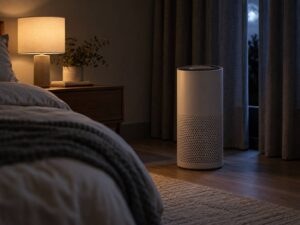
Display Lights and Sleep Mode Matter in Bedrooms
Bedroom use brings its own problems. A purifier can have great specs and still annoy you if the display is too bright or the buttons beep loudly.
Look for these comfort features:
- Display-off mode
- Quiet low and medium fan speeds
- No loud startup sound
- No forced bright light
- Easy controls in the dark
- Stable fan sound without rattles
Sleep mode can help, but check how it works. Some sleep modes reduce airflow too much. In that case, the purifier becomes quiet but not very useful.
For bedrooms, the best setup is often a slightly stronger purifier running at a calm speed. You get cleaner air without a loud fan next to your bed.
Placement Can Change Real Performance
A purifier needs open space around its intake and outlet. If you push it behind furniture, tuck it under a desk, or block it with curtains, performance drops.
Place the unit in the room where you spend the most time. At night, that usually means the bedroom. During the day, it may be the living room or home office.
Pet owners should place the purifier near the area where dander and hair collect, but not in a spot where fur blocks the intake. For smoke or cooking particles, run the purifier before, during, and after the event.
One purifier does not clean a whole house unless the home is very small and open. For closed rooms, each space needs its own airflow.
Features That Are Often Overrated
Some air purifier features look good in ads but do little in daily use.
These are the ones I would treat with caution:
- Huge room coverage claims without clear CADR
- Thin carbon sheets marketed as strong odor control
- Ionizers used as a main selling point
- UV lights in small portable units
- Fancy air quality animations
- App-only controls
- “Medical grade” claims with no clear performance data
- Long filter life claims without real use details
- Tiny tabletop purifiers sold for large rooms
Extras are not always bad. The problem starts when they distract from the basics. A purifier still needs strong airflow, a good filter, safe operation, reasonable noise, and fair filter costs.
The Feature Priority List That Makes Sense
If you want a simple buying order, use this:
- Correct CADR for your room size
- Strong particle filter
- Ozone-free operation
- Quiet performance at usable speeds
- Reasonable replacement filter cost
- Activated carbon for odors and gases
- Low energy use for daily running
- Washable pre-filter
- Clear filter replacement alert
- Useful smart controls, schedules, or app features
This order fits most homes. Allergy users, pet owners, city apartments, and smoke-prone homes should pay extra attention to the first five points.
Common Air Purifier Mistakes to Avoid
The biggest mistake is buying by room size claim alone. CADR gives you a better picture.
Another mistake is running the purifier only for a short time. Indoor air changes all day through cooking, cleaning, pets, dust, fabrics, and outdoor air. Longer run time gives the purifier more chances to clean the room.
Poor placement creates another problem. A blocked intake or outlet reduces airflow. Even a good purifier performs badly in the wrong spot.
Filter neglect hurts performance too. Once a filter gets clogged, airflow drops. Odor filters lose strength over time as well. If the purifier smells dusty or works less well than before, the filter may need attention.
The final mistake is expecting an air purifier to replace basic home care. It should work alongside cleaning, ventilation, humidity control, and source control. Cleaner air starts with fewer pollutants entering the room in the first place.
Final Buying Advice
The air purifier features that really matter are not the flashiest ones. CADR, room fit, filter quality, ozone-free operation, noise, filter cost, and energy use decide most of the real value.
Activated carbon matters if you deal with odors, smoke smells, pets, cooking, or household fumes. Smart features help with convenience, but they should never outrank cleaning power. UV lights and ionizers deserve extra caution, especially if the brand uses them as the main reason to buy.
A good air purifier should be strong enough for the room, quiet enough to run every day, safe enough for regular indoor use, and affordable enough to maintain. If a model checks those boxes, it is probably a better choice than a feature-heavy purifier with weak airflow.
The best air purifier is not the one with the longest feature list. It is the one you will actually run, in the right room, with the right filters, at the right speed.