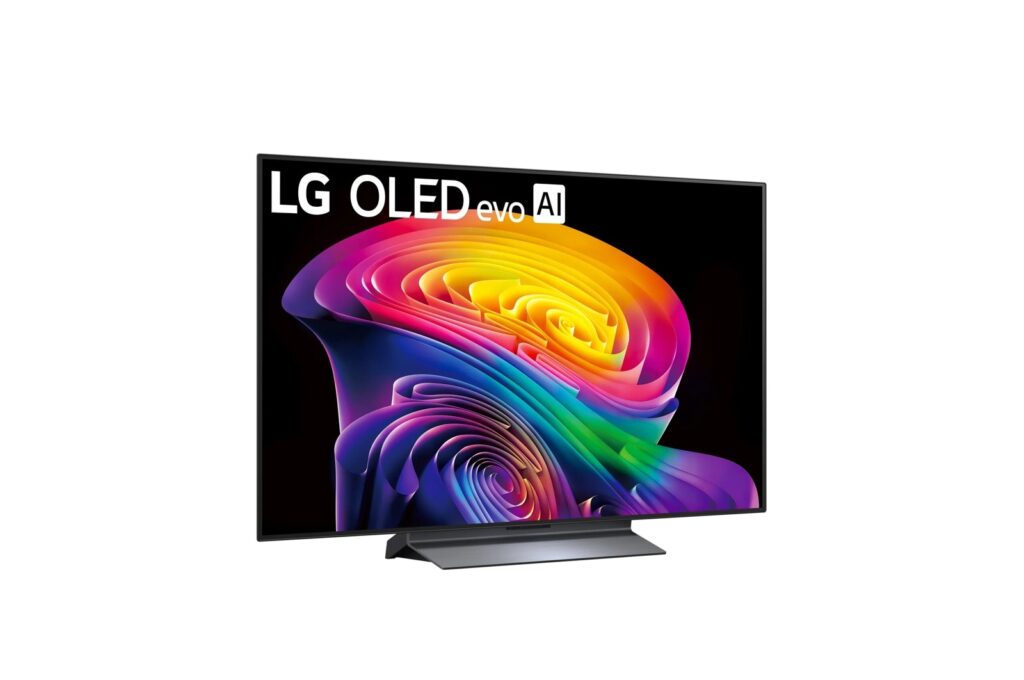
LG C6 48 OLED: Specs, Features, Pros & Cons
This review measures the LG C6 48 OLED against the full 41-spec sheet we track for monitors, comparing it like for like with the 69 other models in our database. It earns a VS Score of 68 out of 100 — the weighted result of every verified specification measured against the class average.
On the spec sheet it is strongest in connectivity and weakest in gaming. Its clearest single advantage over the class average: 18.71" (47.53 cm) more screen size — 48" (121.92 cm) vs 29.29" (74.4 cm) (avg). None of our retail partners currently lists the LG C6 48 OLED, so availability may be limited; a missing price never affects the VS Score. A transparency note: this spec sheet is 32% complete. Anything unverified shows as Unknown and is left out of the score — we never estimate a missing value.
Category strengths
Where the LG C6 48 OLED beats the average
- 18.71" (47.53 cm) more screen size ?48" (121.92 cm) vs 29.29" (74.4 cm) (avg)
- 0.92 ms less response time ?0.1 ms vs 1.02 ms (avg)
- 2.26 more HDMI ports ?4 vs 1.74 (avg)
- Has built-in speakers ?
Where the LG C6 48 OLED trails the average
- 51.37 Hz less refresh rate ?165 Hz vs 216.37 Hz (avg)
Editor’s note
The 48-inch C6 is a television, and people buy it as a monitor anyway. It is worth being clear about which you want, because the trade-offs run in both directions.
As a display it is exceptional. OLED means every pixel lights itself, so blacks are genuinely black and contrast is effectively infinite — nothing with a backlight competes in a dark room. It runs 4K at 165Hz with a 0.1ms response time, supports both NVIDIA G-Sync and AMD FreeSync Premium, and all four HDMI 2.1 ports carry the full bandwidth, so a PC and two consoles can all run at high refresh without choosing sockets.
The complications are physical and practical. At 48 inches on a normal desk you sit close enough that you turn your head to read the corners, and 4K across that diagonal works out to about 92 pixels per inch — noticeably coarser text than a 27-inch 1440p monitor. It runs webOS rather than simply being a screen, so it boots into a TV interface. There is no height-adjustable stand and no USB-C.
Static desktop elements — a taskbar, a fixed toolbar — carry some permanent-retention risk on OLED, which LG mitigates with pixel shifting and screen care features but does not eliminate.
Buy it as a television, or as a gaming display in a room where you sit back. For desk work at arm's length, a smaller dedicated monitor is the better tool.
Specifications
Quality bars are generated automatically against 69 other monitors.
Picture
Larger screens are more immersive; measured diagonally.
The total pixel count; higher is sharper.
The panel technology; OLED offers the best contrast.
The more specific panel or backlight technology (e.g. QD-OLED, WOLED or Mini-LED VA).
The native or supported bit depth used to reproduce colour gradients.
The display surface treatment and its balance of glare control and image clarity.
Higher refresh rates are smoother for gaming and scrolling.
Grey-to-grey response; lower reduces motion blur.
Higher brightness makes HDR highlights pop.
The ratio between the brightest and darkest output.
Wider colour gamut for more vivid, accurate colour.
The certified HDR tier.
Pixels per inch; higher looks sharper.
Dims parts of the backlight independently to improve contrast.
More independently controlled zones can improve HDR precision.
Gaming
Variable-refresh technology for tear-free motion.
Syncs the refresh rate to the GPU.
Backlight strobing for clearer motion.
The delay between an input and the image changing; lower is better.
The minimum-to-maximum refresh range over which variable refresh rate operates.
Ergonomics & design
The width-to-height ratio (e.g. 16:9, 21:9).
The curve radius (e.g. 1000R); blank for a flat panel.
Raise and lower the panel.
Angle the panel up and down.
Rotate the panel left and right.
Rotate to portrait orientation.
The VESA wall / arm mount pattern (e.g. 100 x 100 mm).
Connectivity
More HDMI inputs connect more devices.
The highest HDMI standard supported by the monitor.
DisplayPort inputs, preferred for high refresh rates.
The highest DisplayPort standard supported by the monitor.
A USB-C input, often with power delivery for laptops.
Charges a connected laptop over USB-C.
Built-in USB ports for peripherals.
Integrated speakers.
A 3.5 mm audio output for headphones or external speakers.
Control two computers with one keyboard and mouse.
Features
A built-in camera for video calls.
A built-in microphone for calls.
A wired network port for USB-C docking.
Shows inputs from two computers side by side.
How the VS Score works — and what it can’t tell you
Every measurable spec is scored against the average of all the monitors we track: matching the class average scores 50, clearly beating it climbs towards 100, and each spec counts according to an editorial weight that reflects real-world impact — a battery-capacity gap moves the score far more than a colour-options list. The quality bars on the spec cards above show where this model sits inside the full range for its class, and the overall VS Score rolls every weighted result into one number.
Unknown values are never estimated. A spec this product doesn’t report simply drops out of its scoring — it isn’t penalised with a guess — but a thinner spec sheet does mean a score built on fewer data points, which is why completeness is disclosed under About this data.
Most importantly: a spec-sheet lead is not the same as a better product. Megapixels, gigahertz and benchmark points describe capacity, not experience — image processing, software optimisation, thermals, haptics and ergonomics decide how a device actually feels, and no table captures reliability or long-term support quality. Treat the VS Score as a structured summary of what can be measured, not a substitute for your own priorities.
About this data
- Specifications are compiled from each manufacturer’s official spec sheet, cross-checked against trusted specification databases, and normalised into one schema so identical things are compared identically.
- Specifications last verified August 1, 2026.
- Data completeness: 13 of the 41 specs in this category are verified (32%). Anything we could not verify is shown as Unknown — never estimated — and is excluded from the score.
- Prices and availability come from live retailer feeds via our shopping partners and refresh throughout the day; a missing price means no partner currently lists the product, not that it is discontinued.
- Want the full picture? Our editorial guidelines explain how we research products, weight the scores and stay independent.
- Spotted an error in a spec? Tell us and we will correct the sheet.
Monitors with similar specs to the LG C6 48 OLED
Ratings & reviews
No reviews yet. Be the first to share your experience.
The bottom line
The LG C6 48 OLED earns a VS Score of 68, comfortably above average among the 70 monitors we compare here. It stands out for 18.71" (47.53 cm) more screen size, 0.92 ms less response time and 2.26 more HDMI ports. Just be aware of 51.37 Hz less refresh rate before you buy. For most buyers it is an easy recommendation.
The VS Score is generated automatically from the weighted specifications above, measured against all other monitors in our database. Treat it as a shortlisting guide — not a substitute for your own priorities.