Logitech G Pro Wireless League of Legends Edition Specs
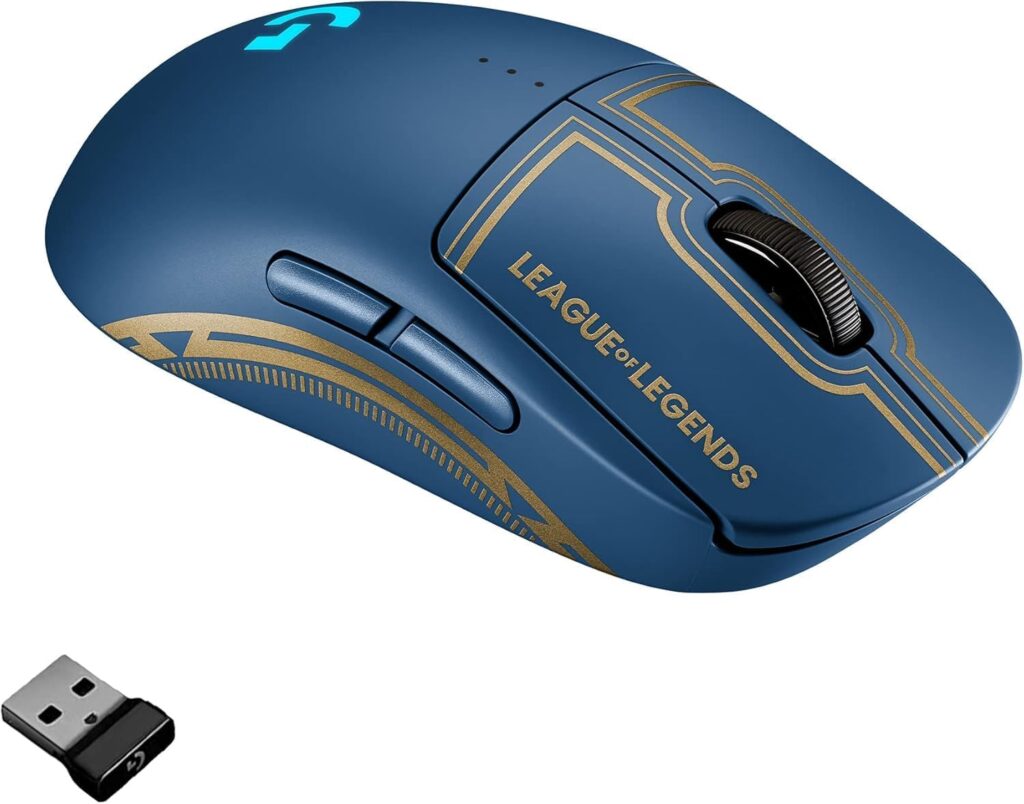
Buying a licensed special edition is usually a decision about the paint rather than the hardware, and this one is no different. The League of Legends Edition puts Riot's navy-and-gold Hextech finish on a mouse Logitech has been selling, unchanged, since 2018. If the styling is what you want, everything below is the price of admission. Otherwise there is a newer mouse in the same family with the same shape.
What that shape is, though, matters more than the era it comes from. The G Pro Wireless is ambidextrous, medium-sized and unusually neutral. It does not force a grip, which is precisely why so many professional players adopted it and why it stayed on desks long after Logitech released lighter successors. Shape ages far more slowly than sensors do.
The most useful feature is the removable side buttons. Both flanks take them, blanking plates fill the sockets you do not use, and left-handed players get a real option. Onboard profiles mean it behaves the same on a machine where you cannot install software, which is why tournament players care about that feature.
The dated part is charging. This generation uses micro-USB, and in a category where everything else moved to USB-C years ago that is a daily irritation: it means carrying a cable you own for nothing else.
So the calculation is unusually simple here. You are paying current prices for proven, older hardware and a collaboration finish. That is a perfectly reasonable thing to want, as long as you know that is what you are choosing.
Category strengths
Where the Logitech G Pro Wireless League of Legends Edition beats the median
- Has wireless charging ?
- Has RGB lighting ?
- More buttons ?8 vs 6 (median)
- A lighter build ?80 g vs 89 g (median)
Where the Logitech G Pro Wireless League of Legends Edition trails the median
- Much shorter battery life ?60 h vs 150 h (median)
- A lower max tracking speed ?400 IPS vs 650 IPS (median)
- No USB-C charging ?
- A lower max acceleration ?40 G vs 50 G (median)
How this VS Score was computed
Score 45: each known spec is measured against the median of all mice (81 products), then weighted; 50 means level with that median. In classes of six or more, a value beyond the class’s 10th–90th percentile range counts as that limit, so one extreme product cannot set the scale. 71% of the scoreable weight could be used; unknown values, features not applicable to this class and proxies (battery capacity where a rated life exists) add or remove nothing.
| Specification | This product | Cohort median | Score weight | Points moved |
|---|---|---|---|---|
| Battery life | 60 — capped at the class’s lower range (75) | 150 | 0.8 | −20.0 |
| Max tracking speed | 400 | 650 | 0.8 | −15.2 |
| USB-C charging | No | 67% of the class have it | 0.3 | −14.4 |
| Buttons | 8 | 6 | 0.6 | +10.2 |
| Wireless charging | Yes | 14% of the class have it | 0.2 | +10.0 |
| RGB lighting | Yes | 46% of the class have it | 0.2 | +10.0 |
| Horizontal scrolling | No | 45% of the class have it | 0.2 | −9.6 |
| Free-spin scroll wheel | No | 34% of the class have it | 0.2 | −9.6 |
| Weight | 80 | 89 | 1 | +6.0 |
| Max acceleration | 40 | 50 | 0.4 | −4.0 |
| Max sensitivity | 25,600 | 25,600 | 1 | +0.0 |
| Polling rate | 1,000 | 1,000 | 0.8 | +0.0 |
| Connection | 2 | 2 | 0.8 | +0.0 |
| Wireless polling rate | 1,000 | 1,000 | 0.5 | +0.0 |
Not scored: Adjustable lift-off distance (unknown: not scored); Grip styles (unknown: not scored); Click latency (unknown: not scored); Switch lifespan (unknown: not scored); Debounce adjustment (unknown: not scored); Battery capacity (unknown: not scored); Quick charge (unknown: not scored); Onboard memory (standard for the class (86% have it)); Software customization (standard for the class (97% have it)); Adjustable weights (not applicable: only 2% of this class have it).
Editor’s note
The League of Legends Edition of the Logitech G Pro Wireless is the same mouse that dominated esports stages for years, wrapped in Riot's navy-and-gold Hextech livery. Underneath, nothing changed: HERO 25K sensor tracking from 100 to 25,600 DPI with zero smoothing or acceleration, rated beyond 400 IPS and 40 G, Lightspeed 2.4 GHz wireless at a 1,000 Hz report rate, and the 80-gram ambidextrous shell that more than 50 professional players helped Logitech shape over two years.
The design details still hold up. The side buttons are removable on both flanks, so left- and right-handed players alike can run two, four, or none and blank the unused sockets. That is the '4 to 8 buttons' in the spec sheet. Onboard memory stores five profiles for tournament machines where G HUB is not installed, the PTFE feet are rated for more than 250 kilometers, and the mouse charges (and works) over its cable, or wirelessly on a Powerplay pad. Battery life is rated at 48 hours with the single RGB zone lit and about 60 hours with it off.
Its age shows in exactly two places. The cable is micro-USB, an inconvenience in a bag full of USB-C cables. And at 80 grams it is no longer the light option. The Superlight 2 line runs some 20 grams lighter with a newer sensor and higher polling for not much more money. That is the decision: this edition is for the player who wants the classic Pro shape or the League styling specifically, and the collaboration finish (Summoner's Rift gold linework over blue) is the best-executed game tie-in Logitech has done.
As a mouse it remains excellent. As a purchase it is a style pick over the newer hardware at the same price.
Specifications
Quality bars show where each figure sits between the lowest and highest of the 81 mice this VS Score is measured against.
Sensor & tracking
Design & handling
Switches & latency
Connectivity
Battery
Features
Sources and verification
Where the specifications come from
- Datasheet or manualsupport.logi.com
- Retailer listing (cross-check)amazon.com
Verification
- First published
- Specifications last checked
- Sheet completeness
- 26 of 34 specifications verified; the rest show as Unknown and are never estimated or scored
- Page type
- Product specification page — Compiled from the manufacturer’s published specifications and the cited sources; this is not a hands-on test.
- Basis
- Research-based: specifications and editorial text were compiled from the documents listed here and the manufacturer’s published data. We have not tested this unit ourselves; where independent measurements are mentioned they belong to the linked publication.
Where to buy
Prices and availability may change. Check the retailer before buying. We may earn a commission on purchases.
Price history
Mice with similar specs to the Logitech G Pro Wireless League of Legends Edition
Ratings & reviews
No reviews yet. Be the first to share your experience.
The bottom line
The Logitech G Pro Wireless League of Legends Edition earns a VS Score of 45, below the median of the 81 mice it is measured against (a score of 50 is level with that median).
- Who it’s for
- Fans of the classic G Pro shape or League of Legends styling who want proven esports hardware.
- Who should look elsewhere
- Weight-obsessed competitive players, because the Superlight line is about 20 g lighter with newer internals.
- The trade-off that matters
- You pay current-gen money for 2018-era (still excellent) hardware with micro-USB charging.
- The main alternative
- Logitech G PRO X SUPERLIGHT 2
The VS Score is calculated from the weighted specifications above, each measured against the median of comparable mice — a shortlisting guide, not a substitute for your own priorities. See how we score.