Logitech G203 LIGHTSYNC: Specs, Price, Pros & Cons
Plug the G203 LIGHTSYNC into a computer and it works, with no battery, no dongle and no pairing step. It is Logitech's entry wired gaming mouse, and much of its appeal comes from how little it asks of the person using it.
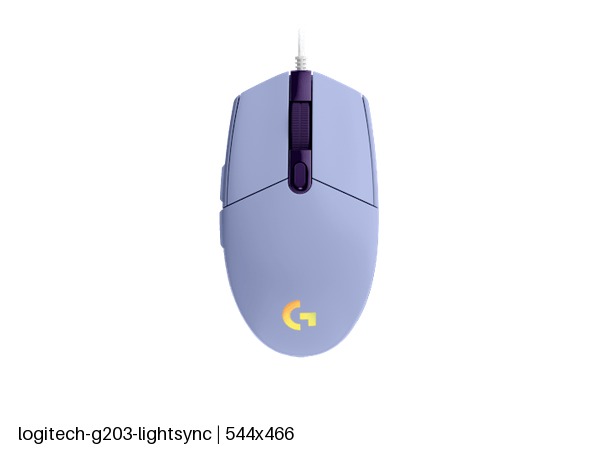
The shell is small and symmetrical with six buttons. It suits most hands and most grips because it does nothing unusual, with no thumb rest and no sculpted flanks to fit around, and its weight sits in the middle of the field. The sensor is listed only as a gaming-grade part, and the report rate is 1,000 Hz, the usual rate for a wired gaming mouse and plenty for anything short of competitive play at the highest level. LIGHTSYNC in the name refers to the lighting. Logitech's software sets the colors along with button mapping and sensitivity steps, and onboard memory keeps those settings so the mouse behaves the same on a second computer without the app installed.
Its weak points on paper are modest resolution, a wired-only connection and no USB-C. None of the three affects a mouse that stays plugged into one desktop, and the sensor ceiling, though well short of the numbers on flagship boxes, clears the settings most players use with room to spare. The economy that shows up in use is the cable, a stiff rubber lead that pulls a little on every swipe. Logitech has not published the switch type under the main buttons.
This mouse keeps turning up as a first gaming mouse, a spare in a drawer and the mouse on a shared family computer. It fits each of those roles because it works on any machine the moment it is connected and needs nothing charged.
Category strengths
Where the Logitech G203 LIGHTSYNC beats the median
- Has RGB lighting ?
- A slightly lighter build ?85 g vs 89 g (median)
Where the Logitech G203 LIGHTSYNC trails the median
- A much lower max sensitivity ?8,000 DPI vs 25,600 DPI (median)
- Fewer connection options ?
How this VS Score was computed
Score 40: each known spec is measured against the median of all mice (83 products), then weighted; 50 means level with that median. In classes of six or more, a value beyond the class’s 10th–90th percentile range counts as that limit, so one extreme product cannot set the scale. 40% of the scoreable weight could be used; unknown values, features not applicable to this class and proxies (battery capacity where a rated life exists) add or remove nothing.
| Specification | This product | Cohort median | Score weight | Points moved |
|---|---|---|---|---|
| Max sensitivity | 8,000 | 25,600 | 1 | −34.0 |
| Connection | 1 | 2 | 0.8 | −20.0 |
| RGB lighting | Yes | 48% of the class have it | 0.2 | +10.0 |
| Weight | 85 | 89 | 1 | +2.0 |
| Polling rate | 1,000 | 1,000 | 0.8 | +0.0 |
| Buttons | 6 | 6 | 0.6 | +0.0 |
Not scored: Max tracking speed (unknown: not scored); Max acceleration (unknown: not scored); Adjustable lift-off distance (unknown: not scored); Grip styles (unknown: not scored); Horizontal scrolling (unknown: not scored); Free-spin scroll wheel (unknown: not scored); Click latency (unknown: not scored); Switch lifespan (unknown: not scored); Debounce adjustment (unknown: not scored); Wireless polling rate (unknown: not scored); USB-C charging (unknown: not scored); Battery life (unknown: not scored); Battery capacity (unknown: not scored); Quick charge (unknown: not scored); Wireless charging (unknown: not scored); Onboard memory (standard for the class (88% have it)); Software customization (standard for the class (98% have it)); Adjustable weights (unknown: not scored).
Editor’s note
The G203 LIGHTSYNC is a budget wired mouse that gets the fundamentals right at a price where most rivals do not.
The shape is a small, simple, symmetrical 116.6 mm shell that suits most hands and most grips, with no thumb rests to fight and no unusual contours to get used to. Six buttons, onboard memory so settings follow the mouse to another machine, and RGB lighting that is the reason for the name.
The sensor runs to 8,000 DPI. That is modest against the 26,000 to 45,000 quoted elsewhere here, and largely irrelevant: almost nobody plays above 3,200 DPI, and a sensor that tracks cleanly through its usable range is worth more than a headline number nobody reaches.
The economies are real but sensible. The cable is plain rather than braided, so it drags more than a flexible one. It weighs 85 g, which is middling. And it is wired only.
Buy it as a first gaming mouse, a spare, or a mouse for a second machine, where reliability and shape matter more than a specification sheet. Buy something lighter, with a more flexible cable, if competitive play is the goal.
Specifications
Quality bars show where each figure sits between the lowest and highest of the 83 mice this VS Score is measured against.
Sensor & tracking
Design & handling
Switches & latency
Connectivity
Battery
Features
Sources and verification
Where the specifications come from
- Official product pagelogitechg.com
Verification
- First published
- Specifications last checked
- Sheet completeness
- 14 of 34 specifications verified; the rest show as Unknown and are never estimated or scored
- Page type
- Product specification page — Compiled from the manufacturer’s published specifications and the cited sources; this is not a hands-on test.
- Basis
- Research-based: specifications and editorial text were compiled from the documents listed here and the manufacturer’s published data. We have not tested this unit ourselves; where independent measurements are mentioned they belong to the linked publication.
Where to buy
Prices and availability may change. Check the retailer before buying. We may earn a commission on purchases.
Price history
Mice with similar specs to the Logitech G203 LIGHTSYNC

Ratings & reviews
No reviews yet. Be the first to share your experience.
The bottom line
The Logitech G203 LIGHTSYNC earns a VS Score of 40, below the median of the 83 mice it is measured against (a score of 50 is level with that median).
- Who it’s for
- A first gaming mouse, a spare for a second machine, or a mouse for a family PC, where a shape that fits most hands matters more than the spec sheet.
- Who should look elsewhere
- Competitive players who want a light shell and a flexible cable.
- The trade-off that matters
- Its plain rubber cable drags on the pad more than a braided one, a small irritation repeated on every swipe.
- The main alternative
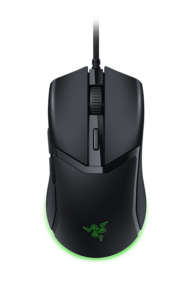
- Razer Cobra: a lighter wired budget mouse with optical switches and a more flexible cable
The VS Score is calculated from the weighted specifications above, each measured against the median of comparable mice — a shortlisting guide, not a substitute for your own priorities. See how we score.