Logitech G305 LIGHTSPEED: Specs, Price, Pros & Cons
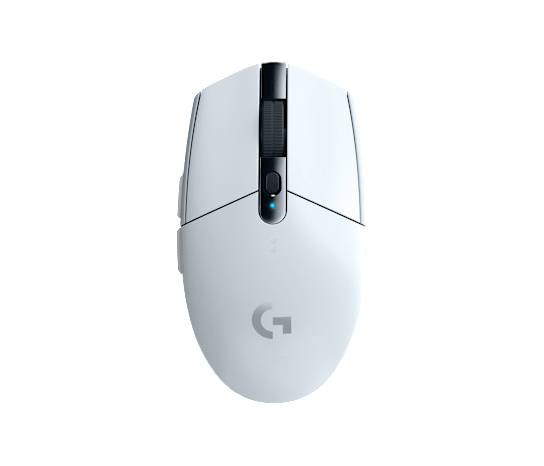
Two Logitech mice now share the G305 name, and this is the original, the one with a battery door. It takes an AA cell, which sets it apart from the newer X SUPERLIGHT and from nearly every rechargeable gaming mouse.
LIGHTSPEED is Logitech's own low-latency wireless link, and it is the one connection the mouse has. There is no Bluetooth, no wired mode and no charging port, so the dongle has to stay plugged into whichever computer the mouse is used with. Onboard memory keeps sensitivity and button settings in the mouse. The shell is small and symmetrical, with six buttons, and Logitech names it as a popular pick for claw grips. Logitech's HERO sensor is rated for 40 G of acceleration, with modest resolution and tracking speed, a gap that shows up only at very low sensitivity with wide, fast swipes.
The AA cell shapes the rest. It adds weight a rechargeable mouse of the same size would not carry, and it gives the G305 a battery rating far beyond most rechargeable mice. A flat cell is replaced in seconds, and there is no built-in battery to wear out after a few years of charging. Anyone who loses cables, travels with a laptop or keeps a mouse on a second computer that sees occasional use will find the design easy to live with.
A player chasing a light shell for shooters will find the cell makes it noticeably heavier than current rechargeable designs, and the X SUPERLIGHT is Logitech's answer for that player. The original still needs less from its owner than Logitech's rechargeable gaming mice, and its age shows mainly in the missing port.
Category strengths
Where the Logitech G305 LIGHTSPEED beats the median
- Much longer battery life ?250 h vs 130 h (median)
Where the Logitech G305 LIGHTSPEED trails the median
- A much lower max sensitivity ?12,000 DPI vs 25,600 DPI (median)
- Fewer connection options ?
- A lower max tracking speed ?400 IPS vs 650 IPS (median)
- Fewer supported grip styles ?
- A much lower switch lifespan ?10 million clicks vs 80 million clicks (median)
- A heavier build ?99 g vs 89 g (median)
- A lower max acceleration ?40 G vs 50 G (median)
How this VS Score was computed
Score 41: each known spec is measured against the median of all mice (83 products), then weighted; 50 means level with that median. In classes of six or more, a value beyond the class’s 10th–90th percentile range counts as that limit, so one extreme product cannot set the scale. 70% of the scoreable weight could be used; unknown values, features not applicable to this class and proxies (battery capacity where a rated life exists) add or remove nothing.
| Specification | This product | Cohort median | Score weight | Points moved |
|---|---|---|---|---|
| Battery life | 250 | 130 | 0.8 | +36.8 |
| Max sensitivity | 12,000 | 25,600 | 1 | −27.0 |
| Connection | 1 | 2 | 0.8 | −20.0 |
| Max tracking speed | 400 | 650 | 0.8 | −15.2 |
| Grip styles | 1 | 2 | 0.4 | −10.0 |
| Horizontal scrolling | No | 46% of the class have it | 0.2 | −9.6 |
| RGB lighting | No | 48% of the class have it | 0.2 | −9.6 |
| Switch lifespan | 10 — capped at the class’s lower range (15) | 80 | 0.2 | −8.2 |
| Weight | 99 | 89 | 1 | −5.0 |
| Max acceleration | 40 | 50 | 0.4 | −4.0 |
| Polling rate | 1,000 | 1,000 | 0.8 | +0.0 |
| Buttons | 6 | 6 | 0.6 | +0.0 |
| Wireless polling rate | 1,000 | 1,000 | 0.5 | +0.0 |
Not scored: Adjustable lift-off distance (unknown: not scored); Free-spin scroll wheel (unknown: not scored); Click latency (unknown: not scored); Debounce adjustment (unknown: not scored); USB-C charging (unknown: not scored); Battery capacity (unknown: not scored); Quick charge (unknown: not scored); Wireless charging (unknown: not scored); Onboard memory (standard for the class (88% have it)); Software customization (standard for the class (98% have it)); Adjustable weights (unknown: not scored).
Editor’s note
The G305 LIGHTSPEED runs on a single AA battery for a quoted 250 hours, and that design choice is why it has stayed on sale so long.
A replaceable cell means there is no built-in battery to degrade after three or four years, which is the failure that quietly retires most wireless mice. A flat battery in the middle of something is solved in ten seconds rather than by finding a cable. Logitech also rates an Endurance mode, set in G HUB, at up to nine months of standard use.
The rest is deliberately modest and entirely sound. Logitech's HERO sensor runs to 12,000 DPI with 400 IPS tracking, polling at 1,000 Hz over the LIGHTSPEED link, which is the same low-latency radio used in Logitech's competitive mice. The shell is small and symmetrical, listed at 116.6 mm long, with six buttons, PTFE feet and onboard memory, and Logitech recommends it for claw grips.
At 99 g it is heavy for a modern gaming mouse (the AA cell accounts for much of that), and there is no RGB, no USB-C and no wired mode.
Do not confuse it with the G305 X SUPERLIGHT, which is a different and much lighter mouse.
Buy it if you want dependable wireless at a low price and prefer swapping a battery to charging one. Buy a rechargeable lightweight if that weight is more than you want to push around, which for competitive play it probably is.
Specifications
Quality bars show where each figure sits between the lowest and highest of the 83 mice this VS Score is measured against.
Sensor & tracking
Design & handling
Switches & latency
Connectivity
Battery
Features
Sources and verification
Where the specifications come from
- Official product pagelogitechg.com
- Datasheet or manualsupport.logi.com
Verification
- First published
- Specifications last checked
- Sheet completeness
- 22 of 34 specifications verified; the rest show as Unknown and are never estimated or scored
- Page type
- Product specification page — Compiled from the manufacturer’s published specifications and the cited sources; this is not a hands-on test.
- Basis
- Research-based: specifications and editorial text were compiled from the documents listed here and the manufacturer’s published data. We have not tested this unit ourselves; where independent measurements are mentioned they belong to the linked publication.
Where to buy
Prices and availability may change. Check the retailer before buying. We may earn a commission on purchases.
Price history
Mice with similar specs to the Logitech G305 LIGHTSPEED
Ratings & reviews
No reviews yet. Be the first to share your experience.
The bottom line
The Logitech G305 LIGHTSPEED earns a VS Score of 41, below the median of the 83 mice it is measured against (a score of 50 is level with that median).
- Who it’s for
- Budget buyers who want dependable low-latency wireless and would rather swap a battery in seconds than hunt for a cable.
- Who should look elsewhere
- Competitive players who move the mouse fast should look elsewhere, since the battery adds weight. There is no wired fallback or USB-C either.
- The trade-off that matters
- A replaceable cell outlasts any built-in battery, and it is also why the mouse weighs noticeably more than modern gaming mice.
- The main alternative
- Logitech G305 X SUPERLIGHT: the much lighter rechargeable model, for faster games where the extra weight gets in the way.
The VS Score is calculated from the weighted specifications above, each measured against the median of comparable mice — a shortlisting guide, not a substitute for your own priorities. See how we score.