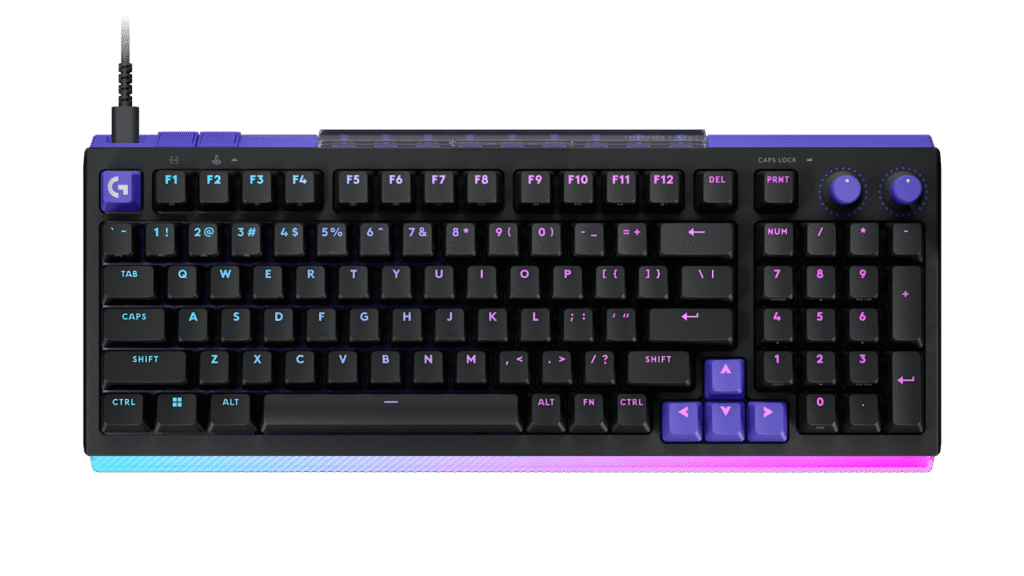
Logitech G512 X 98: Specs, Features, Pros & Cons
Nearly every keyboard built around magnetic actuation is tenkeyless or smaller, because the people who care about rapid trigger mostly play games and mostly want the numeric pad gone. The G512 X 98 keeps it, and that one decision explains most of who the keyboard is for.
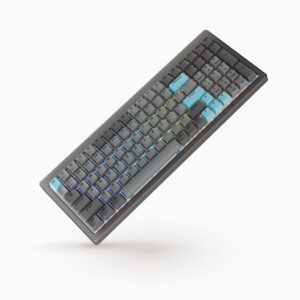
Physically it is a compact full-size of ninety-seven keys, with the numeric pad pushed hard against the main cluster and two rotary knobs in the top-right corner, one for volume and one assignable. Every key ships with a Kailh mechanical switch, tactile or linear by version, and nine Gateron KS20 analog switches come in the box for the Dual Swap beds, whose magnetic sensors read key position continuously so actuation depth and rapid trigger can be set. Polling runs up to 8,000 Hz over the wire, and three profiles live on the keyboard itself.
The buyer this makes obvious sense for is someone whose computer is a single machine doing everything: spreadsheets, data entry or accounting during the day and competitive shooters in the evening, with no appetite for two keyboards or a separate numeric pad cluttering the desk. That is a far larger group than the esports framing most magnetic keyboards are sold with, and it is poorly served elsewhere.
The limits are concrete. It is wired only, with no Bluetooth and no receiver, so it will not double as a keyboard for a laptop or a tablet and it will not travel. And a 96% layout compresses the arrow cluster and the navigation keys against their neighbors with no separating gap, which takes a week or two to relearn coming from a full-size board and never quite stops producing the occasional wrong keypress. Neither is a defect. Both are worth knowing before the box is open.
Category strengths
Where the Logitech G512 X 98 beats the median
- A much higher polling rate ?8,000 Hz vs 1,000 Hz (median)
- Has rapid trigger ?
- Has adjustable actuation ?
Where the Logitech G512 X 98 trails the median
- Fewer connection options ?
How this VS Score was computed
Score 72: each known spec is measured against the median of all keyboards (101 products), then weighted; 50 means level with that median. In classes of six or more, a value beyond the class’s 10th–90th percentile range counts as that limit, so one extreme product cannot set the scale. 54% of the scoreable weight could be used; unknown values, features not applicable to this class and proxies (battery capacity where a rated life exists) add or remove nothing.
| Specification | This product | Cohort median | Score weight | Points moved |
|---|---|---|---|---|
| Polling rate | 8,000 | 1,000 | 0.7 | +35.0 |
| Switch technology | Hall effect | Mechanical | 1 | +33.0 |
| Hot-swappable | Yes | 61% of the class have it | 0.6 | +30.0 |
| Connection | 1 | 3 | 0.8 | −26.4 |
| Rapid trigger | Yes | 25% of the class have it | 0.5 | +25.0 |
| Adjustable actuation | Yes | 24% of the class have it | 0.4 | +20.0 |
| Rotary knob | Yes | 53% of the class have it | 0.2 | +10.0 |
| Wired latency | 0.13 | 0.13 | 0.8 | +0.0 |
| Keycap material | PBT | PBT | 0.4 | +0.0 |
| Backlight | RGB | RGB | 0.3 | +0.0 |
Not scored: Actuation force (unknown: not scored); N-key rollover (standard for the class (85% have it)); Analog input (unknown: not scored); Wireless latency (unknown: not scored); Front height (unknown: not scored); Bluetooth devices (unknown: not scored); Battery life (unknown: not scored); Battery capacity (unknown: not scored); USB passthrough (unknown: not scored); Sound dampening (unknown: not scored); Programmable keys (standard for the class (99% have it)); Media controls (standard for the class (97% have it)); Onboard profiles (standard for the class (89% have it)); Configuration software (standard for the class (95% have it)).
Editor’s note
The interesting idea in the G512 X 98 is that you do not have to commit to analog. Thirty-nine of its ninety-seven keys sit in Dual Swap beds with tunnel magnetoresistance sensors underneath, and those beds accept either the bundled Gateron KS20 analog switches or any standard three or five-pin mechanical switch. Put analog under WASD and the surrounding keys where it matters, and leave ordinary tactile switches everywhere else.
That flexibility is the point, because analog switches are not universally better. They give you adjustable actuation from 0.1 mm to 4.0 mm and rapid trigger for instant re-actuation, which is a real advantage in shooters. For typing they can feel vague. There is no tactile confirmation, and an actuation point that shallow means resting a finger too heavily registers a keystroke.
Logitech kept the numpad, which is the main reason to pick this over the 75 model. At 387 mm wide it is a compact full-size rather than a true 98-key ANSI board, and you also get two rotary knobs in the top right for volume and a second assignable function. Onboard memory holds three profiles, so your settings travel to a machine without G Hub installed.
Two things to weigh. It is wired only (no Bluetooth, no 2.4 GHz dongle), which is fine for a desktop but removes it from consideration if you want one board for a laptop too. And at 987 grams with a PCR ABS case rather than aluminum, it feels solid without feeling premium. The price sits closer to the metal custom boards than the plastic construction suggests.
Get it if you play competitively, want rapid trigger, and refuse to give up a numpad or a wired connection. Skip it if you mostly type, want wireless, or would rather put the money into a hot-swap board with a metal case.
Specifications
Quality bars show where each figure sits between the lowest and highest of the 101 keyboards this VS Score is measured against.
Switches & typing
Performance
Layout & size
Connectivity
Build & sound
Features
Sources and verification
Where the specifications come from
- Official product pagelogitechg.com
- Support and firmware documentationsupport.logi.com
Verification
- First published
- Specifications last checked
- Sheet completeness
- 23 of 34 specifications verified; the rest show as Unknown and are never estimated or scored
- Page type
- Product specification page — Compiled from the manufacturer’s published specifications and the cited sources; this is not a hands-on test.
- Basis
- Research-based: specifications and editorial text were compiled from the documents listed here and the manufacturer’s published data. We have not tested this unit ourselves; where independent measurements are mentioned they belong to the linked publication.
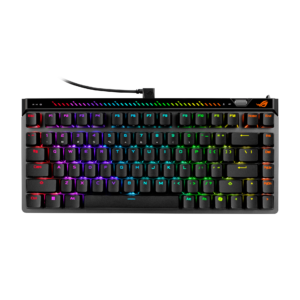
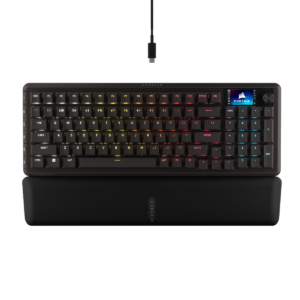
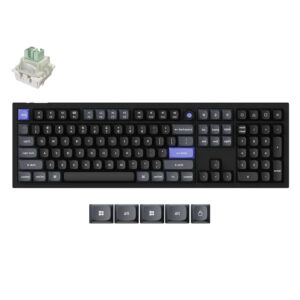
Keyboards with similar specs to the Logitech G512 X 98

Ratings & reviews
No reviews yet. Be the first to share your experience.
The bottom line
The Logitech G512 X 98 earns a VS Score of 72, above the median of the 101 keyboards it is measured against (a score of 50 is level with that median).
- Who it’s for
- Someone whose one computer handles number-heavy work by day and competitive shooters at night, and who wants a single keyboard with a numpad for both.
- Who should look elsewhere
- Look elsewhere if the board must also serve a laptop or tablet, since it is wired only, or if you mostly type and want metal for the money.
- The trade-off that matters
- The compressed layout. Keeping the numpad pushes the arrows and navigation keys tight against their neighbors, and that produces the odd wrong keypress long after the first weeks.
- The main alternative
- Logitech G512 X 75: the same swappable analog beds in a compact board, if the numpad can go.
The VS Score is calculated from the weighted specifications above, each measured against the median of comparable keyboards — a shortlisting guide, not a substitute for your own priorities. See how we score.