Razer Huntsman V3 Pro Low-profile TKL 8KHz: Specs & Verdict
Razer calls this the first low-profile analog optical esports keyboard, and the claim rests on the switch. The Low-profile Analog Optical Gen-2 travels 2.8 mm instead of the usual four, and because it senses with light rather than metal contacts, the actuation point can sit anywhere from 0.1 mm to the full travel. At the factory reference of 1.5 mm the force is 40 g, and the switches are lubricated and rated for 100 million keystrokes.
Everything built on that is about how early a key registers and how quickly it resets. Rapid Trigger releases a key on an upward movement as small as 0.1 mm, wherever the key is in its travel, adjustable on the board itself or per key in Synapse, with separate upstroke and downstroke settings. Snap Tap pairs opposed keys so the newest press wins, with up to four pairs stored. Snap Flex, new to this model and off by default, assigns a second action to the release point of a key. Dynamic Keystroke maps up to four commands to different depths of the same key.
Polling is a true 8,000 Hz over the detachable USB-C cable, and Razer measures 0.39 ms of average latency at the shallowest actuation setting. This is its own switch-to-port measurement rather than an end-to-end figure.
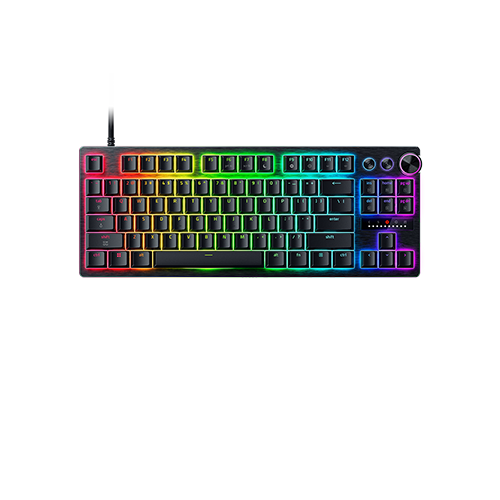
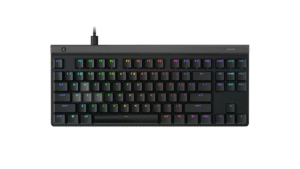
The build is 361 by 139 mm and 28 mm tall (19.5 mm at the front, measured to the top of the keycaps), 795 grams, a 5052 aluminum top case, doubleshot PBT keycaps, thick EPDM and EVA foam in the base, per-key Chroma lighting, six onboard profiles, and a digital dial with two buttons for media and macros.
Two things it does not have: a wrist rest, which its full-height sibling includes, and any mention of hot-swap, as Razer never claims it for this board. It is wired only. Against the full-height Huntsman V3 Pro 8KHz, you trade the deeper travel and the wrist rest for a shorter switch, a lower profile, and the newer Snap Flex and Dynamic Keystroke features.
Category strengths
Where the Razer Huntsman V3 Pro Low-profile TKL 8KHz beats the median
- A much higher polling rate ?8,000 Hz vs 1,000 Hz (median)
- Has rapid trigger ?
- Has adjustable actuation ?
- Has analog input ?
- A lighter actuation force ?40 g vs 45 g (median)
Where the Razer Huntsman V3 Pro Low-profile TKL 8KHz trails the median
- A much higher wired latency ?0.39 ms vs 0.13 ms (median)
- Fewer connection options ?
How this VS Score was computed
Score 65: each known spec is measured against the median of all keyboards (101 products), then weighted; 50 means level with that median. In classes of six or more, a value beyond the class’s 10th–90th percentile range counts as that limit, so one extreme product cannot set the scale. 58% of the scoreable weight could be used; unknown values, features not applicable to this class and proxies (battery capacity where a rated life exists) add or remove nothing.
| Specification | This product | Cohort median | Score weight | Points moved |
|---|---|---|---|---|
| Polling rate | 8,000 | 1,000 | 0.7 | +35.0 |
| Wired latency | 0.39 | 0.13 | 0.8 | −27.2 |
| Connection | 1 | 3 | 0.8 | −26.4 |
| Rapid trigger | Yes | 25% of the class have it | 0.5 | +25.0 |
| Adjustable actuation | Yes | 24% of the class have it | 0.4 | +20.0 |
| Analog input | Yes | 14% of the class have it | 0.4 | +20.0 |
| Switch technology | Optical | Mechanical | 1 | +17.0 |
| Sound dampening | Yes | 76% of the class have it | 0.3 | +15.0 |
| Rotary knob | Yes | 54% of the class have it | 0.2 | +10.0 |
| Actuation force | 40 | 45 | 0.4 | +2.4 |
| Keycap material | PBT | PBT | 0.4 | +0.0 |
| Backlight | RGB | RGB | 0.3 | +0.0 |
Not scored: Hot-swappable (unknown: not scored); N-key rollover (standard for the class (84% have it)); Wireless latency (unknown: not scored); Front height (unknown: not scored); Bluetooth devices (unknown: not scored); Battery life (unknown: not scored); Battery capacity (unknown: not scored); USB passthrough (not applicable: only 4% of this class have it); Programmable keys (standard for the class (99% have it)); Media controls (standard for the class (98% have it)); Onboard profiles (standard for the class (89% have it)); Configuration software (standard for the class (95% have it)).
Editor’s note
This keyboard is aimed at a narrow but real audience: competitive players who have decided a low-profile switch suits them and who want the current generation of actuation tricks. If you have never adjusted an actuation point in your life, most of what you are paying for here will sit unused.
Set the actuation point first, and set it conservatively. At the shallowest setting the board registers a key almost on contact, which sounds ideal and in practice produces accidental inputs while your fingers rest. Start near the factory reference and work down until you find the line where speed stops being worth the mistakes.
Rapid Trigger and Snap Tap are the features that change how a game feels. Snap Flex and Dynamic Keystroke are the kind you configure once and forget. That is not a criticism. Layering two actions on one key is useful in a few games and pointless in the rest.
The low profile is the real decision. The low front edge means flatter wrists, which suits desks without a rest, and Razer does not include one here even though the full-height model does. If you type for a living as well as play, try a low-profile switch before committing: the shorter travel is precise but shallow, and people who love deep keystrokes tend not to adapt.
It is wired only, which for a keyboard sold on its polling rate and sub-millisecond latency is a coherent decision. Against the Huntsman V3 Pro 8KHz, the difference is switch height and the newer features, so anyone happy with a full-height board should buy that one and keep the wrist rest.
Specifications
Quality bars show where each figure sits between the lowest and highest of the 101 keyboards this VS Score is measured against.
Switches & typing
Performance
Layout & size
Connectivity
Build & sound
Features
Sources and verification
Where the specifications come from
- Official product pagerazer.com
Verification
- First published
- Specifications last checked
- Sheet completeness
- 24 of 34 specifications verified; the rest show as Unknown and are never estimated or scored
- Page type
- Product specification page — Compiled from the manufacturer’s published specifications and the cited sources; this is not a hands-on test.
- Basis
- Research-based: specifications and editorial text were compiled from the documents listed here and the manufacturer’s published data. We have not tested this unit ourselves; where independent measurements are mentioned they belong to the linked publication.
Where to buy
Prices and availability may change. Check the retailer before buying. We may earn a commission on purchases.
Price history
Keyboards with similar specs to the Razer Huntsman V3 Pro Low-profile TKL 8KHz

Ratings & reviews
No reviews yet. Be the first to share your experience.
The bottom line
The Razer Huntsman V3 Pro Low-profile TKL 8KHz earns a VS Score of 65, above the median of the 101 keyboards it is measured against (a score of 50 is level with that median).
- Who it’s for
- Competitive players who want low-profile switches with a fully adjustable actuation point, Rapid Trigger and 8K polling in a TKL footprint.
- Who should look elsewhere
- Anyone who prefers deep keystrokes or needs wireless, and buyers who will never touch an actuation setting, because that is most of what this keyboard's price buys.
- The trade-off that matters
- The most adjustable low-profile switch Razer makes, wired only, with no wrist rest and no hot-swap claim to fall back on.
- The main alternative
- Razer Huntsman V3 Pro 8KHz: the full-height version with 4 mm of travel and a magnetic wrist rest, if the low profile is not the appeal.
The VS Score is calculated from the weighted specifications above, each measured against the median of comparable keyboards — a shortlisting guide, not a substitute for your own priorities. See how we score.