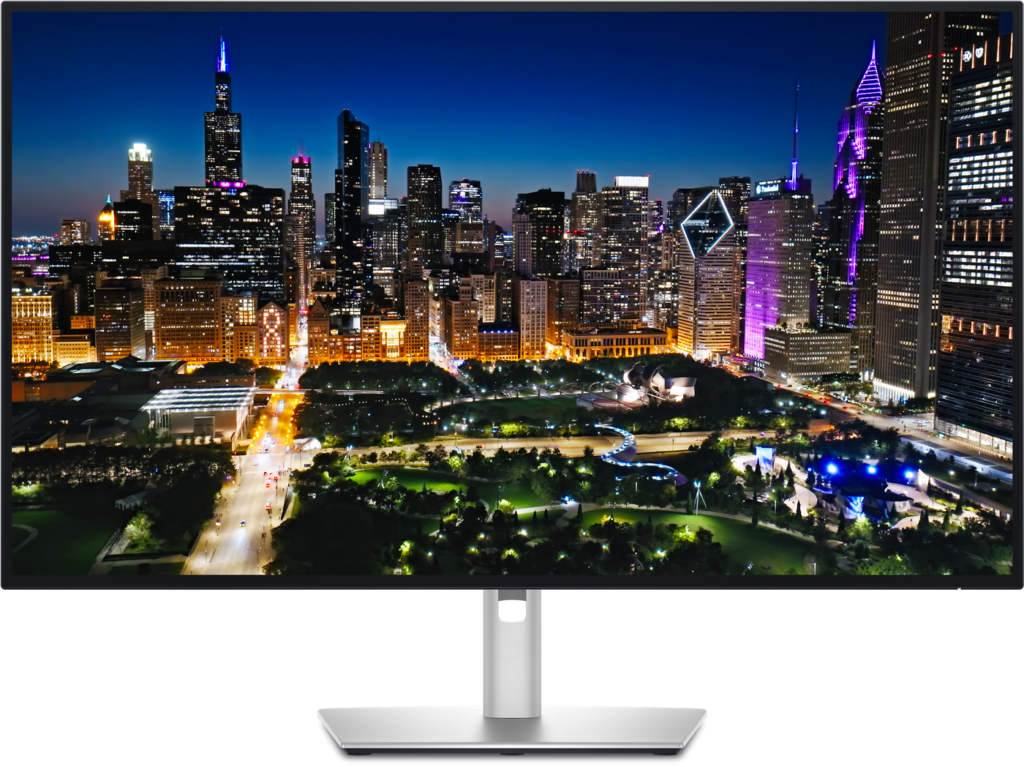
Dell U3225QE: Specs, Features, Pros & Cons
A smaller twin, the U2725QE, shares almost everything with this monitor: the same higher-contrast panel type, the same refresh rate, the same Thunderbolt hub and the same switching between computers. Choosing between them comes down to size and sharpness. The larger screen shows more at comfortable scaling and suits a desk with room for it, while the smaller one fits the same pixels into a tighter, sharper grid.
Both belong to the UltraSharp line, Dell's range for professional desks, and this model is its answer to the hybrid office. A company laptop connects with one cable that carries the picture, charging, wired network and the USB ports, and a personal desktop can share the same keyboard and mouse through the built-in switch. It turns the monitor into the docking station, which is why the price sits well above a plain screen of the same size and resolution. Dell's Display and Peripheral Manager software handles window layouts and input switching from the desktop.
It suits people who hot-desk or move between home and office with a laptop, households where two computers share a desk, and photographers or designers who want deeper blacks than ordinary office panels without living with OLED care rules. The panel also carries an entry HDR certification that is more convincing than most on this class of screen.
Speed and sound are the gaps. Motion is competent for casual games and no more, and there are no speakers, so a desk without its own audio needs a separate pair. Much of the price goes into ports and switching, which pays back on a busy desk and sits idle on a simple one.
Category strengths
Where the Dell U3225QE beats the median
- Much higher peak brightness ?600 nits vs 375 nits (median)
- More DisplayPort inputs ?2 vs 1 (median)
- A much higher contrast ratio ?3000:1 vs 2000:1 (median)
- A bigger screen ?32" (81.28 cm) vs 27" (68.58 cm) (median)
- Has ethernet ?
How this VS Score was computed
Score 63: each known spec is measured against the median of IPS office monitors (14 products), then weighted; 50 means level with that median. In classes of six or more, a value beyond the class’s 10th–90th percentile range counts as that limit, so one extreme product cannot set the scale. 61% of the scoreable weight could be used; unknown values, features not applicable to this class and proxies (battery capacity where a rated life exists) add or remove nothing.
| Specification | This product | Cohort median | Score weight | Points moved |
|---|---|---|---|---|
| USB-C | Yes | 64% of the class have it | 0.5 | +25.0 |
| Peak brightness | 600 | 375 | 0.8 | +24.0 |
| DisplayPort inputs | 2 | 1 | 0.4 | +20.0 |
| Contrast ratio | 3,000 | 2,000 | 0.6 | +15.0 |
| Screen size | 32 | 27 | 1.2 | +10.8 |
| Headphone output | Yes | 56% of the class have it | 0.2 | +10.0 |
| KVM switch | Yes | 58% of the class have it | 0.2 | +10.0 |
| Ethernet | Yes | 42% of the class have it | 0.2 | +10.0 |
| Built-in speakers | No | 33% of the class have it | 0.2 | −9.6 |
| HDR | DisplayHDR 600 | DisplayHDR 400 | 0.5 | +8.5 |
| Resolution | 4K | 4K | 1.2 | +0.0 |
| Panel type | IPS | IPS | 0.8 | +0.0 |
| Refresh rate | 120 | 120 | 0.6 | +0.0 |
| Response time | 5 | 5 | 0.24 | +0.0 |
| DCI-P3 coverage | 99 | 99 | 0.6 | +0.0 |
| Pixel density | 140 | 140 | 0.5 | +0.0 |
| HDMI ports | 1 | 1 | 0.4 | +0.0 |
| USB-C power delivery | 140 | 140 | 0.3 | +0.0 |
Not scored: Color depth (unknown: not scored); Local dimming (unknown: not scored); Local dimming zones (unknown: not scored); Adaptive sync (unknown: not scored); Variable refresh rate (unknown: not scored); Motion blur reduction (unknown: not scored); Input lag (unknown: not scored); Height adjustment (standard for the class (93% have it)); Tilt (standard for the class (100% have it)); Swivel (standard for the class (86% have it)); Pivot (standard for the class (83% have it)); USB hub (standard for the class (86% have it)); Webcam (unknown: not scored); Microphone (unknown: not scored); Picture-by-picture (standard for the class (82% have it)).
Editor’s note
The U3225QE is the monitor to look at if you want one cable to your laptop and no compromises in the picture. Thunderbolt 4 carries display, data and 140 W of power, which is enough to charge almost any laptop short of a workstation while driving the screen.
The panel is Dell's IPS Black, and the contrast figure is the reason to care: 3000:1 against roughly 1000:1 or 1500:1 for ordinary IPS. That is not OLED-level, but it makes dark interfaces and photography look substantially better than a typical office monitor, without OLED's burn-in question on static content. It runs at 120 Hz, covers 99% DCI-P3 and carries DisplayHDR 600, and at 31.5 inches and 4K it lands at 140 ppi, sharp enough for comfortable text at 150% scaling.
The rest reads like a docking station: 2.5 GbE Ethernet, a KVM switch, picture-by-picture, a USB hub with 10 Gbps ports, DisplayPort in and out for daisy-chaining, and a headphone output. There are no speakers.
The limitations are worth stating. Five milliseconds and that refresh rate make it competent rather than good for gaming, and the price is well above a plain 4K monitor. You are paying for the hub, the KVM and the contrast.
Buy it as the anchor of a desk where laptops come and go, particularly if two machines share the same keyboard.
Look at a cheaper 4K IPS panel if you only ever connect one computer and do not need Ethernet or a KVM.
Specifications
Quality bars show where each figure sits between the lowest and highest of the 14 IPS office monitors this VS Score is measured against.
Picture
Gaming
Ergonomics & design
Connectivity
Features
Sources and verification
Where the specifications come from
- Datasheet or manualdell.com
- Independent testingrtings.com
Verification
- First published
- Specifications last checked
- Sheet completeness
- 30 of 42 specifications verified; the rest show as Unknown and are never estimated or scored
- Page type
- Product specification page — Compiled from the manufacturer’s published specifications and the cited sources; this is not a hands-on test.
- Basis
- Research-based: specifications and editorial text were compiled from the documents listed here and the manufacturer’s published data. We have not tested this unit ourselves; where independent measurements are mentioned they belong to the linked publication.
Monitors with similar specs to the Dell U3225QE
Ratings & reviews
No reviews yet. Be the first to share your experience.
The bottom line
The Dell U3225QE earns a VS Score of 63, above the median of the 14 IPS office monitors it is measured against (a score of 50 is level with that median).
- Who it’s for
- A hybrid worker whose desk hosts a company laptop and a personal computer in turn, and who wants one cable for each plus better blacks than ordinary office panels.
- Who should look elsewhere
- Anyone who connects only one computer and needs no wired network or switching, and gamers who want more than competent motion. It also has no speakers.
- The trade-off that matters
- Much of the price goes on the hub. For a multi-machine desk that is money well spent, and for a single computer it is money parked in ports.
- The main alternative
- Dell S3225QC, a similar-sized screen with an OLED panel, built-in speakers and a single-cable laptop input, for someone who wants deeper blacks and sound more than a docking station.
The VS Score is calculated from the weighted specifications above, each measured against the median of comparable IPS office monitors — a shortlisting guide, not a substitute for your own priorities. See how we score.