Xerox C300: Specs, Price, Pros & Cons
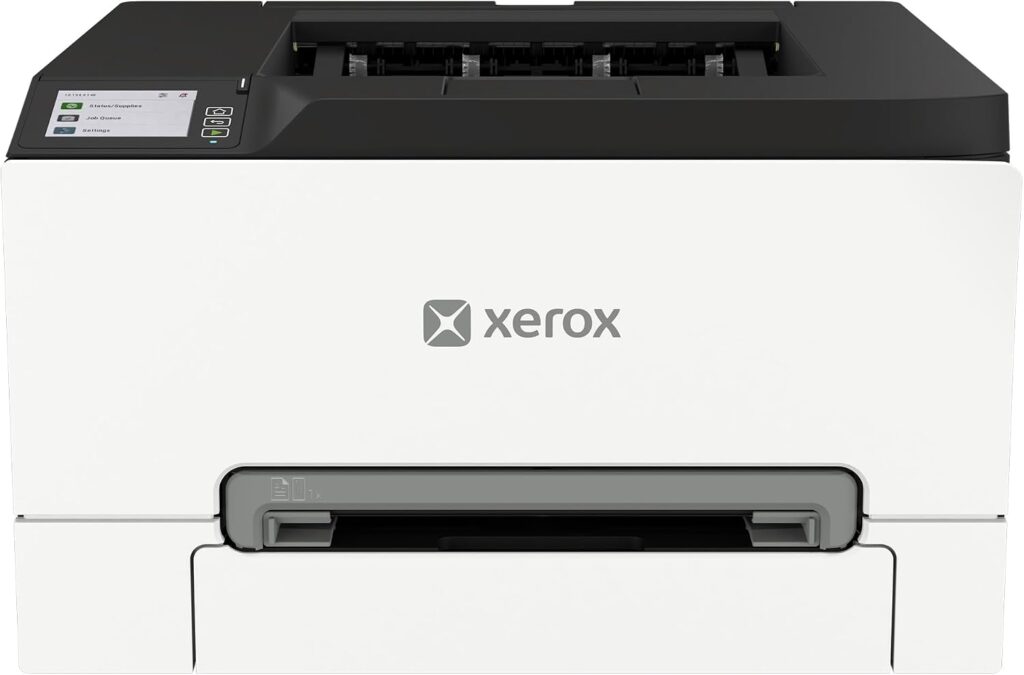
The Xerox C300 is a Lexmark engine wearing a Xerox badge, and that is the most useful thing to know about it. Xerox's current small-office colour range is built by Lexmark, so this printer shares its mechanics, toner and firmware family with Lexmark's own compact colour lasers, and its consumables market is deep because of it.
It is a single-function machine: it prints, in colour, at the same rated speed for mono and colour pages, and it does nothing else. There is no scanner, no copier and no fax. Xerox sells the same engine as the C303a and C305ae multifunction models for offices that need those, and the C240 sits below it as the cheaper, slower print-only option. Choosing between the four is mostly a question of speed, duty cycle and whether you scan.
What defines the C300 within that family is capacity for its size. Automatic two-sided printing is standard, the main tray takes a full ream, a second tray can be added, and Xerox rates it for a monthly volume that would satisfy a small team rather than a home office. Connectivity is complete for 2026: gigabit Ethernet, Wi-Fi with Wi-Fi Direct, USB, AirPrint and Mopria, all managed from a small colour touch panel.
The buyer is a small business or a home worker who prints colour documents in volume and either owns a scanner already or never needs one. Photo enthusiasts should look elsewhere; the resolution figure is a document-engine number, and glossy output is not what this class of laser is for.
Two things to check before buying: the starter cartridges in the box are low-yield, so factor a set of high-capacity toners into the real cost, and the machine is heavy enough that it wants a permanent spot.
Category strengths
Where the Xerox C300 beats the average
- A much higher print speed (color) ?32 ppm vs 9 ppm (avg)
- A much higher print speed (black) ?32 ppm vs 15.5 ppm (avg)
- A much higher monthly duty cycle ?75,000 pages vs 10,000 pages (avg)
- A much higher input tray capacity ?250 sheets vs 150 sheets (avg)
- Has touchscreen display ?
- A much higher output tray capacity ?100 sheets vs 60 sheets (avg)
Where the Xerox C300 trails the average
- No all-in-one ?
- No automatic document feeder ?
- A much heavier build ?16.6 kg vs 7.94 kg (avg)
- A much lower print resolution ?2,400 dpi vs 4,800 dpi (avg)
How this VS Score was computed
Score 63: each known spec is measured against the median of all printers (64 products, medians winsorised to the 10th–90th percentile), then weighted. 70% of the scoreable weight could be used; unknown values, features not applicable to this class and proxies (battery capacity where a rated life exists) add or remove nothing.
| Specification | This product | Cohort median | Score weight | Points moved |
|---|---|---|---|---|
| Print speed (black) | 32 | 15.5 | 2 | +100.0 |
| Print speed (color) | 32 | 9 | 1 | +50.0 |
| Automatic duplex printing | 1 | 1 | 1 | +50.0 |
| All-in-one | 0 | 1 | 1 | −48.0 |
| Automatic document feeder | 0 | 1 | 1 | −48.0 |
| Input tray capacity | 250 | 150 | 1 | +33.0 |
| Ethernet | 1 | 1 | 0.5 | +25.0 |
| Touchscreen display | 1 | 0 | 0.5 | +25.0 |
| Supertank / refillable ink | 0 | 0 | 0.5 | −24.0 |
| Duplex scanning | 0 | 0 | 0.5 | −24.0 |
| Monthly duty cycle | 75,000 | 10,000 | 0.3 | +15.0 |
| Print resolution | 2,400 | 4,800 | 0.5 | −12.5 |
| Output tray capacity | 100 | 60 | 0.3 | +9.9 |
| Fax | 0 | 0 | 0.2 | −9.6 |
| Weight | 16.6 | 7.94 | 0.3 | −7.8 |
Not scored: Color printing (standard for the class (89% have it)); ADF capacity (unknown: not scored); Wi-Fi (standard for the class (97% have it)); Wi-Fi Direct (standard for the class (90% have it)); USB (standard for the class (100% have it)); Apple AirPrint (standard for the class (97% have it)); Mobile app printing (standard for the class (100% have it)).
Editor’s note
I think the C300 is the right printer for a narrower group than its spec sheet suggests. It is excellent at one job – fast, duplexed, colour documents from a network of laptops and phones – and the moment a buyer needs to scan a signed contract, the C303a next to it becomes the smarter purchase for very little more.
Within its own job it makes good decisions. Rated speed is identical in colour and mono, so switching a job to colour costs nothing in throughput. The duty cycle and recommended volume are small-office numbers, which means a home user will never stress it and a five-person office will not wear it out. The touch panel is small but it is a real colour touchscreen, which the cheaper C240 does not offer, and it makes Wi-Fi setup and job management far less painful than button-and-LCD panels.
The economics are where I would hesitate. The included cartridges are starter yields, and the high-capacity replacements are where the running cost becomes reasonable, so the sticker price understates the first year. Because the engine is Lexmark's, third-party toner is plentiful, but Xerox's own cartridges are the ones covered by its warranty terms.
Versus the C240 on this site: the C300 is faster, has a higher duty rating, adds the touchscreen and prints at a higher native resolution. If you print a few hundred pages a month, the C240 is the better value. If you print that many in a week, the C300 pays for itself in time.
I would recommend it to a small office that already has a document scanner or a phone-scanning habit, prints a lot of colour, and wants gigabit Ethernet. I would steer photo printers, occasional printers and anyone who needs copies toward another machine.
Specifications
Quality bars are generated automatically against 63 other printers.
Printing
Scanning & copying
Paper handling
Connectivity
Design
Sources and verification
Where the specifications come from
- Official product pagexerox.com
- Retailer listing (cross-check)amazon.com
Verification
- First published
- Specifications last checked
- Sheet completeness
- 23 of 24 specifications verified; the rest show as Unknown and are never estimated or scored
- Page type
- Product specification page — Compiled from the manufacturer’s published specifications and the cited sources; this is not a hands-on test.
- Basis
- Research-based: specifications and editorial text were compiled from the documents listed here and the manufacturer’s published data. We have not tested this unit ourselves; where independent measurements are mentioned they belong to the linked publication.
Where to buy
Prices and availability may change. Check the retailer before buying. We may earn a commission on purchases.
Price history
Printers with similar specs to the Xerox C300
Ratings & reviews
No reviews yet. Be the first to share your experience.
The bottom line
The Xerox C300 earns a VS Score of 63, comfortably above average among the 64 printers we compare here.
- Who it’s for
- A small office or home business that prints colour documents in real volume, already scans elsewhere, and wants wired gigabit networking plus Wi-Fi.
- Who should look elsewhere
- Anyone who needs to copy, scan or fax – the C303a is the same engine with those added – and anyone printing photographs or a handful of pages a month.
- The trade-off that matters
- Small-office engine capacity in a desk-sized box, paid for with print-only functionality and starter toners that need replacing with high-yield cartridges early.
- The main alternative
- Xerox C240 – the slower, cheaper sibling without the touchscreen, a better match if monthly volume is modest.
The VS Score is calculated from the weighted specifications above, compared with every other printer we track — a shortlisting guide, not a substitute for your own priorities. See how we score.