Dyson HushJet: Specs, Features, Pros & Cons
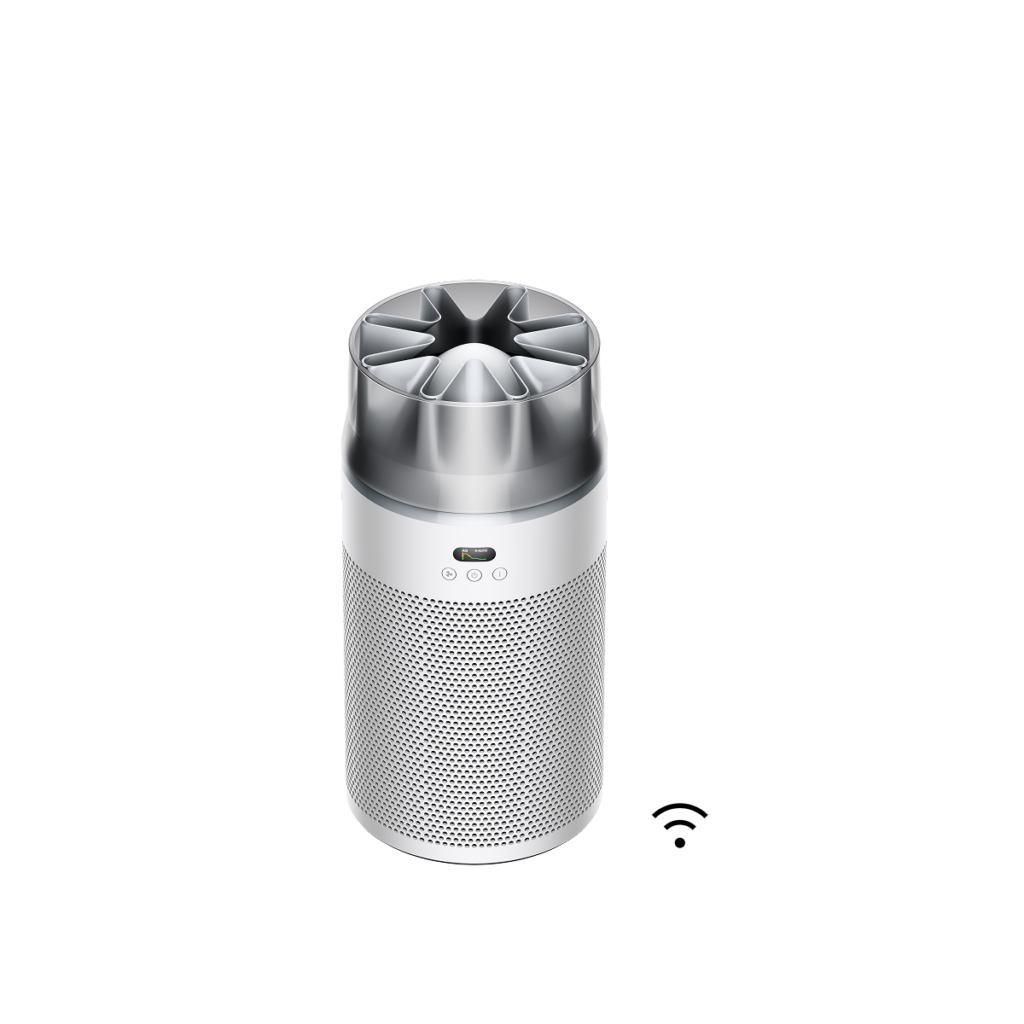
Dyson's full set of purifier controls, from a sensor-led auto mode to the MyDyson app, now comes in the smallest body the company has given a purifier. The HushJet is a cylinder, light enough to lift in one hand, and it is built for a bedroom more than a whole floor.
Its defining part is the nozzle. Dyson shaped it to push a narrow stream of air across the room without the turbulence that makes small purifiers loud, and the brand's quiet claim rests on that. A timer, a sleep mode and a filter replacement indicator sit alongside it, and an onboard sensor drives the automatic setting.
The filtration departs from Dyson habit. The main filter is electrostatic media that Dyson does not sell as HEPA, and it is rated to last several times longer than the company's usual filters. Odors go to a separate stage of activated carbon in pellet form. Owners change very little over the years, and the missing HEPA label is a plain fact of the design. Dyson also leaves gaps in its paperwork. The maker publishes no smoke CADR and no power figure, so the numbers any Levoit or Blueair buyer would check first are missing, and a comparison with published rivals rests on shape, features and filter life.
It suits a bedroom owner who wants Dyson's controls and finish in a smaller form, keeps one room clean and has no interest in reordering filters every year. There is no washable pre-filter, so hair and fluff go straight onto the long-life media, and a home with a shedding pet will want to watch how that filter holds up.
Category strengths
Where the Dyson HushJet beats the median
- A much higher filter life ?60 months vs 12 months (median)
- A lighter build ?3.13 kg vs 5.26 kg (median)
- A lower max noise level ?41 dB vs 52 dB (median)
Where the Dyson HushJet trails the median
- No washable pre-filter ?
- A slightly higher min noise level ?24 dB vs 23 dB (median)
How this VS Score was computed
Score 65: each known spec is measured against the median of all air purifiers (41 products), then weighted; 50 means level with that median. In classes of six or more, a value beyond the class’s 10th–90th percentile range counts as that limit, so one extreme product cannot set the scale. 32% of the scoreable weight could be used; unknown values, features not applicable to this class and proxies (battery capacity where a rated life exists) add or remove nothing.
| Specification | This product | Cohort median | Score weight | Points moved |
|---|---|---|---|---|
| Filter life | 60 | 12 | 1 | +50.0 |
| App control | Yes | 70% of the class have it | 0.5 | +25.0 |
| Washable pre-filter | No | 54% of the class have it | 0.5 | −24.0 |
| Voice assistant | Yes | 64% of the class have it | 0.3 | +15.0 |
| Weight | 3.13 | 5.26 | 0.3 | +10.2 |
| Max noise level | 41 — capped at the class’s lower range (44) | 52 | 0.5 | +4.5 |
| Min noise level | 24 | 23 | 1.5 | −3.0 |
| Filtration stages | 2 — capped at the class’s lower range (3) | 3 | 0.5 | +0.0 |
Not scored: CADR (smoke) (unknown: not scored); Coverage area (unknown: not scored); Air changes per hour (unknown: not scored); True HEPA filter (unknown: not scored); Activated carbon filter (standard for the class (100% have it)); Power consumption (unknown: not scored); Sleep mode (standard for the class (95% have it)); Air quality sensor (standard for the class (93% have it)); Auto mode (standard for the class (90% have it)); Filter replacement indicator (standard for the class (97% have it)); Timer (standard for the class (88% have it)).
Editor’s note
The HushJet is Dyson deciding, after a decade of towers, that a purifier can be a quiet cylinder. It is the company's smallest and least Dyson-looking purifier (18.5 inches tall, under seven pounds), and its engineering pitch is a nozzle that projects a focused stream of air without the turbulence that makes small purifiers noisy. Dyson calls it its most powerful small-format purifier, and the whole product is aimed at one room: the bedroom.
Two design choices matter more than the shape. First, the filter: an electrostatic media rated for five years of use, roughly five times the life of Dyson's usual filters, plus a separate carbon layer for odors. That transforms the ownership cost story that has always dogged this brand. Second, Dyson does not sell it as a HEPA machine, which is worth knowing before you buy. It rates the electrostatic media at 99.97% capture of particles down to 0.3 microns under IEST-RP-CC001.7, the test practice used for HEPA filters, but gives the media no HEPA class.
The standard Dyson toolkit is intact: onboard sensors driving an auto mode, an LCD, sleep mode and timer, MyDyson app control, ten airflow speeds and 90-degree oscillation.
What Dyson does not publish is the frustrating part. Dyson gives a noise range, from 24 dB in sleep mode to 41 dB at maximum, and a room size, but no CADR and no wattage, and at this price the missing airflow figure asks for a lot of trust. Dyson rates it for rooms up to 203 square feet.
For a small, quiet bedroom purifier with five-year filter economics and Dyson polish, this is a likeable machine. Anyone comparing spec sheets against a Levoit or Blueair at well under half the price will notice the money buys design, not documented numbers.
Specifications
Quality bars show where each figure sits between the lowest and highest of the 41 air purifiers this VS Score is measured against.
Performance
Filtration
Noise & power
Design
Smart features
Sources and verification
Where the specifications come from
- Official product pagedyson.com
- Independent testingrtings.com
Verification
- First published
- Specifications last checked
- Sheet completeness
- 16 of 22 specifications verified; the rest show as Unknown and are never estimated or scored
- Page type
- Product specification page — Compiled from the manufacturer’s published specifications and the cited sources; this is not a hands-on test.
- Basis
- Research-based: specifications and editorial text were compiled from the documents listed here and the manufacturer’s published data. We have not tested this unit ourselves; where independent measurements are mentioned they belong to the linked publication.
Air Purifiers with similar specs to the Dyson HushJet
Ratings & reviews
No reviews yet. Be the first to share your experience.
The bottom line
The Dyson HushJet earns a VS Score of 65 on the 32% of specifications we could compare like for like — an indication, not a ranking.
- Who it’s for
- Bedrooms where quiet and looks both matter, and owners tired of filter subscriptions: the electrostatic filter runs five years between changes.
- Who should look elsewhere
- Spec-sheet shoppers: Dyson publishes no CADR and no wattage, and it does not give the electrostatic media a HEPA class.
- The trade-off that matters
- Dyson polish and five-year filter economics at triple the price of small-room rivals whose numbers are published.
- The main alternative
- Blueair Blue Pure 511i Max covers the same bedroom brief for far less, with published figures and a 19 dB low.
The VS Score is calculated from the weighted specifications above, each measured against the median of comparable air purifiers — a shortlisting guide, not a substitute for your own priorities. See how we score.