Blueair Blue Pure 211i Max: Specs, Price, Pros & Cons
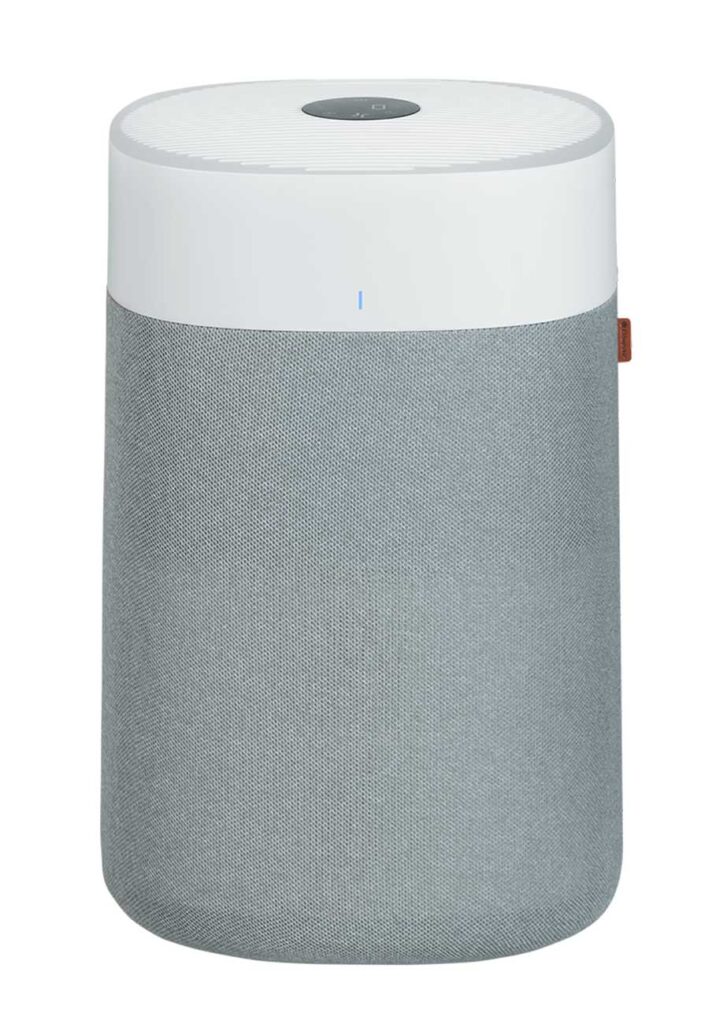
Blueair's Blue Pure machines are the ones that do not look like appliances: a soft-cornered box wrapped in a washable fabric pre-filter sold in several colors, sitting on the floor like a piece of furniture rather than hiding behind one. The 211i Max is the largest of them, and the i in the name is the part worth noticing, because it marks the connected, sensor-equipped generation. The older dial-operated Blue Pure units are still circulating on shelves.
Two things define it. The first is intent: this is the model built for a whole open-plan floor, and everything else about it, including its considerable bulk, follows from that decision. The second is Blueair's filtration approach, which is not the conventional mechanical arrangement the rest of the category uses, and which is worth understanding before you buy because it changes what the word on the box means.
In daily life the useful parts are that fabric pre-filter and the automation. The pre-filter washes instead of being replaced, catching hair and lint before they ever reach the expensive cartridge, and it is the main reason the cartridge lasts as long as it does. The sensing is the best in the Blue Pure range and drives an auto mode you can reasonably leave in charge.
The costs are real and recurring. This is a large machine with a correspondingly large appetite for consumables, and its cartridge schedule is measured in months rather than years, so the purchase price is only part of the arithmetic.
It makes sense for a big, open, frequently occupied space where a purifier has to be looked at as well as listened to.
Category strengths
Where the Blueair Blue Pure 211i Max beats the median
- A much higher CADR (smoke) ?435 CFM vs 161 CFM (median)
- A much higher coverage area ?674 sq ft vs 354 sq ft (median)
- More filtration stages ?4 vs 3 (median)
Where the Blueair Blue Pure 211i Max trails the median
- No true HEPA filter ?
- A lower filter life ?9 months vs 12 months (median)
- A heavier build ?7.35 kg vs 5.26 kg (median)
- A slightly higher power consumption ?46 W vs 45 W (median)
- A slightly higher max noise level ?53 dB vs 52 dB (median)
How this VS Score was computed
Score 62: each known spec is measured against the median of all air purifiers (41 products), then weighted; 50 means level with that median. In classes of six or more, a value beyond the class’s 10th–90th percentile range counts as that limit, so one extreme product cannot set the scale. 77% of the scoreable weight could be used; unknown values, features not applicable to this class and proxies (battery capacity where a rated life exists) add or remove nothing.
| Specification | This product | Cohort median | Score weight | Points moved |
|---|---|---|---|---|
| CADR (smoke) | 435 — capped at the class’s upper range (355) | 161 | 2 | +100.0 |
| True HEPA filter | No | 61% of the class have it | 1.5 | −72.0 |
| Coverage area | 674 — capped at the class’s upper range (550) | 354 | 2 | +56.0 |
| Washable pre-filter | Yes | 54% of the class have it | 0.5 | +25.0 |
| App control | Yes | 70% of the class have it | 0.5 | +25.0 |
| Voice assistant | Yes | 64% of the class have it | 0.3 | +15.0 |
| Filter life | 9 | 12 | 1 | −12.0 |
| Filtration stages | 4 | 3 | 0.5 | +8.5 |
| Weight | 7.35 | 5.26 | 0.3 | −4.2 |
| Max noise level | 53 | 52 | 0.5 | −0.5 |
| Power consumption | 46 | 45 | 0.5 | −0.5 |
| Air changes per hour | 4.8 | 4.8 | 1 | +0.0 |
| Min noise level | 23 | 23 | 1.5 | +0.0 |
Not scored: Activated carbon filter (standard for the class (100% have it)); Sleep mode (standard for the class (95% have it)); Air quality sensor (standard for the class (93% have it)); Auto mode (standard for the class (90% have it)); Filter replacement indicator (standard for the class (97% have it)); Timer (standard for the class (88% have it)).
Editor’s note
The 211i Max is Blueair's strongest Blue Pure, and it is built for exactly one problem: a big, open space that smaller purifiers only pretend to cover. Its honest capacity figure (Blueair's own AHAM-basis number, and it matches the 435 smoke CADR arithmetic precisely) is 674 square feet at nearly five air changes an hour. The '3,000 sq ft' in the marketing is a one-air-change-per-hour stretch. Ignore it: the real figure is still more than almost anything else in this price bracket delivers.
What makes it liveable at that output is the noise curve. 23 dB on low is bedroom-quiet from a machine nearly two feet tall, and 53 dB flat out is moderate for the airflow involved. The sensor package is Blueair's best (PM1, PM2.5 and PM10, where most of the range reads PM2.5 only), feeding a proper auto mode, and this model does support Alexa and Google Home, which its smaller sibling does not advertise.
The trade-offs are characteristically Blueair. HEPASilent is electrostatic-plus-mechanical filtration, effective but not a certified True HEPA class, which matters to some buyers on principle. Consumables are big-machine priced, from the standard nine-month filter up to the specialized SmokeBlock and AllergenBlock variants, plus a washable fabric pre-filter. And it is a large object (22.7 inches tall and over 16 pounds) that needs floor space to breathe.
At its list price it competes with Coway's Airmega 400S and Levoit's Core 600S. The Levoit moves comparable air for less money, and the Blueair answer is quieter operation, the three-size particle sensor and considerably better looks. For an open-plan living space that the family sits in, those are the right priorities.
Specifications
Quality bars show where each figure sits between the lowest and highest of the 41 air purifiers this VS Score is measured against.
Performance
Filtration
Noise & power
Design
Smart features
Sources and verification
Where the specifications come from
- Official product pageblueair.com
- Independent testingrtings.com
Verification
- First published
- Specifications last checked
- Sheet completeness
- 21 of 22 specifications verified; the rest show as Unknown and are never estimated or scored
- Page type
- Product specification page — Compiled from the manufacturer’s published specifications and the cited sources; this is not a hands-on test.
- Basis
- Research-based: specifications and editorial text were compiled from the documents listed here and the manufacturer’s published data. We have not tested this unit ourselves; where independent measurements are mentioned they belong to the linked publication.
Where to buy
Prices and availability may change. Check the retailer before buying. We may earn a commission on purchases.
Price history
Air Purifiers with similar specs to the Blueair Blue Pure 211i Max
Ratings & reviews
No reviews yet. Be the first to share your experience.
The bottom line
The Blueair Blue Pure 211i Max earns a VS Score of 62, above the median of the 41 air purifiers it is measured against (a score of 50 is level with that median).
- Who it’s for
- Open-plan living rooms and studios, where the sensing is the best in the Blue Pure range and the low-speed noise stays civilised enough to leave running overnight.
- Who should look elsewhere
- Small rooms (this is a great deal of physical machine for a bedroom) and buyers who specifically want a certified True HEPA class, which HEPASilent is not by design.
- The trade-off that matters
- Big-space performance that stays pleasant to live with, funded by filter cycles that cost more per year than some rivals charge for their entire hardware.
- The main alternative
- Levoit Core 600S moves comparable air for noticeably less money. The Blueair's case is noise, sensors and looks.
The VS Score is calculated from the weighted specifications above, each measured against the median of comparable air purifiers — a shortlisting guide, not a substitute for your own priorities. See how we score.