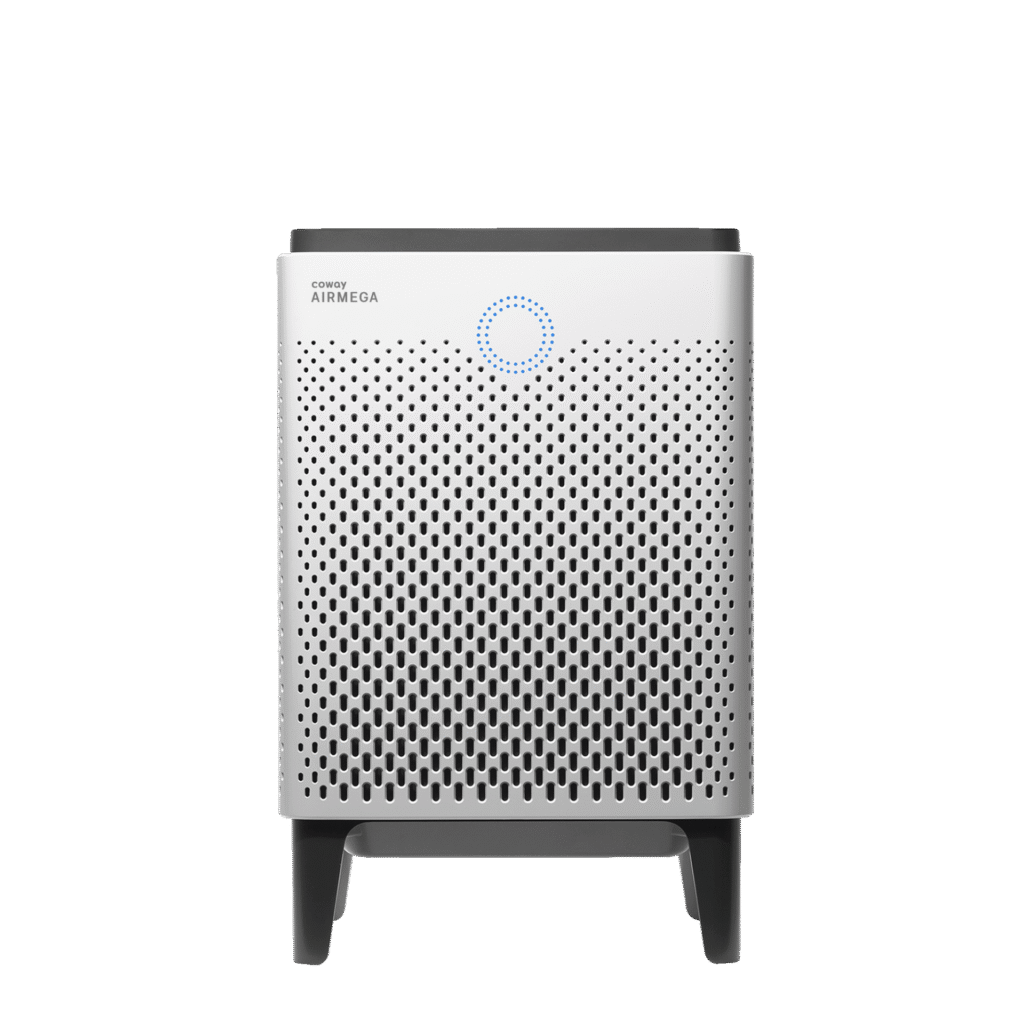
Coway Airmega 400: Specs, Price, Pros & Cons
Measured the strict way, the Airmega 400 is rated for 508 sq ft, the area it clears at the demanding pace of 4.8 air changes an hour, and that is still one of the biggest rooms in the category. Coway's own box quotes a much larger area at a gentler rate. Both describe the same machine, and the smaller figure is the one to plan a lounge around.
It is the big purifier in Coway's Airmega line, above the 200M, and it comes in two versions. This is the plain 400. The 400S is the connected one, with Wi-Fi, the app and voice control, and it costs more.
The design aims at being left alone for months. A washable pre-filter traps hair and dust, and behind it a single Max2 combination filter pairs activated carbon with True HEPA media, so there is one part to reorder each year. A particle sensor feeds the auto mode and a colored ring on top, and a sleep mode lets it run through the night without lighting up the room. The timer works from fixed presets, which is enough for a machine that mostly runs on auto, and an owner who dislikes fiddling can leave it there for the season.
Its size is the cost of that reach. It stands tall, weighs about twice as much as a typical small purifier and needs floor space of its own, so it suits an open-plan ground floor, a loft conversion or a through-lounge far better than a bedroom. Buyers with ordinary rooms have smaller Coways to choose from. This one is for the house where every other purifier on the shortlist was rated for a room half the size of the one it would stand in.
Category strengths
Where the Coway Airmega 400 beats the median
- A much higher CADR (smoke) ?328 CFM vs 161 CFM (median)
- A higher coverage area ?508 sq ft vs 354 sq ft (median)
- A slightly lower min noise level ?22 dB vs 23 dB (median)
Where the Coway Airmega 400 trails the median
- No app control ?
- A much heavier build ?11.2 kg vs 5.26 kg (median)
- No voice assistant ?
- A much higher power consumption ?66 W vs 45 W (median)
How this VS Score was computed
Score 66: each known spec is measured against the median of all air purifiers (41 products), then weighted; 50 means level with that median. In classes of six or more, a value beyond the class’s 10th–90th percentile range counts as that limit, so one extreme product cannot set the scale. 77% of the scoreable weight could be used; unknown values, features not applicable to this class and proxies (battery capacity where a rated life exists) add or remove nothing.
| Specification | This product | Cohort median | Score weight | Points moved |
|---|---|---|---|---|
| CADR (smoke) | 328 | 161 | 2 | +100.0 |
| True HEPA filter | Yes | 61% of the class have it | 1.5 | +75.0 |
| Coverage area | 508 | 354 | 2 | +44.0 |
| Washable pre-filter | Yes | 54% of the class have it | 0.5 | +25.0 |
| App control | No | 70% of the class have it | 0.5 | −24.0 |
| Voice assistant | No | 64% of the class have it | 0.3 | −14.4 |
| Power consumption | 66 | 45 | 0.5 | −8.0 |
| Weight | 11.2 — capped at the class’s upper range (7.8) | 5.26 | 0.3 | −4.8 |
| Min noise level | 22 | 23 | 1.5 | +3.0 |
| Air changes per hour | 4.8 | 4.8 | 1 | +0.0 |
| Filtration stages | 3 | 3 | 0.5 | +0.0 |
| Filter life | 12 | 12 | 1 | +0.0 |
| Max noise level | 52 | 52 | 0.5 | +0.0 |
Not scored: Activated carbon filter (standard for the class (100% have it)); Sleep mode (standard for the class (95% have it)); Air quality sensor (standard for the class (93% have it)); Auto mode (standard for the class (90% have it)); Filter replacement indicator (standard for the class (97% have it)); Timer (standard for the class (88% have it)).
Editor’s note
The Airmega 400 is Coway answering one specific brief: clean a large space properly. Its coverage claim of 1,560 sq ft is quoted at two air changes per hour, a real cleaning rate, where most rivals inflate their numbers by quoting a single air change. Back it with a 328 CFM smoke CADR and you have one of the few consumer purifiers sized for an open-plan living area.
The design brief is set-and-forget. A washable pre-filter catches the big stuff, the Max2 combo filter (activated carbon plus Coway's Green True HEPA media) is a single annual replacement, and the auto mode leans on a real-time particle sensor with a color ring that tells you at a glance what your air is doing. The floor noise of 22 dB is remarkably quiet for a unit this size, and peak power draw is a modest 66 watts.
Know what you're not getting. This is the non-smart 400: no Wi-Fi, no app, no voice control. Coway reserves those for the 400S, about a hundred dollars more at list. The timer is fixed presets (1, 4, 8 hours). And it's a presence in the room: over 11 kilograms and nearly 58 cm tall, with an annual filter set as a recurring cost.
One data note: Coway's current spec sheet says 328/328/400 CADR while older listings still circulate 350/340/350. We've used the official current figures.
At its frequent street price I'd call it the default answer for big-room purification. If your rooms are normal-sized, the Coway Airmega 200M does the same philosophy for a third of the money. The 400S exists for anyone who insists on app control, but paying more for Wi-Fi on a machine whose whole point is autonomy feels backwards to me.
Specifications
Quality bars show where each figure sits between the lowest and highest of the 41 air purifiers this VS Score is measured against.
Performance
Filtration
Noise & power
Design
Smart features
Sources and verification
Where the specifications come from
- Official product pagecowaymega.com
- Independent testingrtings.com
Verification
- First published
- Specifications last checked
- Sheet completeness
- 22 of 22 specifications verified; the rest show as Unknown and are never estimated or scored
- Page type
- Product specification page — Compiled from the manufacturer’s published specifications and the cited sources; this is not a hands-on test.
- Basis
- Research-based: specifications and editorial text were compiled from the documents listed here and the manufacturer’s published data. We have not tested this unit ourselves; where independent measurements are mentioned they belong to the linked publication.
Where to buy
Prices and availability may change. Check the retailer before buying. We may earn a commission on purchases.
Price history
Air Purifiers with similar specs to the Coway Airmega 400
Ratings & reviews
No reviews yet. Be the first to share your experience.
The bottom line
The Coway Airmega 400 earns a VS Score of 66, above the median of the 41 air purifiers it is measured against (a score of 50 is level with that median).
- Who it’s for
- Open-plan living areas and big rooms where most purifiers are undersized. Its coverage rating is quoted at two air changes per hour, and the single annual combo filter suits people who want zero fiddling.
- Who should look elsewhere
- Bedrooms and normal rooms (it's a lot of machine you don't need, and the 200M does those for a third of the price), and anyone who wants app or voice control, which Coway reserves for the pricier 400S.
- The trade-off that matters
- Coverage honesty versus footprint: you get rare, truthfully-rated large-room performance, but it arrives as a large, heavy appliance with a costly annual filter habit.
- The main alternative
- Coway Airmega 200M: if your largest room is under ~400 sq ft, it delivers the same set-and-forget philosophy and sensor-driven auto mode at a fraction of the cost.
The VS Score is calculated from the weighted specifications above, each measured against the median of comparable air purifiers — a shortlisting guide, not a substitute for your own priorities. See how we score.