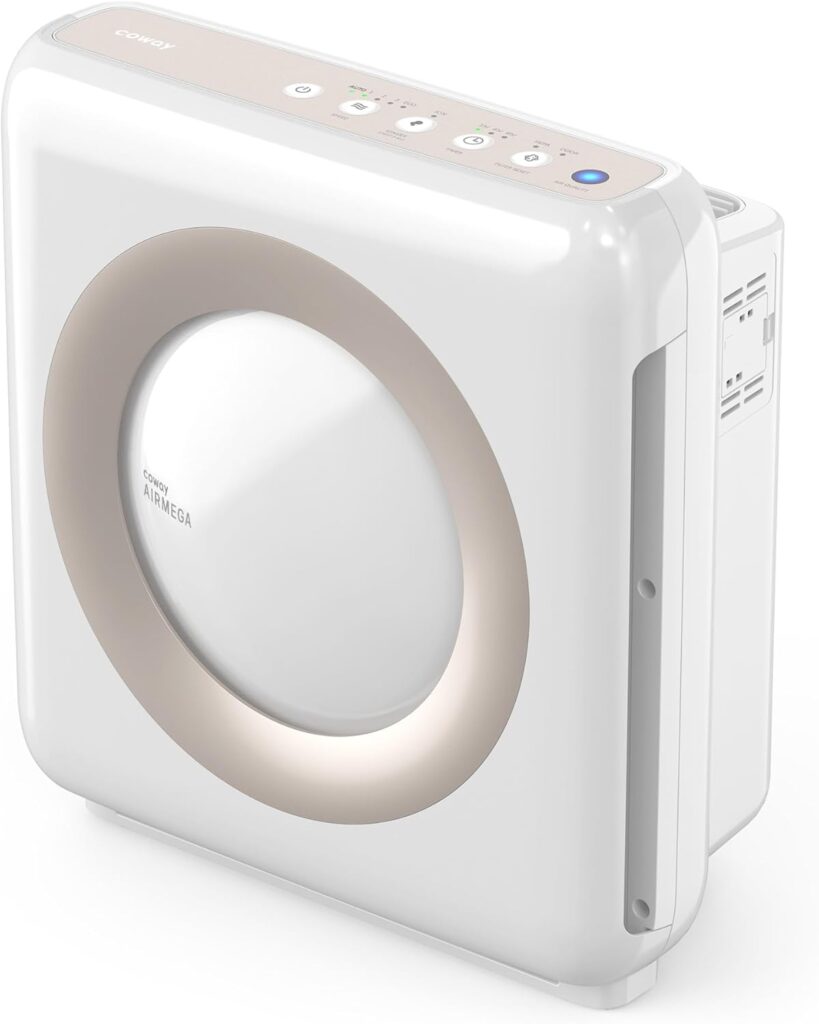
Coway Airmega Mighty AP-1512HH: Specs, Features, Pros & Cons
The AP-1512HH was on sale before Coway had an Airmega range at all. When the brand arrived, the company moved this bestseller into it and kept the old model number, which is why the same purifier turns up under two names and in roundups going back a decade.
Long service tells you the design works, and it also tells you the choices inside were made years ago. The squat body holds four filtration stages, among them a washable pre-filter, a carbon layer for smells and a True HEPA element. A particle sensor drives the auto mode and a colored air quality ring, and there is a sleep setting for the night. The quietest speed measures 24 dB and the loudest tops out at 53 dB.
The eco mode surprises new owners. Once the room has stayed clean for a while, the fan stops completely, and a silent, motionless purifier looks like a broken one. It is working as designed, and it restarts on its own when the sensor picks up dust again.
Two parts of the design show their age. The purifier is entirely offline, with no app, no scheduling and no history of readings, and its motor uses far more electricity at full speed than newer rivals of the same size. The first suits anyone who wants no app at all. The second shows up on the power bill of a machine meant to run all year. Its rated area makes it a match for a medium living room or a large bedroom but not an open-plan floor, and the owner it fits wants a self-contained appliance with nothing to configure and no account to keep alive.
Category strengths
Where the Coway Airmega Mighty AP-1512HH beats the median
- A higher CADR (smoke) ?233 CFM vs 161 CFM (median)
- More filtration stages ?4 vs 3 (median)
- A slightly higher coverage area ?361 sq ft vs 354 sq ft (median)
Where the Coway Airmega Mighty AP-1512HH trails the median
- No app control ?
- A much higher power consumption ?77 W vs 45 W (median)
- No voice assistant ?
- A slightly higher min noise level ?24 dB vs 23 dB (median)
- A slightly heavier build ?5.6 kg vs 5.26 kg (median)
- A slightly higher max noise level ?53 dB vs 52 dB (median)
How this VS Score was computed
Score 58: each known spec is measured against the median of all air purifiers (41 products), then weighted; 50 means level with that median. In classes of six or more, a value beyond the class’s 10th–90th percentile range counts as that limit, so one extreme product cannot set the scale. 77% of the scoreable weight could be used; unknown values, features not applicable to this class and proxies (battery capacity where a rated life exists) add or remove nothing.
| Specification | This product | Cohort median | Score weight | Points moved |
|---|---|---|---|---|
| True HEPA filter | Yes | 61% of the class have it | 1.5 | +75.0 |
| CADR (smoke) | 233 | 161 | 2 | +44.0 |
| Washable pre-filter | Yes | 54% of the class have it | 0.5 | +25.0 |
| App control | No | 70% of the class have it | 0.5 | −24.0 |
| Voice assistant | No | 64% of the class have it | 0.3 | −14.4 |
| Power consumption | 77 | 45 | 0.5 | −10.5 |
| Filtration stages | 4 | 3 | 0.5 | +8.5 |
| Min noise level | 24 | 23 | 1.5 | −3.0 |
| Coverage area | 361 | 354 | 2 | +2.0 |
| Weight | 5.6 | 5.26 | 0.3 | −0.9 |
| Max noise level | 53 | 52 | 0.5 | −0.5 |
| Air changes per hour | 4.8 | 4.8 | 1 | +0.0 |
| Filter life | 12 | 12 | 1 | +0.0 |
Not scored: Activated carbon filter (standard for the class (100% have it)); Sleep mode (standard for the class (95% have it)); Air quality sensor (standard for the class (93% have it)); Auto mode (standard for the class (90% have it)); Filter replacement indicator (standard for the class (97% have it)); Timer (standard for the class (88% have it)).
Editor’s note
The Airmega Mighty has been a default recommendation in this category for years, and most of the reasons still hold. It publishes a proper smoke CADR of 233 CFM (explicitly labeled as smoke, which is rarer than it ought to be), covering 361 square feet on the AHAM measure. There are four filtration stages, a washable pre-filter, a real sensor with a color air-quality ring, an Auto mode and an Eco mode that stops the fan entirely once the air has been clean for a while.
The number that has aged badly is power. It draws 77 watts at maximum, the highest here by a wide margin, and it is worth setting that beside the Levoit Core 600S, which draws 49 watts while delivering considerably more clean air. On a machine designed to run continuously that gap is real money across a few years, and it is the strongest argument against buying the Mighty today.
It is also entirely offline. No Wi-Fi, no app, no voice control. For some buyers that is a feature, because there is no account, nothing to update, and nothing that stops working when a company retires a service. For others it means no scheduling and no air-quality history to look back on.
Filter costs are moderate. Coway rates the HEPA element for a year, while the deodorizing carbon layer wants replacing at around six months, and the pre-filter is washable so it costs nothing at all.
I would still put this in a medium-sized living room without hesitating, particularly at the discounts it frequently sees. What I would not do is pay full list price while a more efficient machine covering a bigger area sits next to it on the shelf.
Specifications
Quality bars show where each figure sits between the lowest and highest of the 41 air purifiers this VS Score is measured against.
Performance
Filtration
Noise & power
Design
Smart features
Sources and verification
Where the specifications come from
- Official product pagecowaymega.com
- Independent testingrtings.com
Verification
- First published
- Specifications last checked
- Sheet completeness
- 21 of 22 specifications verified; the rest show as Unknown and are never estimated or scored
- Page type
- Product specification page — Compiled from the manufacturer’s published specifications and the cited sources; this is not a hands-on test.
- Basis
- Research-based: specifications and editorial text were compiled from the documents listed here and the manufacturer’s published data. We have not tested this unit ourselves; where independent measurements are mentioned they belong to the linked publication.
Air Purifiers with similar specs to the Coway Airmega Mighty AP-1512HH
Ratings & reviews
No reviews yet. Be the first to share your experience.
The bottom line
The Coway Airmega Mighty AP-1512HH earns a VS Score of 58, above the median of the 41 air purifiers it is measured against (a score of 50 is level with that median).
- Who it’s for
- Medium living rooms, and buyers who actively want an offline appliance with no account, no app and nothing that stops working when a service is retired.
- Who should look elsewhere
- Anyone running a purifier around the clock who cares about electricity, and anyone wanting scheduling or air-quality history, which need an app this model lacks.
- The trade-off that matters
- A proven, well-documented, entirely self-contained purifier that is also the least efficient here, which costs money over years of continuous running.
- The main alternative
- Levoit Core 600S-P covers a much larger area on 49 watts and adds app control, which makes it the stronger buy if the unit will run continuously.
The VS Score is calculated from the weighted specifications above, each measured against the median of comparable air purifiers — a shortlisting guide, not a substitute for your own priorities. See how we score.