Epson EcoTank ET-2400: Specs, Price, Pros & Cons
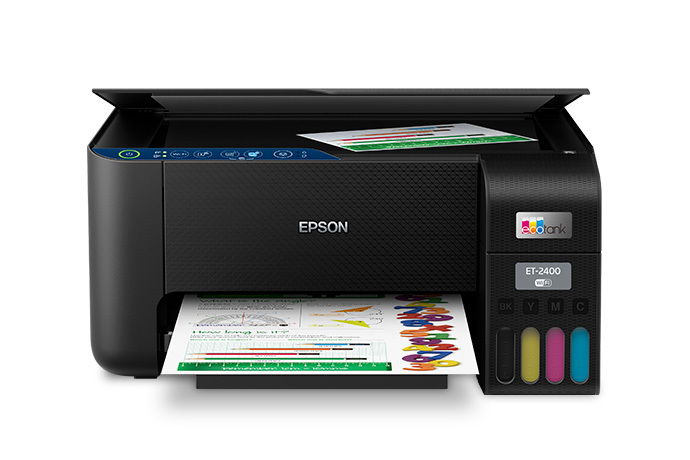
Epson's ET-2400 is the smallest step a household can take away from ink cartridges. Ink arrives in bottles, goes into tanks built into the printer's body, and refilling turns into an occasional job instead of a regular purchase. It sits at the bottom of the EcoTank line, below models that add a document feeder, automatic two-sided printing, fax and a wired network port, and it is the cheapest way into the range.
Under the tanks is a plain flatbed all-in-one. It prints, copies and scans, joins the home network over Wi-Fi, and takes paper from an open feed at the back. Controls are buttons beside a small status readout, with no touchscreen. Photos print borderless at snapshot size, and the spec sheet gives a maximum print resolution of 5,760 dpi. Phones send jobs through Epson's own app, so setting it up for a family means installing that app on each phone that will print.
The printer suits a home that prints often enough for cartridge prices to sting and seldom enough that speed never becomes a complaint: a few sheets for school, a boarding pass, a return label for a parcel. It is a light printer, easy to lift from a desk to a shelf when the room is needed for something else.
What Epson took out saves labor. A ten-page document is scanned one sheet at a time on the glass, and printing on both sides means turning the stack over by hand halfway through the job. Black pages also come out slowly, so a long document is a job to start and leave. None of that costs ink, only minutes.
Category strengths
Where the Epson EcoTank ET-2400 beats the median
- Has supertank / refillable ink ?
- A much lighter build ?3.9 kg vs 7.98 kg (median)
- A higher print resolution ?5,760 dpi vs 4,800 dpi (median)
Where the Epson EcoTank ET-2400 trails the median
- No automatic duplex printing ?
- No automatic document feeder ?
- A lower print speed (black) ?10 ppm vs 16 ppm (median)
- No ethernet ?
- A lower print speed (color) ?5 ppm vs 9 ppm (median)
- A lower input tray capacity ?100 sheets vs 150 sheets (median)
- A much lower monthly duty cycle ?3,000 pages vs 10,000 pages (median)
- A much lower output tray capacity ?30 sheets vs 67.5 sheets (median)
How this VS Score was computed
Score 26: each known spec is measured against the median of all printers (65 products), then weighted; 50 means level with that median. In classes of six or more, a value beyond the class’s 10th–90th percentile range counts as that limit, so one extreme product cannot set the scale. 63% of the scoreable weight could be used; unknown values, features not applicable to this class and proxies (battery capacity where a rated life exists) add or remove nothing.
| Specification | This product | Cohort median | Score weight | Points moved |
|---|---|---|---|---|
| Automatic duplex printing | No | 73% of the class have it | 1 | −48.0 |
| Automatic document feeder | No | 55% of the class have it | 1 | −48.0 |
| Print speed (black) | 10 | 16 | 2 | −38.0 |
| Supertank / refillable ink | Yes | 30% of the class have it | 0.5 | +25.0 |
| Duplex scanning | No | 23% of the class have it | 0.5 | −24.0 |
| Ethernet | No | 54% of the class have it | 0.5 | −24.0 |
| Touchscreen display | No | 45% of the class have it | 0.5 | −24.0 |
| Print speed (color) | 5 | 9 | 1 | −22.0 |
| Input tray capacity | 100 | 150 | 1 | −17.0 |
| Weight | 3.9 — capped at the class’s lower range (4) | 7.98 | 0.3 | +15.0 |
| Monthly duty cycle | 3,000 | 10,000 | 0.3 | −10.5 |
| Fax | No | 35% of the class have it | 0.2 | −9.6 |
| Output tray capacity | 30 | 67.5 | 0.3 | −8.4 |
| Print resolution | 5,760 | 4,800 | 0.5 | +5.0 |
Not scored: Color printing (standard for the class (88% have it)); All-in-one (standard for the class (85% have it)); ADF capacity (unknown: not scored); Wi-Fi (standard for the class (97% have it)); Wi-Fi Direct (standard for the class (90% have it)); USB (standard for the class (100% have it)); Apple AirPrint (unknown: not scored); Mobile app printing (standard for the class (100% have it)).
Editor’s note
The EcoTank ET-2400 is the cheapest ticket into Epson's refillable-tank world, and the value proposition is disarmingly simple: the box includes enough ink for roughly two years of typical home printing, and a full replacement bottle set, about the price of one round of cartridges, yields 4,500 black and 7,500 color pages. If your household prints steadily, the machine effectively pays for its own premium over a cartridge printer within the first year, then keeps saving.
What Epson removed to hit the price is just as clear. There's no document feeder, no fax, no Ethernet and no automatic duplex, which is the one that surprises people: two-sided printing is a manual flip. Speeds are modest at 10 pages a minute black and 5 color, borderless photos stop at 4×6, and mobile printing runs through Epson's Smart Panel app rather than AirPrint, which the spec sheet pointedly does not list. The rear 100-sheet feed sits exposed rather than in a cassette, and the control panel is buttons with a tiny status readout, not a touchscreen.
None of that undermines the core case. This is a flatbed print/copy/scan unit for a family that prints homework, recipes and forms, and its running costs embarrass every cartridge machine at twice the price. Know which household you are: if you scan stacks of documents, want hands-off duplex, or need fax, the step-up EcoTank models exist precisely for you.
At its common price the honest comparison is Canon's MegaTank G3270: similar formula, similar compromises. Between them I'd shop on price that week. Against any cartridge printer under a hundred dollars, the ET-2400 wins the moment you count a year of ink.
Specifications
Quality bars show where each figure sits between the lowest and highest of the 65 printers this VS Score is measured against.
Printing
Scanning & copying
Paper handling
Connectivity
Design
Sources and verification
Where the specifications come from
- Official product pageepson.com
- Independent testingrtings.com
Verification
- First published
- Specifications last checked
- Sheet completeness
- 22 of 24 specifications verified; the rest show as Unknown and are never estimated or scored
- Page type
- Product specification page — Compiled from the manufacturer’s published specifications and the cited sources; this is not a hands-on test.
- Basis
- Research-based: specifications and editorial text were compiled from the documents listed here and the manufacturer’s published data. We have not tested this unit ourselves; where independent measurements are mentioned they belong to the linked publication.
Where to buy
Prices and availability may change. Check the retailer before buying. We may earn a commission on purchases.
Price history
Printers with similar specs to the Epson EcoTank ET-2400
Ratings & reviews
No reviews yet. Be the first to share your experience.
The bottom line
The Epson EcoTank ET-2400 earns a VS Score of 26, below the median of the 65 printers it is measured against (a score of 50 is level with that median).
- Who it’s for
- Steady-printing families who want the cartridge treadmill gone: two years of ink in the box and bottle refills at pennies per page make it the cheapest sane entry into tank printing.
- Who should look elsewhere
- Anyone who scans stacks (no ADF), prints two-sided daily (duplex is a manual flip), or needs fax, Ethernet or AirPrint. The step-up EcoTanks exist for exactly those people.
- The trade-off that matters
- You pre-pay your ink savings as hardware: triple the price of a basic cartridge printer up front, in exchange for running costs that repay it within about a year of regular use.
- The main alternative
- Canon MegaTank PIXMA G3270: the same entry-tank formula with the same compromises. Buy whichever is cheaper the week you shop.
The VS Score is calculated from the weighted specifications above, each measured against the median of comparable printers — a shortlisting guide, not a substitute for your own priorities. See how we score.