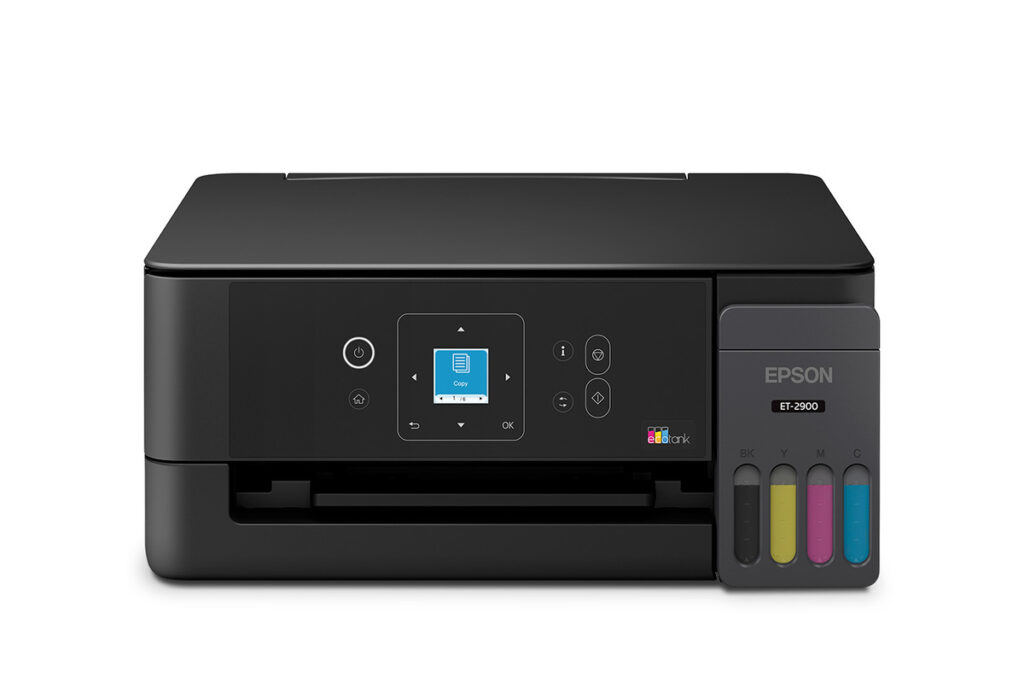
Epson EcoTank ET-2900: Specs, Price, Pros & Cons
The largest number on this product's spec sheet is its print resolution, and it is close to the least useful thing you could know about it. Inkjet resolution figures describe how finely a head can place droplets, not how a finished page looks, and every maker quotes them on a different basis. Treat it as a figure Epson publishes because the category expects one.
What separates this machine from the cartridge printers sold beside it is the refill interval. A cartridge printer asks you to buy consumables on its schedule. A tank printer asks you to top up bottles on yours, and the gap between those two events runs to months. That single design decision reorganizes the whole ownership experience, and it is the only real reason to consider this model over something cheaper on the shelf.
Where it sits in Epson's range matters more than usual, because the EcoTank ladder is defined by subtraction. Every rung above this one shares the same ink system and the same bottles. What you buy as you climb is hardware convenience: a closed paper cassette instead of an exposed rear stack, two-sided printing that happens without you, a scanner that swallows a stack instead of one sheet at a time. The ink economics do not improve as you go up. The handling does.
The tank system is worth having. What remains is whether the trimmed hardware at the bottom of the ladder matches how you print. Someone who prints a few pages at a time and scans a page at a time will never notice what is absent. Someone feeding it school work, contracts or anything double-sided will notice inside a week, and for them the decision belongs one or two models further up the range.
Category strengths
Where the Epson EcoTank ET-2900 beats the median
- Has supertank / refillable ink ?
- A much lighter build ?4.2 kg vs 7.98 kg (median)
- A higher print resolution ?5,760 dpi vs 4,800 dpi (median)
Where the Epson EcoTank ET-2900 trails the median
- No automatic duplex printing ?
- No automatic document feeder ?
- A lower print speed (black) ?11 ppm vs 16 ppm (median)
- No ethernet ?
- A lower print speed (color) ?6 ppm vs 9 ppm (median)
- A lower input tray capacity ?100 sheets vs 150 sheets (median)
- A much lower output tray capacity ?30 sheets vs 67.5 sheets (median)
- A much lower monthly duty cycle ?5,000 pages vs 10,000 pages (median)
How this VS Score was computed
Score 27: each known spec is measured against the median of all printers (65 products), then weighted; 50 means level with that median. In classes of six or more, a value beyond the class’s 10th–90th percentile range counts as that limit, so one extreme product cannot set the scale. 63% of the scoreable weight could be used; unknown values, features not applicable to this class and proxies (battery capacity where a rated life exists) add or remove nothing.
| Specification | This product | Cohort median | Score weight | Points moved |
|---|---|---|---|---|
| Automatic duplex printing | No | 73% of the class have it | 1 | −48.0 |
| Automatic document feeder | No | 55% of the class have it | 1 | −48.0 |
| Print speed (black) | 11 | 16 | 2 | −32.0 |
| Supertank / refillable ink | Yes | 30% of the class have it | 0.5 | +25.0 |
| Duplex scanning | No | 23% of the class have it | 0.5 | −24.0 |
| Ethernet | No | 54% of the class have it | 0.5 | −24.0 |
| Touchscreen display | No | 45% of the class have it | 0.5 | −24.0 |
| Print speed (color) | 6 | 9 | 1 | −17.0 |
| Input tray capacity | 100 | 150 | 1 | −17.0 |
| Weight | 4.2 | 7.98 | 0.3 | +13.5 |
| Fax | No | 35% of the class have it | 0.2 | −9.6 |
| Output tray capacity | 30 | 67.5 | 0.3 | −8.4 |
| Monthly duty cycle | 5,000 | 10,000 | 0.3 | −7.5 |
| Print resolution | 5,760 | 4,800 | 0.5 | +5.0 |
Not scored: Color printing (standard for the class (88% have it)); All-in-one (standard for the class (85% have it)); ADF capacity (unknown: not scored); Wi-Fi (standard for the class (97% have it)); Wi-Fi Direct (standard for the class (90% have it)); USB (standard for the class (100% have it)); Apple AirPrint (standard for the class (97% have it)); Mobile app printing (standard for the class (100% have it)).
Editor’s note
The ET-2900 is the cheapest way into Epson's EcoTank idea, and that idea is still the most persuasive argument in home printing. Instead of cartridges you get four bottles in the box, enough for roughly three years of light household use, and refills that cost a fraction of what an equivalent stack of cartridges would. If you are the sort of person who prints twenty pages one week and nothing for two months, this is the machine that stops you discovering a dried-out, empty cartridge every time you need something urgently. Epson's Heat-Free printhead is designed to last the life of the printer, which matters more on a tank machine than a cartridge one.
The ET-2900 is the bottom of the range, and Epson has trimmed accordingly. There is no automatic duplex, so two-sided printing means feeding the stack back in yourself. Without a document feeder, scanning or copying a ten-page contract is ten trips to the flatbed lid. There is no ethernet port and no fax, and the 1.44-inch screen is navigated with buttons. The wireless radio is Wi-Fi 4 only, which is fine for a printer's tiny data needs but does mean it will want a 2.4 GHz network available.
Speed is modest and honest: 11 ISO ppm black, 6 color. The four-bottle dye set is worth noting on its own. Most printers this cheap use a single tri-color cartridge, so one exhausted color scraps the whole unit. Here each color is refilled independently.
The design detail I would flag is the paper path. The 100-sheet capacity comes from an open vertical rear feed with no closed front cassette, so loaded paper sits exposed, which is worth thinking about if the printer is going to live somewhere dusty or in a room where things get knocked.
Buy it for low-volume home printing where ink cost is the thing that has been irritating you. Anything resembling office work wants a model further up the range.
Specifications
Quality bars show where each figure sits between the lowest and highest of the 65 printers this VS Score is measured against.
Printing
Scanning & copying
Paper handling
Connectivity
Design
Sources and verification
Where the specifications come from
- Official product pageepson.com
- Datasheet or manualcdn.bfldr.com
- Retailer listing (cross-check)amazon.com
Verification
- First published
- Specifications last checked
- Sheet completeness
- 23 of 24 specifications verified; the rest show as Unknown and are never estimated or scored
- Page type
- Product specification page — Compiled from the manufacturer’s published specifications and the cited sources; this is not a hands-on test.
- Basis
- Research-based: specifications and editorial text were compiled from the documents listed here and the manufacturer’s published data. We have not tested this unit ourselves; where independent measurements are mentioned they belong to the linked publication.
Where to buy
Prices and availability may change. Check the retailer before buying. We may earn a commission on purchases.
Price history
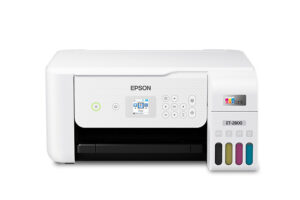
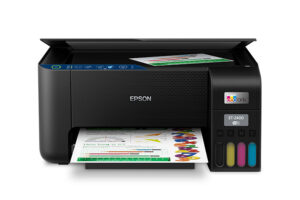
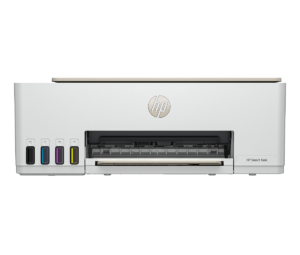
Printers with similar specs to the Epson EcoTank ET-2900
Ratings & reviews
No reviews yet. Be the first to share your experience.
The bottom line
The Epson EcoTank ET-2900 earns a VS Score of 27, below the median of the 65 printers it is measured against (a score of 50 is level with that median).
- Who it’s for
- Low-volume households that print in bursts and have been burned by cartridges drying out between jobs. The four separate dye bottles also make it a more sensible choice for occasional photo printing than a tri-color cartridge machine.
- Who should look elsewhere
- Anyone who routinely prints double-sided, scans or copies multi-page documents, needs a wired network connection, or prints often enough that an entry-level print speed would become a daily irritation.
- The trade-off that matters
- You get EcoTank's ink economics at the lowest price Epson charges for them, and give up the automatic duplex, document feeder and ethernet that the models one step up include.
- The main alternative
- The Epson EcoTank ET-2850 is the same ink system with automatic 2-sided printing added, which is the ET-2900's most obvious gap and worth the modest step up if you print reports or school work.
The VS Score is calculated from the weighted specifications above, each measured against the median of comparable printers — a shortlisting guide, not a substitute for your own priorities. See how we score.