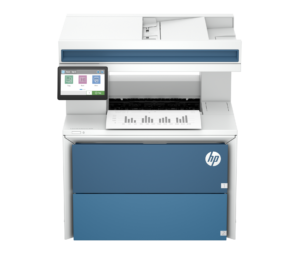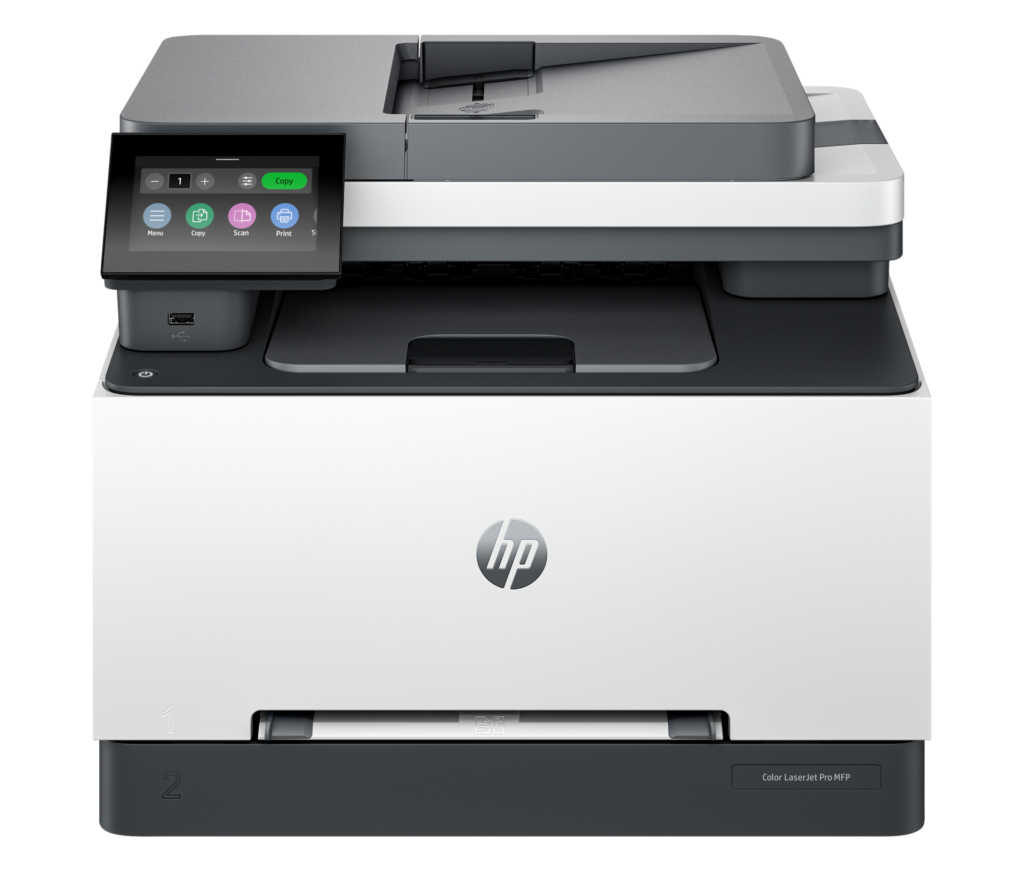
HP Color LaserJet Pro MFP 3301fdw: Specs, Pros & Cons
Color and black pages leave HP's Color LaserJet Pro MFP 3301fdw at the same rated speed, so an office printing charts and branded invoices never waits longer for color. That single engine, laser in all four colors, is what sets it apart from the inkjets that make up most of this category, and it means a mixed queue of color and black jobs runs at one pace.
It is a complete all-in-one in a body that still fits on a desk. A document feeder copies and scans stacks, pages print on both sides automatically, a fax modem is built in, and a touchscreen runs the menus. It connects over Ethernet, Wi-Fi and USB, and phones reach it through AirPrint and HP's own app, so a visitor with a laptop or phone can print from the office network.
It belongs with the heavier office machines. Its monthly duty rating runs to tens of thousands of pages and its main paper tray takes half a ream, so it expects a queue of people sending jobs to it, and a small team sharing one network printer is the buyer HP has in mind. It is heavy, too, which makes it a printer to set down once near the network socket and leave.
What it gives up is picture quality and freedom over supplies. Laser resolution is conventional, sharp for text and graphs and wrong for photographs, so anyone hoping to print holiday pictures between invoices should look at an inkjet. The bigger commitment is toner. HP designs the printer to run on its own cartridges, and that choice lasts as long as the printer does.
Category strengths
Where the HP Color LaserJet Pro MFP 3301fdw beats the median
- A much higher print speed (color) ?26 ppm vs 9 ppm (median)
- A much higher print speed (black) ?26 ppm vs 16 ppm (median)
- A much higher monthly duty cycle ?40,000 pages vs 10,000 pages (median)
- A much higher input tray capacity ?250 sheets vs 150 sheets (median)
- Has duplex scanning ?
- Has touchscreen display ?
- A higher ADF capacity ?50 sheets vs 35 sheets (median)
- Has fax ?
- A much higher output tray capacity ?100 sheets vs 67.5 sheets (median)
Where the HP Color LaserJet Pro MFP 3301fdw trails the median
- A much lower print resolution ?600 dpi vs 4,800 dpi (median)
- A much heavier build ?17.1 kg vs 7.98 kg (median)
How this VS Score was computed
Score 81: each known spec is measured against the median of all printers (65 products), then weighted; 50 means level with that median. In classes of six or more, a value beyond the class’s 10th–90th percentile range counts as that limit, so one extreme product cannot set the scale. 66% of the scoreable weight could be used; unknown values, features not applicable to this class and proxies (battery capacity where a rated life exists) add or remove nothing.
| Specification | This product | Cohort median | Score weight | Points moved |
|---|---|---|---|---|
| Print speed (black) | 26 | 16 | 2 | +62.0 |
| Print speed (color) | 26 | 9 | 1 | +50.0 |
| Automatic duplex printing | Yes | 73% of the class have it | 1 | +50.0 |
| Automatic document feeder | Yes | 55% of the class have it | 1 | +50.0 |
| Input tray capacity | 250 | 150 | 1 | +33.0 |
| Duplex scanning | Yes | 23% of the class have it | 0.5 | +25.0 |
| Ethernet | Yes | 54% of the class have it | 0.5 | +25.0 |
| Touchscreen display | Yes | 45% of the class have it | 0.5 | +25.0 |
| Supertank / refillable ink | No | 30% of the class have it | 0.5 | −24.0 |
| Print resolution | 600 — capped at the class’s lower range (1,200) | 4,800 | 0.5 | −18.5 |
| Monthly duty cycle | 40,000 | 10,000 | 0.3 | +15.0 |
| ADF capacity | 50 | 35 | 0.5 | +10.5 |
| Fax | Yes | 35% of the class have it | 0.2 | +10.0 |
| Weight | 17.1 | 7.98 | 0.3 | −8.1 |
| Output tray capacity | 100 | 67.5 | 0.3 | +7.2 |
Not scored: Color printing (standard for the class (88% have it)); All-in-one (standard for the class (85% have it)); Wi-Fi (standard for the class (97% have it)); Wi-Fi Direct (standard for the class (90% have it)); USB (standard for the class (100% have it)); Apple AirPrint (standard for the class (97% have it)); Mobile app printing (standard for the class (100% have it)).
Editor’s note
This is HP's compact color laser MFP for a small work team: 26 ppm in both black and color, automatic two-sided printing, a 50-sheet document feeder, fax, and a 4.3-inch capacitive touchscreen in a 17.1 kg body that sits on a desk.
The numbers that matter for a shared machine are the volume ones. HP rates the 3301fdw at up to 40,000 pages a month and pairs a 250-sheet tray with a 100-sheet output bin. Print resolution is a conventional 600 x 600 dpi in both black and color: laser sharpness for text and charts, not photo output. HP quotes two-sided printing at 15.5 ipm, so duplex costs roughly 40 percent of the simplex rate.
Two things to read before buying. First, HP's own datasheet labels this a 'Dynamic security enabled printer': it contains technology that may prevent cartridges without an Original HP chip or circuitry from working, and firmware updates can change that behavior. If third-party toner is part of your cost plan, this is the wrong printer. The second is better news: HP rates the document feeder for single-pass two-sided scanning, so double-sided paperwork goes through once.
Connectivity is complete for an office: Gigabit Ethernet, dual-band Wi-Fi, Wi-Fi Direct, a walk-up USB port, AirPrint, Mopria and HP's app. The toner is HP's TerraJet formulation, which HP presents as a lower-energy fuse. That is a claim about power draw during printing, and it says nothing about print quality.
Specifications
Quality bars show where each figure sits between the lowest and highest of the 65 printers this VS Score is measured against.
Printing
Scanning & copying
Paper handling
Connectivity
Design
Sources and verification
Where the specifications come from
- Official product pagehp.com
- Datasheet or manualhp.com
- Independent testingrtings.com
Verification
- First published
- Specifications last checked
- Sheet completeness
- 24 of 24 specifications verified; the rest show as Unknown and are never estimated or scored
- Page type
- Product specification page — Compiled from the manufacturer’s published specifications and the cited sources; this is not a hands-on test.
- Basis
- Research-based: specifications and editorial text were compiled from the documents listed here and the manufacturer’s published data. We have not tested this unit ourselves; where independent measurements are mentioned they belong to the linked publication.
Printers with similar specs to the HP Color LaserJet Pro MFP 3301fdw
Ratings & reviews
No reviews yet. Be the first to share your experience.
The bottom line
The HP Color LaserJet Pro MFP 3301fdw earns a VS Score of 81, above the median of the 65 printers it is measured against (a score of 50 is level with that median).
- Who it’s for
- Small teams printing color documents daily who want laser speed and a fax line in one desk-sized box: 26 ppm in either color, a 40,000-page duty cycle and Gigabit Ethernet.
- Who should look elsewhere
- Anyone planning to run third-party toner: HP's own datasheet declares this a dynamic-security printer. Also wrong for photo output, where this laser resolution is meant for text and charts.
- The trade-off that matters
- Fast, compact color laser pages, at the cost of committing to Original HP toner for the life of the printer.
- The main alternative
- Brother MFC-L3780CDW: a faster 31 ppm color laser MFP with the same 50-sheet ADF and fax, if HP's cartridge policy is a dealbreaker.
The VS Score is calculated from the weighted specifications above, each measured against the median of comparable printers — a shortlisting guide, not a substitute for your own priorities. See how we score.