Brother MFC-J5110DW: Specs, Features, Pros & Cons
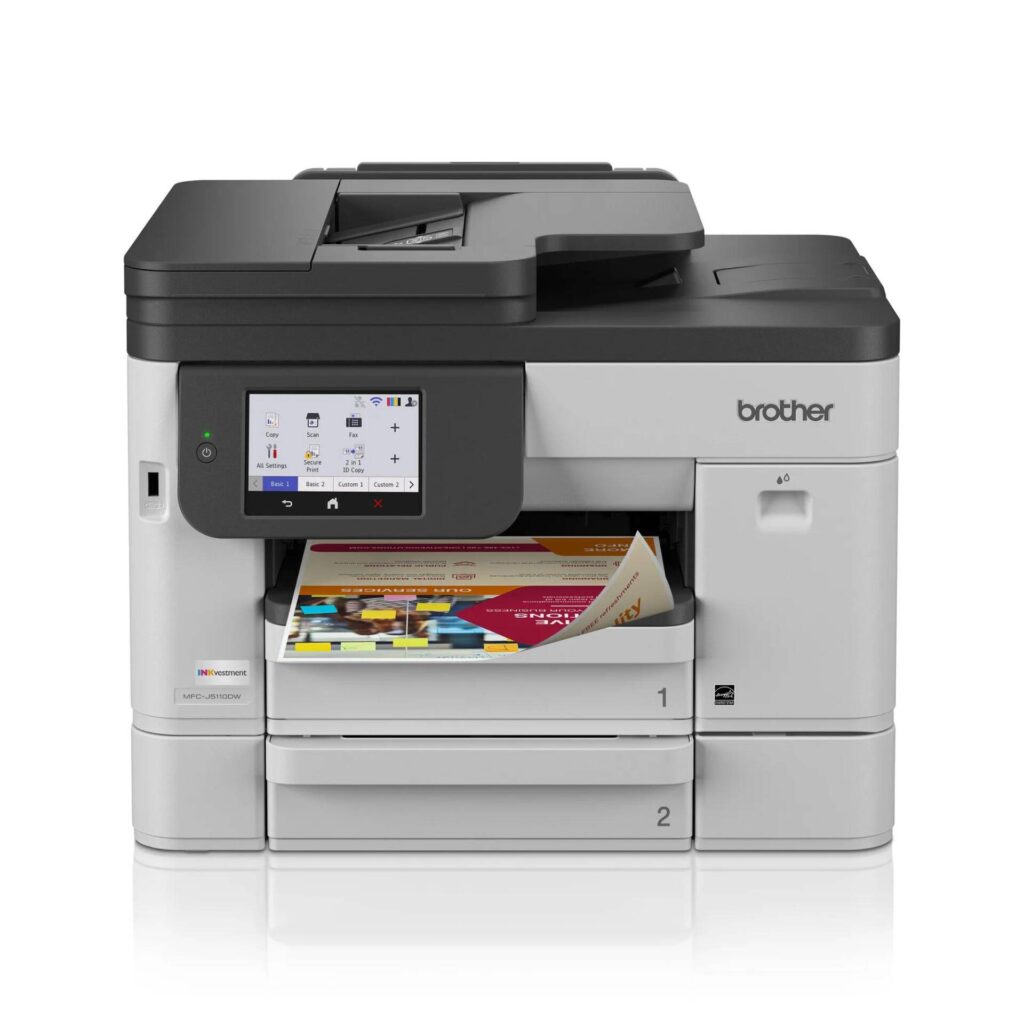
Brother's J5 inkjets have always aimed at the small office that wants laser-like paper handling without laser running costs, and the MFC-J5110DW is the two-tray version of that idea. It holds 500 sheets across two 250-sheet cassettes plus a 100-sheet multi-purpose tray at the back (unusual at this price) and feeds 50 sheets into a document feeder that scans both sides.
Speeds are quoted at 28 ppm black and 26 ppm color under the ISO standard, quick for an inkjet, and Brother rates the machine at up to 35,000 pages a month with a recommended volume of 250 to 2,500. Print resolution tops out at 4800 x 1200 dpi. Automatic two-sided printing, fax with a 33.6k modem, Gigabit Ethernet, Wi-Fi Direct, AirPrint and Brother's Mobile Connect app are all present, driven from a 4.3-inch color touchscreen.
One expectation is worth correcting. Despite the J5 badge, this is not a tabloid printer: Brother's specification lists Letter, Legal, Executive, Folio and A4, and 11 x 17 printing belongs to other models in the family.
Ink is the INKvestment system, which runs on high-capacity cartridges and has no refillable tanks. That trades the very lowest per-page cost for cheaper hardware and a simpler refill routine, which is the same bargain the rest of the machine makes. At 17.1 kg, most of it the second tray in the base, treat it as office furniture, too heavy to count as a desk accessory.
Category strengths
Where the Brother MFC-J5110DW beats the median
- A much higher input tray capacity ?500 sheets vs 150 sheets (median)
- A much higher print speed (color) ?26 ppm vs 9 ppm (median)
- A much higher print speed (black) ?28 ppm vs 16 ppm (median)
- A much higher monthly duty cycle ?35,000 pages vs 10,000 pages (median)
- Has duplex scanning ?
- Has touchscreen display ?
- A much higher output tray capacity ?150 sheets vs 67.5 sheets (median)
- A higher ADF capacity ?50 sheets vs 35 sheets (median)
- Has fax ?
Where the Brother MFC-J5110DW trails the median
- A much heavier build ?17.1 kg vs 7.98 kg (median)
How this VS Score was computed
Score 87: each known spec is measured against the median of all printers (65 products), then weighted; 50 means level with that median. In classes of six or more, a value beyond the class’s 10th–90th percentile range counts as that limit, so one extreme product cannot set the scale. 66% of the scoreable weight could be used; unknown values, features not applicable to this class and proxies (battery capacity where a rated life exists) add or remove nothing.
| Specification | This product | Cohort median | Score weight | Points moved |
|---|---|---|---|---|
| Print speed (black) | 28 | 16 | 2 | +76.0 |
| Print speed (color) | 26 | 9 | 1 | +50.0 |
| Automatic duplex printing | Yes | 73% of the class have it | 1 | +50.0 |
| Automatic document feeder | Yes | 55% of the class have it | 1 | +50.0 |
| Input tray capacity | 500 — capped at the class’s upper range (350) | 150 | 1 | +50.0 |
| Duplex scanning | Yes | 23% of the class have it | 0.5 | +25.0 |
| Ethernet | Yes | 54% of the class have it | 0.5 | +25.0 |
| Touchscreen display | Yes | 45% of the class have it | 0.5 | +25.0 |
| Supertank / refillable ink | No | 30% of the class have it | 0.5 | −24.0 |
| Monthly duty cycle | 35,000 | 10,000 | 0.3 | +15.0 |
| Output tray capacity | 150 | 67.5 | 0.3 | +15.0 |
| ADF capacity | 50 | 35 | 0.5 | +10.5 |
| Fax | Yes | 35% of the class have it | 0.2 | +10.0 |
| Weight | 17.1 | 7.98 | 0.3 | −8.1 |
| Print resolution | 4,800 | 4,800 | 0.5 | +0.0 |
Not scored: Color printing (standard for the class (88% have it)); All-in-one (standard for the class (85% have it)); Wi-Fi (standard for the class (97% have it)); Wi-Fi Direct (standard for the class (90% have it)); USB (standard for the class (100% have it)); Apple AirPrint (standard for the class (97% have it)); Mobile app printing (standard for the class (100% have it)).
Editor’s note
The J5110DW is the machine I would put in an office that reloads paper more often than it changes ink. Two cassettes mean letterhead can live in one and plain stock in the other, or one doubles the runway between refills. Either way, the walk to the paper cupboard becomes rare.
In use, the feeder earns its keep on two-sided originals: contracts and statements go through in one pass instead of the flip-and-refeed ritual smaller machines impose. The touchscreen makes scan-to destinations a one-touch habit for the people who use them daily.
The badge deserves a second warning because it catches people: no tabloid output. Anyone whose spreadsheets end up on the big paper size needs a different model, and finding out after delivery is a bad day.
On running costs, the cartridge system sits deliberately between worlds: cheaper per page than ordinary inkjets, pricier than tanks, with none of a tank's bottle-filling. For mixed, bursty office volumes that is usually the right trade. For relentless volume, a tank machine or a laser wins the arithmetic.
The single-tray J5010DW is the same engine for less if the second cassette would sit empty.
Specifications
Quality bars show where each figure sits between the lowest and highest of the 65 printers this VS Score is measured against.
Printing
Scanning & copying
Paper handling
Connectivity
Design
Sources and verification
Where the specifications come from
- Official product pagebrother-usa.com
- Retailer listing (cross-check)amazon.com
Verification
- First published
- Specifications last checked
- Sheet completeness
- 24 of 24 specifications verified; the rest show as Unknown and are never estimated or scored
- Page type
- Product specification page — Compiled from the manufacturer’s published specifications and the cited sources; this is not a hands-on test.
- Basis
- Research-based: specifications and editorial text were compiled from the documents listed here and the manufacturer’s published data. We have not tested this unit ourselves; where independent measurements are mentioned they belong to the linked publication.
Printers with similar specs to the Brother MFC-J5110DW
Ratings & reviews
No reviews yet. Be the first to share your experience.
The bottom line
The Brother MFC-J5110DW earns a VS Score of 87, above the median of the 65 printers it is measured against (a score of 50 is level with that median).
- Who it’s for
- Small offices that get through paper: two cassettes plus a bypass, a duplex document feeder and fax, all at inkjet running costs.
- Who should look elsewhere
- Anyone who needs tabloid output (Brother lists this model as Letter and Legal only) or anyone who specifically wants refillable tanks instead of cartridges.
- The trade-off that matters
- Laser-grade paper handling in an inkjet, paid for with cartridge running costs and a footprint that houses the second tray.
- The main alternative
- Brother MFC-J5010DW: the same engine and feeder in a single-tray body, if two cassettes of input are more than you need.
The VS Score is calculated from the weighted specifications above, each measured against the median of comparable printers — a shortlisting guide, not a substitute for your own priorities. See how we score.