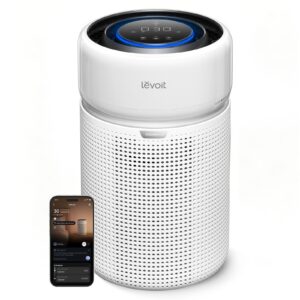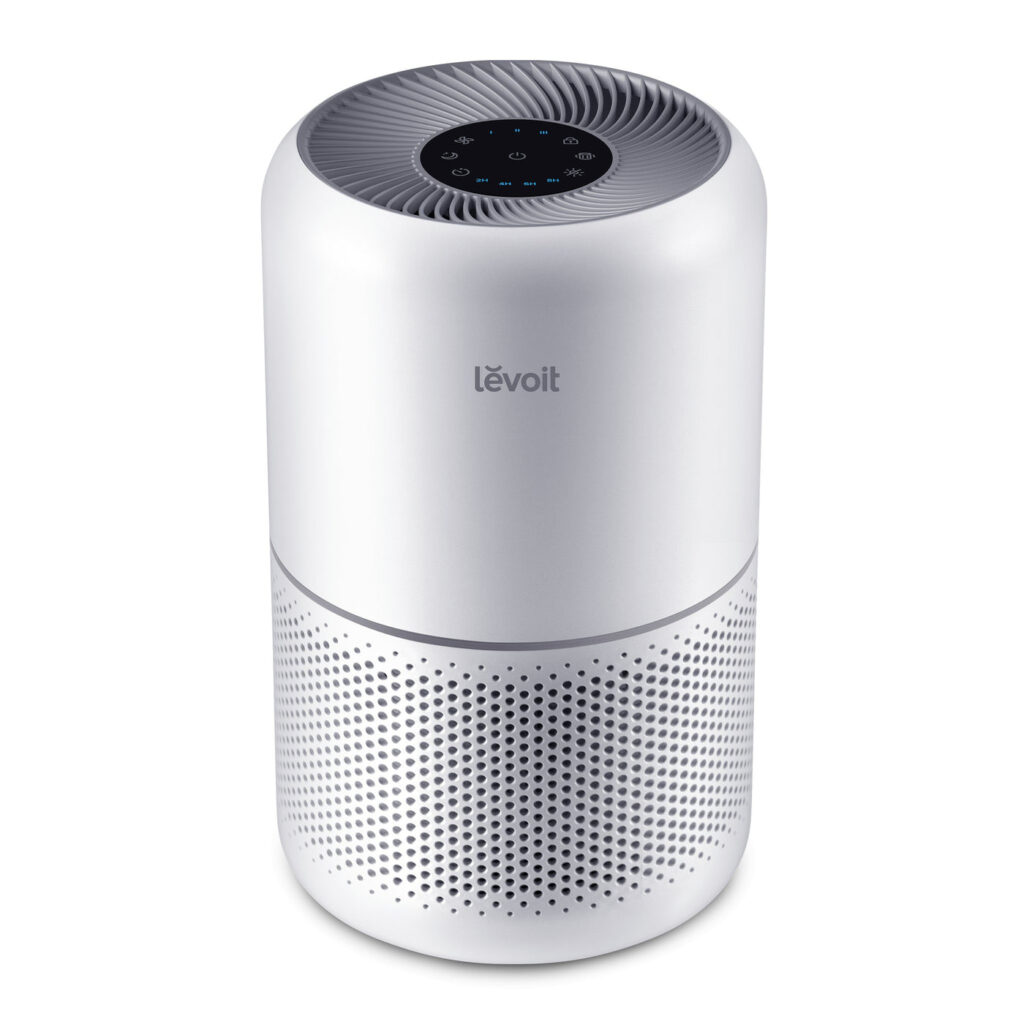
Levoit Core 300: Specs, Price, Pros & Cons
Shop for a Core 300 today and you will meet two sets of numbers. Older listings quote 141 CFM and 45 W, while Levoit's own US store now sells the purifier as the Core 300-P, with a spec block that still names the model Core 300 and gives a CADR of 143 CFM and a rated power of 56 W. The newer figures are the ones to plan around.
It is a small cylinder for one room, under nine inches across and just over fourteen inches tall, with a three-stage cartridge inside: a pre-filter, a pleated main filter and a layer of activated carbon. There is no sensor, no app and no auto mode. Three fan speeds, a sleep mode and a timer are set from buttons on the top, so the purifier needs no account and no network. At 7.9 lb it moves from bedroom to office in one hand.
Levoit's room sizing is the part to read twice. The headline figure is 1,066 sq ft, but that assumes one air change an hour, which is slow for allergies or smoke. At the 4.8 changes an hour that AHAM's sizing guideline uses, the same airflow covers 222 sq ft, roughly a 12 by 18 ft bedroom.
The filter family is its other strength. Levoit sells the same body with an original cartridge, a pet allergy version, a toxin absorber and a four-stage smoke remover, so the purifier can be pointed at a new problem without replacing it. Levoit backs it with a two-year limited warranty.
Category strengths
Where the Levoit Core 300 beats the median
- A lighter build ?3.6 kg vs 5.26 kg (median)
Where the Levoit Core 300 trails the median
- No air quality sensor ?
- A lower coverage area ?222 sq ft vs 354 sq ft (median)
- No washable pre-filter ?
- No auto mode ?
- No app control ?
- No voice assistant ?
- A lower CADR (smoke) ?143 CFM vs 161 CFM (median)
- A higher power consumption ?56 W vs 45 W (median)
- A slightly higher min noise level ?24 dB vs 23 dB (median)
- A slightly higher max noise level ?54.5 dB vs 52 dB (median)
How this VS Score was computed
Score 33: each known spec is measured against the median of all air purifiers (41 products), then weighted; 50 means level with that median. In classes of six or more, a value beyond the class’s 10th–90th percentile range counts as that limit, so one extreme product cannot set the scale. 71% of the scoreable weight could be used; unknown values, features not applicable to this class and proxies (battery capacity where a rated life exists) add or remove nothing.
| Specification | This product | Cohort median | Score weight | Points moved |
|---|---|---|---|---|
| Air quality sensor | No | 93% of the class have it | 1 | −48.0 |
| Coverage area | 222 | 354 | 2 | −38.0 |
| Washable pre-filter | No | 54% of the class have it | 0.5 | −24.0 |
| Auto mode | No | 90% of the class have it | 0.5 | −24.0 |
| App control | No | 70% of the class have it | 0.5 | −24.0 |
| Voice assistant | No | 64% of the class have it | 0.3 | −14.4 |
| CADR (smoke) | 143 | 161 | 2 | −12.0 |
| Weight | 3.6 | 5.26 | 0.3 | +6.9 |
| Power consumption | 56 | 45 | 0.5 | −5.0 |
| Min noise level | 24 | 23 | 1.5 | −3.0 |
| Max noise level | 54.5 | 52 | 0.5 | −1.0 |
| Air changes per hour | 4.8 | 4.8 | 1 | +0.0 |
| Filtration stages | 3 | 3 | 0.5 | +0.0 |
Not scored: True HEPA filter (unknown: not scored); Activated carbon filter (standard for the class (100% have it)); Filter life (unknown: not scored); Sleep mode (standard for the class (95% have it)); Filter replacement indicator (standard for the class (97% have it)); Timer (standard for the class (88% have it)).
Editor’s note
Levoit's filtration wording has changed along with the model name. The current US pages call the cartridge HEPA-grade, and the filter listing ties its HEPA-level efficiency claim, marked with an asterisk, to Sleep Mode, the slowest setting, where air spends longest in the media. Levoit's French store still describes the European Core 300 as True HEPA. The main filter is rated to catch 99.97% of particles down to 0.3 microns, so the practical difference in a bedroom is small, but anyone buying on the certification word should read the current box.
Noise runs from 24 to 54.5 dB across the speeds, by Levoit's figures. The low end is quiet enough for a night table. The top end, about the level of ordinary conversation, is the speed that delivers the rated airflow, so a room cleaned quickly is a room with a fan you can hear.
Levoit recommends a new cartridge every 6 to 8 months, and the pet, toxin and smoke versions cost more than the original, so filters are most of what the purifier costs to run.
I'd keep it for a bedroom, where it spends the night on Sleep and a sensor would have little to react to.
Specifications
Quality bars show where each figure sits between the lowest and highest of the 41 air purifiers this VS Score is measured against.
Performance
Filtration
Noise & power
Design
Smart features
Sources and verification
Where the specifications come from
- Official product pagelevoit.co.uk
- Independent testingrtings.com
Verification
- First published
- Specifications last checked
- Sheet completeness
- 19 of 22 specifications verified; the rest show as Unknown and are never estimated or scored
- Page type
- Product specification page — Compiled from the manufacturer’s published specifications and the cited sources; this is not a hands-on test.
- Basis
- Research-based: specifications and editorial text were compiled from the documents listed here and the manufacturer’s published data. We have not tested this unit ourselves; where independent measurements are mentioned they belong to the linked publication.
Where to buy
Prices and availability may change. Check the retailer before buying. We may earn a commission on purchases.
Price history
Air Purifiers with similar specs to the Levoit Core 300
Ratings & reviews
No reviews yet. Be the first to share your experience.
The bottom line
The Levoit Core 300 earns a VS Score of 33, below the median of the 41 air purifiers it is measured against (a score of 50 is level with that median).
- Who it’s for
- A bedroom or home office of ordinary size where the purifier runs on a fixed speed or Sleep all night, and the owner wants no app, no account and a choice of specialty filters.
- Who should look elsewhere
- Rooms much larger than a big bedroom, and anyone who wants the purifier to react on its own to cooking smoke or dust, since there is no sensor or auto mode.
- The trade-off that matters
- Without a sensor the fan stays where you left it, so a burst of cooking smoke gets the same airflow as a clean afternoon unless someone walks over and changes the speed.
- The main alternative
- Levoit Core 300S: the smart version, with an air quality sensor, auto mode and app control.
The VS Score is calculated from the weighted specifications above, each measured against the median of comparable air purifiers — a shortlisting guide, not a substitute for your own priorities. See how we score.