Blueair Blue Pure Mini Max: Specs, Features, Pros & Cons
A 60 CFM smoke CADR puts the Blue Pure Mini Max near the bottom of the air purifier class on raw output, and Blueair planned it that way. It is the smallest model in the Blue Pure family, sized for one closed room and light enough to carry from the bedroom to the study with one hand.
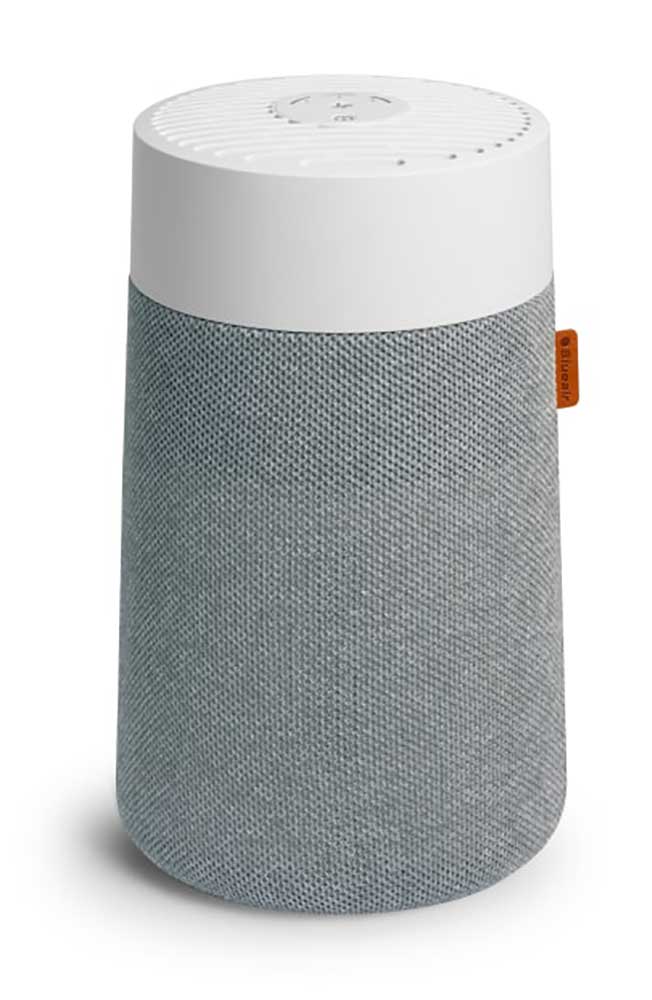
The look follows the family pattern. A fabric sleeve covers the body and works as the pre-filter, so on a shelf it reads as a soft cylinder more than an appliance. Behind it, the main filter carries activated carbon for cooking and pet smells and uses HEPASilent for particles. That is Blueair's name for pairing an electrostatic charge with mechanical media, and it carries no True HEPA certificate.
Control is manual. You pick a fan speed or the sleep setting and the purifier holds it, because nothing on board reads the air. Blueair's sensor, auto mode and app begin one rung higher in the range, so buying in at this level means owning a purifier that never adjusts itself when the room changes.
The other thing it trades away is reach. Coverage and clean air delivery both stop at a single small room, which rules out a living room or an open kitchen. What remains is a narrow, clear job in a child's bedroom, a small home office or a guest room, somewhere the door stays closed and the purifier sits within arm's reach of whoever sets it. Its light build and small appetite for electricity suit that brief, since a purifier this size tends to be left running for days at a stretch, and moving it to another room takes no tools, no account and no pairing.
Category strengths
Where the Blueair Blue Pure Mini Max beats the median
- A much lower power consumption ?10 W vs 45 W (median)
- A much lighter build ?1.36 kg vs 5.26 kg (median)
- A lower min noise level ?20 dB vs 23 dB (median)
- A lower max noise level ?44 dB vs 52 dB (median)
Where the Blueair Blue Pure Mini Max trails the median
- No true HEPA filter ?
- A much lower coverage area ?90 sq ft vs 354 sq ft (median)
- A much lower CADR (smoke) ?60 CFM vs 161 CFM (median)
- A much lower filter life ?6 months vs 12 months (median)
- No auto mode ?
- No app control ?
- No voice assistant ?
How this VS Score was computed
Score 33: each known spec is measured against the median of all air purifiers (41 products), then weighted; 50 means level with that median. In classes of six or more, a value beyond the class’s 10th–90th percentile range counts as that limit, so one extreme product cannot set the scale. 74% of the scoreable weight could be used; unknown values, features not applicable to this class and proxies (battery capacity where a rated life exists) add or remove nothing.
| Specification | This product | Cohort median | Score weight | Points moved |
|---|---|---|---|---|
| True HEPA filter | No | 61% of the class have it | 1.5 | −72.0 |
| Coverage area | 90 — capped at the class’s lower range (140) | 354 | 2 | −60.0 |
| CADR (smoke) | 60 — capped at the class’s lower range (115) | 161 | 2 | −28.0 |
| Filter life | 6 | 12 | 1 | −25.0 |
| Power consumption | 10 — capped at the class’s lower range (17) | 45 | 0.5 | +25.0 |
| Auto mode | No | 90% of the class have it | 0.5 | −24.0 |
| App control | No | 70% of the class have it | 0.5 | −24.0 |
| Weight | 1.36 — capped at the class’s lower range (2.53) | 5.26 | 0.3 | +15.0 |
| Voice assistant | No | 64% of the class have it | 0.3 | −14.4 |
| Min noise level | 20 | 23 | 1.5 | +10.5 |
| Max noise level | 44 | 52 | 0.5 | +4.5 |
| Air changes per hour | 4.8 | 4.8 | 1 | +0.0 |
Not scored: Filtration stages (unknown: not scored); Activated carbon filter (standard for the class (100% have it)); Washable pre-filter (unknown: not scored); Sleep mode (standard for the class (95% have it)); Air quality sensor (unknown: not scored); Filter replacement indicator (unknown: not scored); Timer (unknown: not scored).
Editor’s note
The Mini Max is Blueair distilled to its smallest sensible size: a three-pound fabric-wrapped cylinder for a bedside table, a desk, or a nursery shelf. The honest coverage figure is 90 square feet at nearly five air changes an hour (a single small room, properly cleaned), and the whole product should be judged on that scale.
Judged there, it is likeable. Twenty decibels on low is effectively silent, and Blueair's spec caps it at 44 dB flat out. That is quiet enough that the top speed is usable, which is not true of most small purifiers. Power draw is 2 to 10 watts, cheaper to run continuously than an LED bulb. The fabric pre-filter wraps the body in typical Blueair fashion, and the main filter changes twice a year.
The usual Blueair caveat applies: HEPASilent is the company's electrostatic-plus-mechanical system, not a certified True HEPA class. The capture claim is the same 99.97%, but buyers who specifically want the HEPA certificate should know the difference going in.
What you give up at this size and price is intelligence. There is no air-quality sensor driving an auto mode, no app, no voice control, so you set a speed and it stays there. Reviewers consistently flag this as the Mini Max's one real gap, and we agree: the machine is only ever as well-set as you left it.
The Amazon listing for the Mini Max carries a recycled product code, so check the price with Blueair directly or a major retailer.
As a quiet, near-free-to-run purifier for one small room, this is an easy machine to like. Anyone wanting the purifier to think for itself should step up to the 511i Max.
Specifications
Quality bars show where each figure sits between the lowest and highest of the 41 air purifiers this VS Score is measured against.
Performance
Filtration
Noise & power
Design
Smart features
Sources and verification
Where the specifications come from
- Official product pageblueair.com
- Retailer listing (cross-check)amazon.com
Verification
- First published
- Specifications last checked
- Sheet completeness
- 15 of 22 specifications verified; the rest show as Unknown and are never estimated or scored
- Page type
- Product specification page — Compiled from the manufacturer’s published specifications and the cited sources; this is not a hands-on test.
- Basis
- Research-based: specifications and editorial text were compiled from the documents listed here and the manufacturer’s published data. We have not tested this unit ourselves; where independent measurements are mentioned they belong to the linked publication.
Air Purifiers with similar specs to the Blueair Blue Pure Mini Max
Ratings & reviews
No reviews yet. Be the first to share your experience.
The bottom line
The Blueair Blue Pure Mini Max earns a VS Score of 33, below the median of the 41 air purifiers it is measured against (a score of 50 is level with that median).
- Who it’s for
- A bedside or desk purifier for one small room: near-silent on low, a tiny power draw, and Blueair's fabric-wrapped design that doesn't look like an appliance.
- Who should look elsewhere
- Anyone expecting the purifier to manage itself (there is no sensor, no auto mode, no app) or wanting a certified True HEPA class, which HEPASilent is not.
- The trade-off that matters
- Near-silent, near-free continuous running in exchange for zero intelligence: it is only ever as well-set as you left it.
- The main alternative
- Blueair's own Blue Pure 511i Max adds the sensor, auto mode and app for the step-up price, and remains the smarter small-room pick.
The VS Score is calculated from the weighted specifications above, each measured against the median of comparable air purifiers — a shortlisting guide, not a substitute for your own priorities. See how we score.