Razer DeathAdder V3 Pro: Specs, Features, Pros & Cons
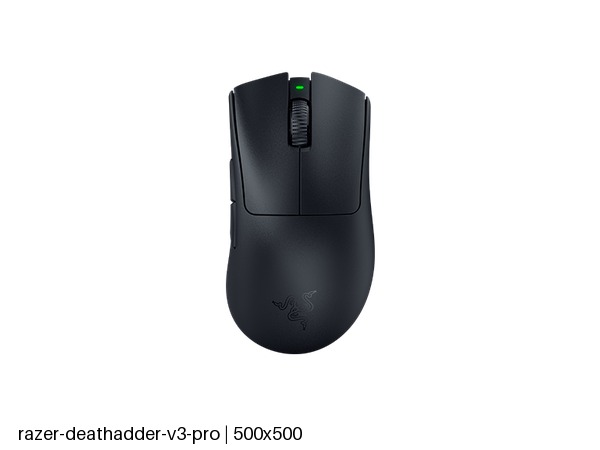
The DeathAdder is the closest thing the mouse market has to an institution. Razer has been refining the same essential right-handed shape for roughly two decades, and the reason it keeps reappearing is not marketing momentum. It is that a large number of hands fit it. The V3 Pro is one entry in that lineage, and the shape is still the argument for it.
What Razer did in this generation was strip the shape down. Earlier DeathAdders were heavier, with more lighting and more buttons. This one removes almost all of that in favor of a light shell, a plain surface and only the controls a competitive player binds. There is no lighting at all, which on a mouse aimed at tournaments is a feature rather than an omission.
It is wireless with a cable in the box for charging and play, and there is no Bluetooth. It is a deliberate choice, since Bluetooth adds latency and this mouse is not trying to be a second device for a laptop.
The context that matters is that Razer has since released a successor with a faster sensor, high-rate polling without an add-on dongle and a slightly lower weight. Those are real improvements, and they land in the region where the difference becomes hard to feel. Buying this generation is not a compromise so much as a decision about whether the last increment is worth its premium to you.
Where it is wrong is for left-handed players and for anyone who wants more than a handful of buttons. It is a focused, deliberately narrow mouse, and the focus is the whole appeal.
Category strengths
Where the Razer DeathAdder V3 Pro beats the median
- A lighter build ?63 g vs 89 g (median)
- A higher max sensitivity ?30,000 DPI vs 25,600 DPI (median)
- A higher max acceleration ?70 G vs 50 G (median)
- A higher max tracking speed ?750 IPS vs 650 IPS (median)
- A higher switch lifespan ?90 million clicks vs 80 million clicks (median)
Where the Razer DeathAdder V3 Pro trails the median
- Shorter battery life ?90 h vs 130 h (median)
How this VS Score was computed
Score 56: each known spec is measured against the median of all mice (83 products), then weighted; 50 means level with that median. In classes of six or more, a value beyond the class’s 10th–90th percentile range counts as that limit, so one extreme product cannot set the scale. 72% of the scoreable weight could be used; unknown values, features not applicable to this class and proxies (battery capacity where a rated life exists) add or remove nothing.
| Specification | This product | Cohort median | Score weight | Points moved |
|---|---|---|---|---|
| Weight | 63 | 89 | 1 | +21.0 |
| Adjustable lift-off distance | Yes | 65% of the class have it | 0.3 | +15.0 |
| USB-C charging | Yes | 68% of the class have it | 0.3 | +15.0 |
| Battery life | 90 | 130 | 0.8 | −12.0 |
| Horizontal scrolling | No | 46% of the class have it | 0.2 | −9.6 |
| RGB lighting | No | 48% of the class have it | 0.2 | −9.6 |
| Max sensitivity | 30,000 | 25,600 | 1 | +9.0 |
| Max acceleration | 70 | 50 | 0.4 | +8.0 |
| Max tracking speed | 750 | 650 | 0.8 | +6.4 |
| Switch lifespan | 90 | 80 | 0.2 | +1.2 |
| Polling rate | 1,000 | 1,000 | 0.8 | +0.0 |
| Buttons | 6 | 6 | 0.6 | +0.0 |
| Connection | 2 | 2 | 0.8 | +0.0 |
| Wireless polling rate | 1,000 | 1,000 | 0.5 | +0.0 |
Not scored: Grip styles (unknown: not scored); Free-spin scroll wheel (unknown: not scored); Click latency (unknown: not scored); Debounce adjustment (unknown: not scored); Battery capacity (unknown: not scored); Quick charge (unknown: not scored); Wireless charging (unknown: not scored); Onboard memory (standard for the class (88% have it)); Software customization (standard for the class (98% have it)); Adjustable weights (unknown: not scored).
Editor’s note
The DeathAdder V3 Pro is the previous generation of Razer's competitive flagship, and knowing exactly what the V4 changed makes this an easy decision.
The shell is identical: 128 x 68 x 44 mm, the same right-handed profile for palm and claw grips. The dimensions match to the millimeter, so the shape is the same, and shape is what most people choose a mouse for.
Three specifications moved on. The sensor here is the Focus Pro 30K at 30,000 DPI with 750 IPS tracking, against the V4's 45K and 900 IPS. Polling is 1,000 Hz by default, and 8,000 Hz needs Razer's HyperPolling dongle, sold separately, where the V4 Pro reaches it on its own. And it weighs 63 g against 56 g. Every one of those is a real improvement on paper, and every one sits in the region where perception fades: its tracking is already beyond what a human swipe produces, and 7 g is at the edge of noticeable.
What you keep is substantial: 100% PTFE feet, optical switches rated to 90 million clicks, adjustable lift-off distance, onboard memory, USB-C charging and a quoted 90 hours of battery, with wired and 2.4 GHz connection.
There is no RGB lighting and no tilt wheel for horizontal scrolling, which is the point of the design.
Buy it if you want this shape and the last generation's price: for the overwhelming majority of players it is indistinguishable in use. Buy the V4 Pro if the faster polling on a high-refresh monitor is something you specifically want.
Specifications
Quality bars show where each figure sits between the lowest and highest of the 83 mice this VS Score is measured against.
Sensor & tracking
Design & handling
Switches & latency
Connectivity
Battery
Features
Sources and verification
Where the specifications come from
- Official product pagerazer.com
Verification
- First published
- Specifications last checked
- Sheet completeness
- 26 of 34 specifications verified; the rest show as Unknown and are never estimated or scored
- Page type
- Product specification page — Compiled from the manufacturer’s published specifications and the cited sources; this is not a hands-on test.
- Basis
- Research-based: specifications and editorial text were compiled from the documents listed here and the manufacturer’s published data. We have not tested this unit ourselves; where independent measurements are mentioned they belong to the linked publication.
Mice with similar specs to the Razer DeathAdder V3 Pro
Ratings & reviews
No reviews yet. Be the first to share your experience.
The bottom line
The Razer DeathAdder V3 Pro earns a VS Score of 56, above the median of the 83 mice it is measured against (a score of 50 is level with that median).
- Who it’s for
- Right-handed palm and claw players who want the DeathAdder shape without a cable and would rather keep the money than chase the newest sensor.
- Who should look elsewhere
- Left-handers should pass, and so should anyone who wants Bluetooth, lighting or more than a handful of buttons.
- The trade-off that matters
- Battery life is short for a mouse polling at the ordinary rate, so it spends more time near its charging cable than longer-lasting rivals.
- The main alternative
- Razer DeathAdder V4 Pro: the same shell with high-rate polling built in, no add-on dongle needed, and a newer sensor, for players on high-refresh screens
The VS Score is calculated from the weighted specifications above, each measured against the median of comparable mice — a shortlisting guide, not a substitute for your own priorities. See how we score.