Akko Bun Wonderland 5108 V5 (V3 Piano Pro): Specs & Verdict
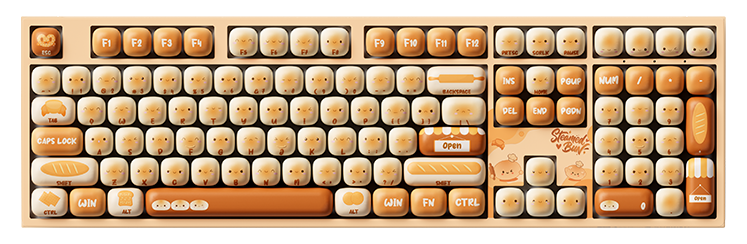
This is a full-size mechanical keyboard whose keycaps are steamed buns with faces, and the sensible thing to do is take that seriously, because Akko does. The 5108 V5 is the board underneath a dozen licensed and in-house themes, and Bun Wonderland is one of the in-house ones: a cream-and-caramel colorway carried across the case, the dye-sublimated PBT keycaps and a themed back panel.
The keyboard is more serious than the artwork suggests. It is a 108-key layout on a gasket mount with a flex-cut, two-piece polycarbonate plate, which is Akko's answer to the complaint that full-size boards feel stiffer than compact ones. It is hot-swappable for three- and five-pin switches, has per-key addressable RGB, N-key rollover, and connects three ways: USB-C, a 2.4 GHz receiver, and Bluetooth 5.0.
The variant matters. This version ships with Akko's V3 Piano Pro linear switches at 45 grams, and that pairs it with the 1 kHz controller and an 8,000 mAh battery. Akko sells the same board with Creamy Yellow U1 switches, 8 kHz polling and a 10,000 mAh battery, and the two are easy to confuse on a listing. Akko publishes no battery-life figure for either.
At 1.41 kilograms and 440 millimeters wide it is a desk fixture, not a travel keyboard, and the MOG-profile keycaps are rounder and taller than the more common Cherry profile. Configuration is through Akko's web driver, which needs no install.
The buyer it suits is someone who wants a complete, well-built, gasket-mounted full-size board and actively likes the theme. It is not for anyone who needs the faster polling for competitive play, who wants a knob or dedicated media keys, or who would rather the keyboard stayed out of the conversation.
Category strengths
Where the Akko Bun Wonderland 5108 V5 (V3 Piano Pro) beats the median
- A much bigger battery ?8,000 mAh vs 4,000 mAh (median)
Where the Akko Bun Wonderland 5108 V5 (V3 Piano Pro) trails the median
- No rotary knob ?
How this VS Score was computed
Score 57: each known spec is measured against the median of all keyboards (101 products), then weighted; 50 means level with that median. In classes of six or more, a value beyond the class’s 10th–90th percentile range counts as that limit, so one extreme product cannot set the scale. 46% of the scoreable weight could be used; unknown values, features not applicable to this class and proxies (battery capacity where a rated life exists) add or remove nothing.
| Specification | This product | Cohort median | Score weight | Points moved |
|---|---|---|---|---|
| Hot-swappable | Yes | 61% of the class have it | 0.6 | +30.0 |
| Sound dampening | Yes | 76% of the class have it | 0.3 | +15.0 |
| Rotary knob | No | 54% of the class have it | 0.2 | −9.6 |
| Battery capacity | 8,000 — capped at the class’s upper range (4,200) | 4,000 | 0.2 | +0.6 |
| Switch technology | Mechanical | Mechanical | 1 | +0.0 |
| Actuation force | 45 | 45 | 0.4 | +0.0 |
| Polling rate | 1,000 | 1,000 | 0.7 | +0.0 |
| Connection | 3 | 3 | 0.8 | +0.0 |
| Keycap material | PBT | PBT | 0.4 | +0.0 |
| Backlight | RGB | RGB | 0.3 | +0.0 |
Not scored: N-key rollover (standard for the class (84% have it)); Adjustable actuation (unknown: not scored); Analog input (unknown: not scored); Wired latency (unknown: not scored); Wireless latency (unknown: not scored); Rapid trigger (unknown: not scored); Front height (unknown: not scored); Bluetooth devices (unknown: not scored); Battery life (unknown: not scored); USB passthrough (unknown: not scored); Programmable keys (standard for the class (99% have it)); Media controls (unknown: not scored); Onboard profiles (unknown: not scored); Configuration software (standard for the class (95% have it)).
Editor’s note
The trick with themed Akko boards is to separate the theme from the keyboard, because the keyboard is the better argument. Underneath the buns is a full-size gasket-mount board with a split flex-cut plate, PBT dye-sub caps, hot-swap sockets and tri-mode wireless, at a price that a bare enthusiast kit with none of those things would struggle to match. That is the reason to buy it. The artwork is the reason you would pick this one over the others.
The V3 Piano Pro switch is the version to understand. It is a smooth, light linear with a slightly shorter total travel than Akko's other linears, and it comes with the slower controller. For typing and ordinary gaming that is entirely fine, and the battery is enormous by keyboard standards even without a published runtime. The faster-polling version is the Creamy Yellow model.
What I would flag is the profile. MOG keycaps are tall, rounded and spherical-topped, and they are part of the look. If you type on Cherry-profile caps all day, expect a week of adjustment and possibly a decision to swap them, which undoes half the point.
The part that would make me hesitate is the absence of a volume knob and dedicated media keys on a board this size. Full-size layouts are usually where those live, and their absence is a noticeable omission on a keyboard aimed at a desk that also plays music.
I would choose it for a home desk where the owner wants a serious typing board that also makes people smile, and has the space for a 108-key footprint. I would send someone who wants the same construction in a plainer, knob-equipped package to Keychron's V-series Max boards, and a competitive player to the Creamy Yellow 8K variant.
Specifications
Quality bars show where each figure sits between the lowest and highest of the 101 keyboards this VS Score is measured against.
Switches & typing
Performance
Layout & size
Connectivity
Build & sound
Features
Sources and verification
Where the specifications come from
- Official product pageen.akkogear.com
- Retailer listing (cross-check)amazon.com
Verification
- First published
- Specifications last checked
- Sheet completeness
- 22 of 34 specifications verified; the rest show as Unknown and are never estimated or scored
- Page type
- Product specification page — Compiled from the manufacturer’s published specifications and the cited sources; this is not a hands-on test.
- Basis
- Research-based: specifications and editorial text were compiled from the documents listed here and the manufacturer’s published data. We have not tested this unit ourselves; where independent measurements are mentioned they belong to the linked publication.
Keyboards with similar specs to the Akko Bun Wonderland 5108 V5 (V3 Piano Pro)
Ratings & reviews
No reviews yet. Be the first to share your experience.
The bottom line
The Akko Bun Wonderland 5108 V5 (V3 Piano Pro) earns a VS Score of 57, above the median of the 101 keyboards it is measured against (a score of 50 is level with that median).
- Who it’s for
- Someone with desk space for a 108-key board who wants gasket-mount build quality, PBT dye-sub caps, hot-swap sockets and three connection modes at a fair price, and who actively likes the Bun Wonderland theme rather than merely tolerating it.
- Who should look elsewhere
- Competitive players who need the faster polling of the Creamy Yellow U1 version, anyone who wants a volume knob or dedicated media keys, and anyone who would rather their keyboard drew no attention.
- The trade-off that matters
- The theme is the point and the price of admission: you get an unusually well-built full-size board, but the rounded MOG keycaps and the artwork are inseparable from it, and swapping the caps to a familiar profile undoes what you paid for.
- The main alternative
- Keychron V6 Max: a full-size, hot-swappable, tri-mode gasket board with a volume knob and plain double-shot keycaps, for buyers who want the same construction without the theme.
The VS Score is calculated from the weighted specifications above, each measured against the median of comparable keyboards — a shortlisting guide, not a substitute for your own priorities. See how we score.