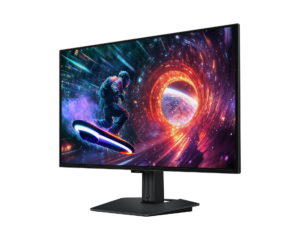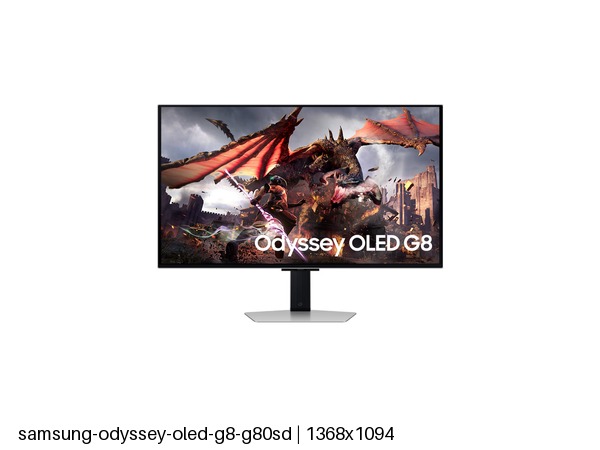
Samsung Odyssey OLED G8 G80SD: Specs, Features, Pros & Cons
A 32-inch QD-OLED at 4K is the rare OLED monitor that is comfortable to write and read on all day, and that is the case for Samsung's Odyssey OLED G8. Text at this size and resolution looks clean at a normal distance, and the same panel still refreshes fast enough for games.
Samsung sells it in its Odyssey gaming range under the G80SD code. The screen has a matte finish that keeps reflections down in a lit room, contrast that turns dark scenes into true black, and variable refresh that works with both graphics card makers. The stand adjusts for height. Two HDMI inputs, a DisplayPort input and a USB hub cover a PC and a console.
Built-in speakers are an unusual fitting on an OLED monitor, and they are enough for a bedroom or a second screen. The odd part is the lack of a headphone socket next to them, so headphones still plug into the PC or the console.
What it gives up is partly on the spec sheet and partly missing from it. Samsung publishes a typical brightness for this panel and no HDR peak, and it claims no VESA True Black certification, so how bright its highlights get is a question the maker leaves open. There is no USB-C, which means a laptop cannot charge or connect through a single cable.
It suits someone who wants one large, sharp OLED for work in the day and games or films at night, mostly in standard dynamic range. Its matte screen and speakers make it an easy fit for a room with a window and no sound system.
Category strengths
Where the Samsung Odyssey OLED G8 G80SD beats the median
- Has built-in speakers ?
Where the Samsung Odyssey OLED G8 G80SD trails the median
- No USB-C ?
- No headphone output ?
- No KVM switch ?
How this VS Score was computed
Score 44: each known spec is measured against the median of OLED gaming monitors, 32 inches and up (13 products), then weighted; 50 means level with that median. In classes of six or more, a value beyond the class’s 10th–90th percentile range counts as that limit, so one extreme product cannot set the scale. 62% of the scoreable weight could be used; unknown values, features not applicable to this class and proxies (battery capacity where a rated life exists) add or remove nothing.
| Specification | This product | Cohort median | Score weight | Points moved |
|---|---|---|---|---|
| USB-C | No | 77% of the class have it | 0.5 | −24.0 |
| HDR | HDR10 | True Black 400 | 0.5 | −20.0 |
| Motion blur reduction | No | 25% of the class have it | 0.3 | −14.4 |
| Built-in speakers | Yes | 40% of the class have it | 0.2 | +10.0 |
| Headphone output | No | 89% of the class have it | 0.2 | −9.6 |
| Pivot | Yes | 64% of the class have it | 0.02 | +1.0 |
| KVM switch | No | 67% of the class have it | 0.02 | −1.0 |
| Screen size | 32 | 32 | 1.2 | +0.0 |
| Resolution | 4K | 4K | 1.2 | +0.0 |
| Panel type | OLED | OLED | 0.8 | +0.0 |
| Color depth | 10 | 10 | 0.3 | +0.0 |
| Refresh rate | 240 | 240 | 1.2 | +0.0 |
| Response time | 0.03 | 0.03 | 0.8 | +0.0 |
| Contrast ratio | 1,000,000 — capped at the class’s lower range (1,500,000) | 1,500,000 | 0.6 | +0.0 |
| Pixel density | 140 | 140 | 0.5 | +0.0 |
| Adaptive sync | G-Sync Compatible | G-Sync Compatible | 0.6 | +0.0 |
| HDMI ports | 2 | 2 | 0.4 | +0.0 |
| DisplayPort inputs | 1 | 1 | 0.4 | +0.0 |
Not scored: Peak brightness (unknown: not scored); DCI-P3 coverage (unknown: not scored); Local dimming (not applicable: only 0% of this class have it); Local dimming zones (unknown: not scored); Variable refresh rate (standard for the class (100% have it)); Input lag (unknown: not scored); Height adjustment (standard for the class (100% have it)); Tilt (standard for the class (100% have it)); Swivel (standard for the class (100% have it)); USB-C power delivery (unknown: not scored); USB hub (standard for the class (85% have it)); Webcam (not applicable: only 0% of this class have it); Microphone (not applicable: only 0% of this class have it); Ethernet (not applicable: only 0% of this class have it); Picture-by-picture (standard for the class (100% have it)).
Editor’s note
Samsung's sheet gives 250 nits as a typical brightness and stops there. There is no HDR peak and no VESA rating, only the HDR10, HDR10+ and HDR10+ Gaming formats. Rival QD-OLEDs certified to True Black at least put a floor under their highlights, and this one leaves you to take its HDR on trust.
The care for a long working day is better documented. Samsung's OLED Safeguard+ predicts panel temperature and turns brightness down to control heat, dims static elements it detects such as icons and taskbars, and lowers the whole screen after ten minutes without input. None of that removes the burn-in risk every OLED carries. It is more than a sticker, though, and a panel that will show spreadsheets for eight hours a day needs it.
The smart-TV side is the unusual part. The G8 runs Samsung's streaming apps and Gaming Hub without a PC attached, and its NQ8 AI Gen3 processor upscales lower-resolution sources. In a bedroom or a small apartment it can stand in for the television as well as the monitor, which is where the audio fitted to it starts to earn its place.
For gaming, 240 Hz with a 0.03 ms response and G-Sync Compatible variable refresh leaves nothing to want at this resolution, provided the graphics card can feed it. New games at full speed and full resolution ask for a recent high-end card, and older or lighter titles get there on much less.
I would buy it for its contrast and its matte screen, and count any HDR punch as a bonus until someone publishes a measurement.
Specifications
Quality bars show where each figure sits between the lowest and highest of the 13 OLED gaming monitors, 32 inches and up this VS Score is measured against.
Picture
Gaming
Ergonomics & design
Connectivity
Features
Sources and verification
Where the specifications come from
- Official product pagesamsung.com
- Datasheet or manualimages.samsung.com
Verification
- First published
- Specifications last checked
- Sheet completeness
- 35 of 42 specifications verified; the rest show as Unknown and are never estimated or scored
- Page type
- Product specification page — Compiled from the manufacturer’s published specifications and the cited sources; this is not a hands-on test.
- Basis
- Research-based: specifications and editorial text were compiled from the documents listed here and the manufacturer’s published data. We have not tested this unit ourselves; where independent measurements are mentioned they belong to the linked publication.
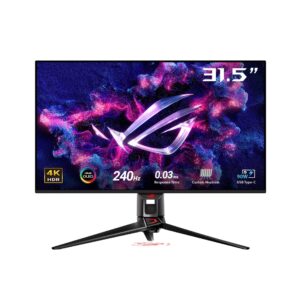
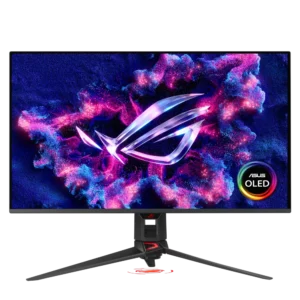
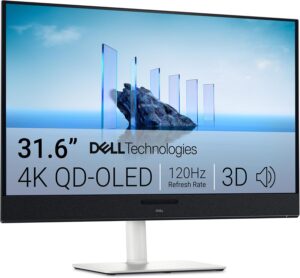
Monitors with similar specs to the Samsung Odyssey OLED G8 G80SD
Ratings & reviews
No reviews yet. Be the first to share your experience.
The bottom line
The Samsung Odyssey OLED G8 G80SD earns a VS Score of 44, below the median of the 13 OLED gaming monitors, 32 inches and up it is measured against (a score of 50 is level with that median).
- Who it’s for
- Someone who wants a big, sharp OLED for games and films in a bright room, with speakers built in so a bedroom or second-screen setup needs no extra audio.
- Who should look elsewhere
- HDR enthusiasts who want a certified highlight level, and anyone who plugs headphones into the monitor, because there is no headphone jack.
- The trade-off that matters
- It is bought for contrast and a matte finish, and its HDR is taken on trust, because Samsung never says how bright the highlights get.
- The main alternative
- ASUS ROG Swift OLED PG32UCDM: the same size and resolution with a VESA True Black certification and USB-C laptop charging, if the room can be darkened for its glossy screen.
The VS Score is calculated from the weighted specifications above, each measured against the median of comparable OLED gaming monitors, 32 inches and up — a shortlisting guide, not a substitute for your own priorities. See how we score.