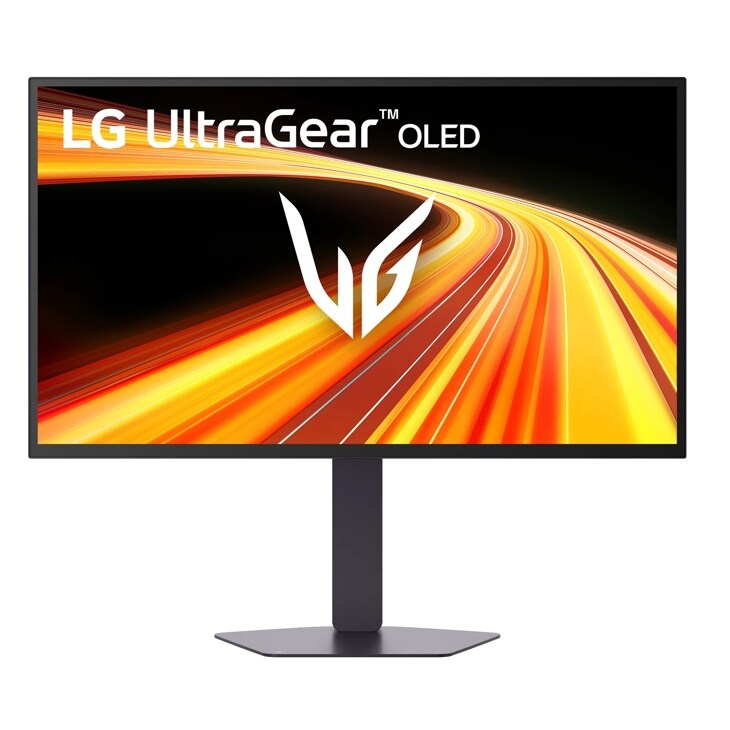
LG 27GX790B-B: Specs, Price, Pros & Cons
The number on the box is 720 Hz. The number this monitor runs at its own resolution is 540 Hz, and the gap between those two figures is the most important thing to understand about it.
This is a 27-inch WOLED panel with a native resolution of 2560×1440, which is where that lower figure applies. The faster mode is real, but reaching it means dropping the panel to 1920×1080: LG's Dual Mode switch trades pixels for frames. Both numbers are genuine. They do not happen at the same time, and any listing that prints the box figure beside QHD is describing a mode the display does not have.
With that settled, what remains is a very good OLED. Response time is 0.02 ms, HDR is certified DisplayHDR True Black 500 rather than the True Black 400 most rivals carry, and LG quotes 99.5 percent DCI-P3 coverage with factory calibration included in the box. The WOLED subpixel layout also renders small text more conventionally than QD-OLED does, which matters if the same screen does your work.
Connectivity is current: DisplayPort 2.1, two HDMI 2.1 inputs, a USB-C that carries data as well as picture, a two-port USB 3.0 hub and a headphone output. The stand adjusts for height, tilt, swivel and pivot, and the panel takes a standard 100 mm VESA mount if you would rather hang it from an arm.
At 109 pixels per inch it is a gaming display first and a desktop second. The buyer it fits is someone playing competitively who already owns a graphics card capable of pushing frame rates in that territory. For anyone else, the panel is excellent and the refresh figure is mostly headroom.
Category strengths
Where the LG 27GX790B-B beats the median
- A much higher refresh rate ?540 Hz vs 240 Hz (median)
- Has USB-C ?
Where the LG 27GX790B-B trails the median
- A slightly lower pixel density ?109 ppi vs 111 ppi (median)
How this VS Score was computed
Score 57: each known spec is measured against the median of OLED gaming monitors, 27 to 31 inches (16 products), then weighted; 50 means level with that median. In classes of six or more, a value beyond the class’s 10th–90th percentile range counts as that limit, so one extreme product cannot set the scale. 63% of the scoreable weight could be used; unknown values, features not applicable to this class and proxies (battery capacity where a rated life exists) add or remove nothing.
| Specification | This product | Cohort median | Score weight | Points moved |
|---|---|---|---|---|
| Refresh rate | 540 — capped at the class’s upper range (360) | 240 | 1.2 | +30.0 |
| USB-C | Yes | 33% of the class have it | 0.5 | +25.0 |
| Headphone output | Yes | 75% of the class have it | 0.2 | +10.0 |
| HDR | True Black 500 | True Black 400 | 0.5 | +5.0 |
| USB hub | Yes | 73% of the class have it | 0.05 | +2.3 |
| Pixel density | 109 | 111 | 0.5 | −0.5 |
| Screen size | 27 | 27 | 1.2 | +0.0 |
| Resolution | 1440p | 1440p | 1.2 | +0.0 |
| Panel type | OLED | OLED | 0.8 | +0.0 |
| Color depth | 10 | 10 | 0.3 | +0.0 |
| Response time | 0.02 — capped at the class’s lower range (0.03) | 0.03 | 0.8 | +0.0 |
| Contrast ratio | 1,500,000 | 1,500,000 | 0.6 | +0.0 |
| DCI-P3 coverage | 99.5 | 99 | 0.6 | +0.0 |
| Adaptive sync | G-Sync Compatible | G-Sync Compatible | 0.6 | +0.0 |
| HDMI ports | 2 | 2 | 0.4 | +0.0 |
| DisplayPort inputs | 1 | 1 | 0.4 | +0.0 |
Not scored: Peak brightness (unknown: not scored); Local dimming (not applicable: only 0% of this class have it); Local dimming zones (unknown: not scored); Variable refresh rate (standard for the class (100% have it)); Motion blur reduction (unknown: not scored); Input lag (unknown: not scored); Height adjustment (standard for the class (94% have it)); Tilt (standard for the class (100% have it)); Swivel (standard for the class (88% have it)); Pivot (standard for the class (81% have it)); USB-C power delivery (unknown: not scored); Built-in speakers (unknown: not scored); KVM switch (unknown: not scored); Webcam (unknown: not scored); Microphone (unknown: not scored); Ethernet (unknown: not scored); Picture-by-picture (unknown: not scored).
Editor’s note
Set the marketing aside and the question is simple: is the native rate worth paying for over the mainstream high-refresh OLEDs that now cost considerably less?
For almost everyone, no. The perceptual returns above that mainstream rate fall off steeply, and sustaining that many frames at native resolution in anything but an older competitive title needs a graphics card that costs more than this monitor does. The people for whom it changes outcomes are a small group, and they generally already know they are in it.
What the number does tell you is that LG did not compromise elsewhere to reach it. The response time and the HDR tier are both a step above the class average, and the new-generation port is what makes the bandwidth work without leaning entirely on compression. That engineering is real even when the headline figure is mostly headroom.
The Dual Mode switch is more interesting than it first sounds. Dropping the resolution for the doubled rate is not a gimmick if you play one competitive shooter seriously and everything else at native resolution. It is effectively two monitors in one panel, and it costs nothing to use.
Where I would hesitate is text. At this density the screen is not sharp by current desktop standards, and OLED subpixel layouts are unforgiving about that. LG also quotes typical full-screen brightness at 335 nits, which is ordinary for the technology but worth knowing if the room is a bright one.
If the refresh figure is not the actual reason you are buying, the LG UltraGear 27GS95QE-B gives you the same size and panel family at the lower rate for a great deal less, and the difference is better spent on the graphics card.
Specifications
Quality bars show where each figure sits between the lowest and highest of the 16 OLED gaming monitors, 27 to 31 inches this VS Score is measured against.
Picture
Gaming
Ergonomics & design
Connectivity
Features
Sources and verification
Where the specifications come from
- Official product pagelg.com
- Independent testingrtings.com
Verification
- First published
- Specifications last checked
- Sheet completeness
- 27 of 42 specifications verified; the rest show as Unknown and are never estimated or scored
- Page type
- Product specification page — Compiled from the manufacturer’s published specifications and the cited sources; this is not a hands-on test.
- Basis
- Research-based: specifications and editorial text were compiled from the documents listed here and the manufacturer’s published data. We have not tested this unit ourselves; where independent measurements are mentioned they belong to the linked publication.
Where to buy
Prices and availability may change. Check the retailer before buying. We may earn a commission on purchases.
Price history
Monitors with similar specs to the LG 27GX790B-B
Ratings & reviews
No reviews yet. Be the first to share your experience.
The bottom line
The LG 27GX790B-B earns a VS Score of 57, above the median of the 16 OLED gaming monitors, 27 to 31 inches it is measured against (a score of 50 is level with that median).
- Who it’s for
- Competitive players who already own a graphics card that can sustain very high frame rates, and who would use the Dual Mode drop for one serious shooter.
- Who should look elsewhere
- Anyone buying on the box figure alone, since that mode only exists at the lower resolution, and anyone who wants a sharp desktop, which this density is not.
- The trade-off that matters
- The refresh headroom carries a large premium over a mainstream OLED that looks identical in normal use. What the money buys is the engineering underneath the number, not the number.
- The main alternative
- LG UltraGear 27GS95QE-B is the same size and panel family at 240 Hz for considerably less, and is the better buy unless the frame rate is the entire point.
The VS Score is calculated from the weighted specifications above, each measured against the median of comparable OLED gaming monitors, 27 to 31 inches — a shortlisting guide, not a substitute for your own priorities. See how we score.