Epson EcoTank ET-2800: Specs, Features, Pros & Cons
Few printers on sale have as long a public record as the ET-2800. Its firmware has had years to settle, owners have had years to write up its habits, and the machine on the shelf today is the one those reviews describe. Buyers who distrust new models get a printer with no surprises left in it.
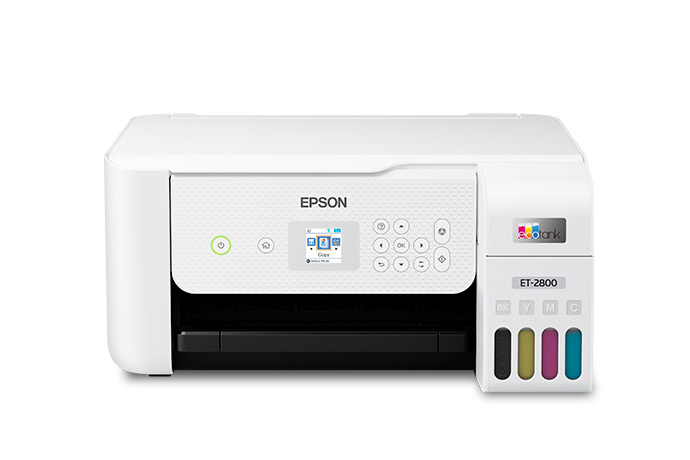
That record belongs to a very plain printer. Four ink tanks sit in the body of a flatbed all-in-one and fill from bottles, which is the whole EcoTank idea and, on this model, close to the whole feature list. It prints, copies and scans, joins a home network over Wi-Fi, and takes jobs from an iPhone through AirPrint as well as from Epson's app. Paper loads into a feed at the back, the status display is a simple segmented readout, and the spec sheet puts maximum resolution at 5,760 dpi.
What is missing reads like the list of step-up features. There is no document feeder, so multi-page originals go onto the glass one sheet at a time. There is no automatic duplex, no Ethernet socket and no fax. Color output is slow enough that a batch of handouts is something to start and then leave. The buyer it fits prints a little every week and wants ink to stop being a recurring thought: homework, forms, shipping labels, the odd photo for the fridge door.
Its place in Epson's line is the complication. It is no longer the newest entry EcoTank, a successor now shares its list price, and stock of this one has thinned. Check the shelf price before you study the spec sheet, because on this model the price decides the purchase.
Category strengths
Where the Epson EcoTank ET-2800 beats the median
- Has supertank / refillable ink ?
- A much lighter build ?4 kg vs 7.98 kg (median)
- A higher print resolution ?5,760 dpi vs 4,800 dpi (median)
Where the Epson EcoTank ET-2800 trails the median
- No automatic duplex printing ?
- No automatic document feeder ?
- A lower print speed (black) ?10 ppm vs 16 ppm (median)
- No ethernet ?
- A lower print speed (color) ?5 ppm vs 9 ppm (median)
- A lower input tray capacity ?100 sheets vs 150 sheets (median)
- A much lower output tray capacity ?30 sheets vs 67.5 sheets (median)
How this VS Score was computed
Score 27: each known spec is measured against the median of all printers (65 products), then weighted; 50 means level with that median. In classes of six or more, a value beyond the class’s 10th–90th percentile range counts as that limit, so one extreme product cannot set the scale. 61% of the scoreable weight could be used; unknown values, features not applicable to this class and proxies (battery capacity where a rated life exists) add or remove nothing.
| Specification | This product | Cohort median | Score weight | Points moved |
|---|---|---|---|---|
| Automatic duplex printing | No | 73% of the class have it | 1 | −48.0 |
| Automatic document feeder | No | 55% of the class have it | 1 | −48.0 |
| Print speed (black) | 10 | 16 | 2 | −38.0 |
| Supertank / refillable ink | Yes | 30% of the class have it | 0.5 | +25.0 |
| Duplex scanning | No | 23% of the class have it | 0.5 | −24.0 |
| Ethernet | No | 54% of the class have it | 0.5 | −24.0 |
| Touchscreen display | No | 45% of the class have it | 0.5 | −24.0 |
| Print speed (color) | 5 | 9 | 1 | −22.0 |
| Input tray capacity | 100 | 150 | 1 | −17.0 |
| Weight | 4 | 7.98 | 0.3 | +15.0 |
| Fax | No | 35% of the class have it | 0.2 | −9.6 |
| Output tray capacity | 30 | 67.5 | 0.3 | −8.4 |
| Print resolution | 5,760 | 4,800 | 0.5 | +5.0 |
Not scored: Color printing (standard for the class (88% have it)); Monthly duty cycle (unknown: not scored); All-in-one (standard for the class (85% have it)); ADF capacity (unknown: not scored); Wi-Fi (standard for the class (97% have it)); Wi-Fi Direct (standard for the class (90% have it)); USB (standard for the class (100% have it)); Apple AirPrint (standard for the class (97% have it)); Mobile app printing (standard for the class (100% have it)).
Editor’s note
The ET-2800 has been Epson's entry EcoTank since 2021, long enough to become the default answer to a common complaint: the sixty-dollar printer whose cartridges cost forty. Its four tanks fill from 65 ml bottles (black rated at 4,500 ISO pages, colors at 7,500), and Epson quotes up to two years of printing from the bottles in the box. Per page, it costs around a tenth of what cartridge machines charge, and that single fact has sold millions of EcoTanks.
A note on the name, because it trips shoppers up: the ET-2800 and ET-2803 are the same printer in different retail channels. If you see both, buy whichever is cheaper, because there is no hardware difference. This page covers the ET-2800 numbering.
As a machine it is deliberately basic. It prints, scans and copies over Wi-Fi 4, with a small non-touch display and a 100-sheet feed. There is no automatic duplex, no document feeder, no fax, no Ethernet, and color output is a slow 5 ISO ppm, the slowest of Epson's current entry group. The warranty is also capped at 30,000 sheets as well as by time.
The more current consideration is its own successor. The ET-2903 replaced it in 2025 with a slightly faster engine and higher-yield black bottles at the same list price, and Epson's direct stock of the ET-2800 has been patchy. At equal prices the newer machine is the obvious pick. The ET-2800 makes sense today mainly when discounted or when it is what is on the shelf.
For light-duty home printing where ink anxiety is the thing being bought away, it still does exactly what it always did. Just know that every two-sided page is a manual flip.
Specifications
Quality bars show where each figure sits between the lowest and highest of the 65 printers this VS Score is measured against.
Printing
Scanning & copying
Paper handling
Connectivity
Design
Sources and verification
Where the specifications come from
- Official product pageepson.com
- Independent testingrtings.com
Verification
- First published
- Specifications last checked
- Sheet completeness
- 22 of 24 specifications verified; the rest show as Unknown and are never estimated or scored
- Page type
- Product specification page — Compiled from the manufacturer’s published specifications and the cited sources; this is not a hands-on test.
- Basis
- Research-based: specifications and editorial text were compiled from the documents listed here and the manufacturer’s published data. We have not tested this unit ourselves; where independent measurements are mentioned they belong to the linked publication.
Printers with similar specs to the Epson EcoTank ET-2800
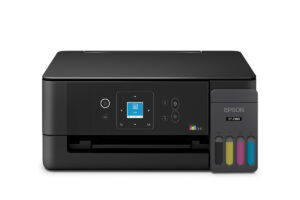
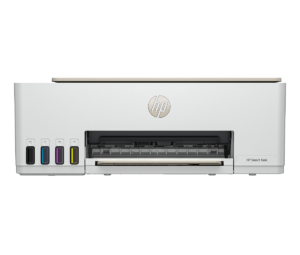
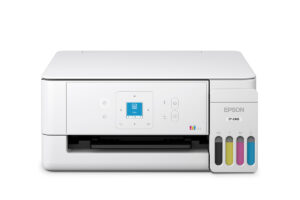
Ratings & reviews
No reviews yet. Be the first to share your experience.
The bottom line
The Epson EcoTank ET-2800 earns a VS Score of 27, below the median of the 65 printers it is measured against (a score of 50 is level with that median).
- Who it’s for
- Light-duty home printing at a discount price. This is the proven entry EcoTank, still doing exactly what made it the default cartridge-escape since 2021.
- Who should look elsewhere
- Buyers paying full price: the newer ET-2903 lists at the same price with a faster engine and higher-yield black bottles. No duplex or ADF here either.
- The trade-off that matters
- A superseded model's maturity against its successor's better numbers. It is worth it only when the shelf price says so.
- The main alternative
- Epson EcoTank ET-2903 is the direct replacement at the same list price, and the version to buy when both are available for similar money.
The VS Score is calculated from the weighted specifications above, each measured against the median of comparable printers — a shortlisting guide, not a substitute for your own priorities. See how we score.