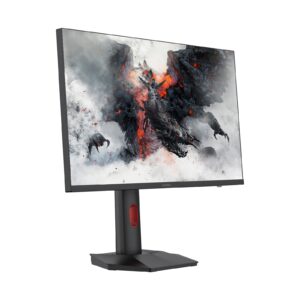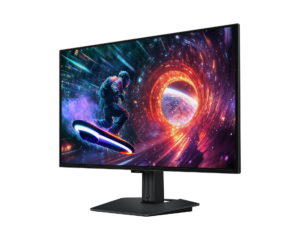
ASUS ROG Swift OLED PG27AQWP-G Edition 20: Specs & Verdict
Buying a 27-class OLED means choosing which axis to spend on, because no panel yet gives you both. One route takes the resolution and accepts a merely good refresh rate. The other takes extreme motion clarity and stays at the lower resolution. The PG27AQWP sits firmly at the second extreme, and ROG has built it for people who have already made that choice deliberately.
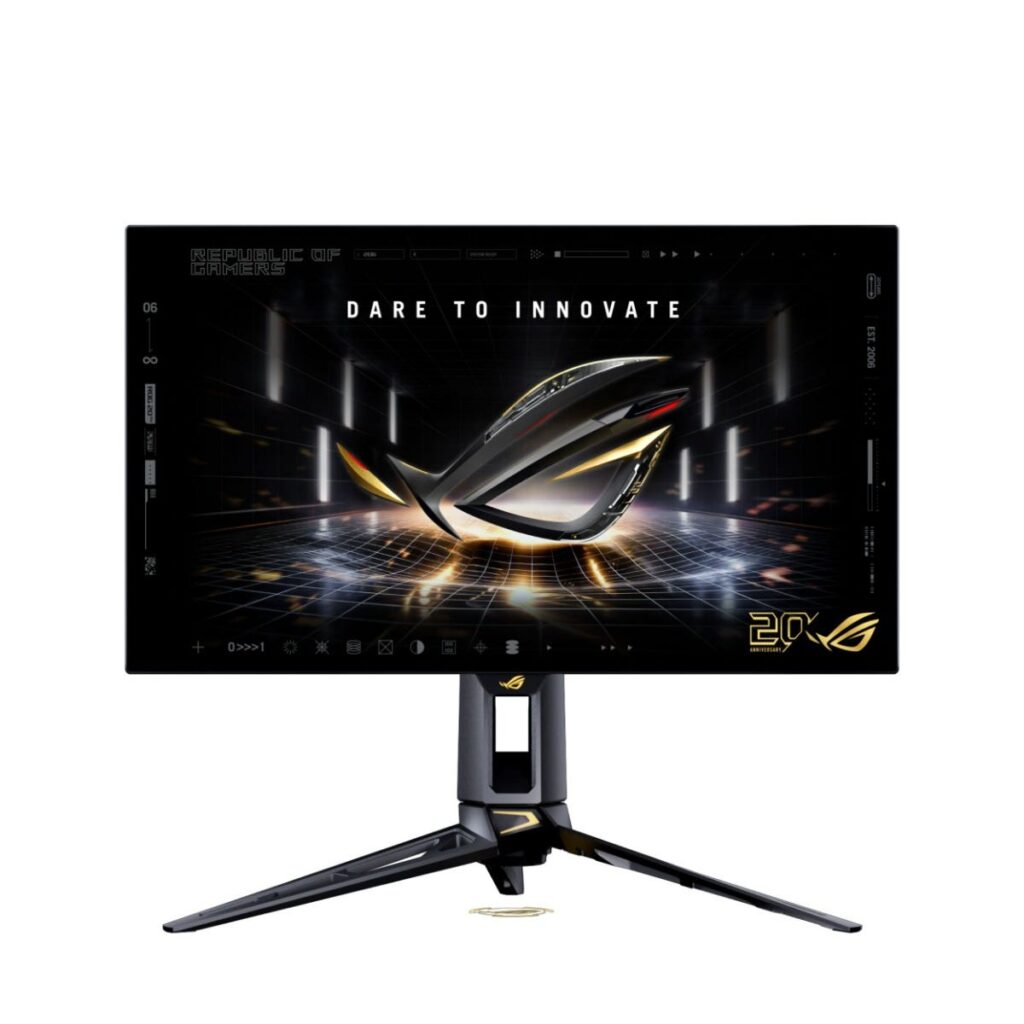
This particular version is the anniversary edition of that monitor, a translucent black chassis with gold-plated detailing produced to mark twenty years of the ROG brand. Mechanically and electrically it is the model ASUS already sells in white, which makes the finish the only real variable, a point the note below takes up properly.
The panel is a tandem WOLED, an approach that stacks two emissive layers instead of one. In practice that buys headroom: the display can be driven harder for bright highlights, and the work is shared between the layers, which is why manufacturers have grown willing to write longer burn-in cover into the warranty. ASUS layers its own panel-care routines on top, including a proximity sensor that blanks the screen when you leave the desk.
The surface is glossy. That is the right choice for a display whose central advantage is true black, and the wrong one for a room with a window behind the chair.
It suits a competitive player with a graphics card capable of driving the fastest mode, and a collector who wants the anniversary finish on the desk. It is a poor choice as the only screen on a desk that also has to get through a working day, for practical reasons rather than aesthetic ones, and those are worth reading before the finish decides it for you.
Category strengths
Where the ASUS ROG Swift OLED PG27AQWP-G Edition 20 beats the median
- A much higher refresh rate ?540 Hz vs 360 Hz (median)
- A faster response time ?0.02 ms vs 0.03 ms (median)
- Higher peak brightness ?1,500 nits vs 1,300 nits (median)
How this VS Score was computed
Score 55: each known spec is measured against the median of OLED gaming monitors, under 27 inches (5 products), then weighted; 50 means level with that median. In classes of six or more, a value beyond the class’s 10th–90th percentile range counts as that limit, so one extreme product cannot set the scale. 69% of the scoreable weight could be used; unknown values, features not applicable to this class and proxies (battery capacity where a rated life exists) add or remove nothing.
| Specification | This product | Cohort median | Score weight | Points moved |
|---|---|---|---|---|
| Refresh rate | 540 | 360 | 1.2 | +30.0 |
| Response time | 0.02 | 0.03 | 0.8 | +20.0 |
| USB-C | No — held to half its range (fewer than six products in this class list it) | 40% of the class have it | 0.5 | −12.5 |
| Motion blur reduction | Yes — held to half its range (fewer than six products in this class list it) | 75% of the class have it | 0.3 | +7.5 |
| Peak brightness | 1,500 | 1,300 | 0.8 | +6.4 |
| HDR | True Black 500 | True Black 400 | 0.5 | +5.0 |
| Screen size | 26.5 | 26.5 | 1.2 | +0.0 |
| Resolution | 1440p | 1440p | 1.2 | +0.0 |
| Panel type | OLED | OLED | 0.8 | +0.0 |
| Color depth | 10 | 10 | 0.3 | +0.0 |
| Contrast ratio | 1,500,000 | 1,500,000 | 0.6 | +0.0 |
| DCI-P3 coverage | 99.5 | 99 | 0.6 | +0.0 |
| Pixel density | 111 | 111 | 0.5 | +0.0 |
| Adaptive sync | G-Sync Compatible | G-Sync Compatible | 0.6 | +0.0 |
| HDMI ports | 2 | 2 | 0.4 | +0.0 |
| DisplayPort inputs | 1 | 1 | 0.4 | +0.0 |
Not scored: Local dimming (unknown: not scored); Local dimming zones (unknown: not scored); Variable refresh rate (standard for the class (100% have it)); Input lag (unknown: not scored); Height adjustment (standard for the class (100% have it)); Tilt (standard for the class (100% have it)); Swivel (standard for the class (100% have it)); Pivot (standard for the class (100% have it)); USB-C power delivery (unknown: not scored); USB hub (standard for the class (80% have it)); Built-in speakers (not applicable: only 0% of this class have it); Headphone output (standard for the class (100% have it)); KVM switch (unknown: not scored); Webcam (unknown: not scored); Microphone (unknown: not scored); Ethernet (unknown: not scored); Picture-by-picture (unknown: not scored).
Editor’s note
Think of the Edition 20 as a trim level. ASUS lists it as its own model and it carries its own price, but every measurable line on the specification page matches the standard PG27AQWP-W: the same tandem panel, the same dual mode, the same inputs and the same burn-in cover. What you are choosing is a translucent black chassis with 24-karat gold-plated details and anniversary branding on the rear. If that appeals to you, nothing else on the market does it. If it does not, the white version is the better buy.
The panel itself I rate highly. Tandem WOLED runs brighter than earlier WOLED generations, with a quoted peak of 1500 nits in small highlights, and the extra layer shares the load so the burn-in risk that has shadowed OLED monitors is lower, which is what makes the warranty credible. The 0.02 ms response time is real OLED behavior rather than a marketing overdrive figure, and combined with the top refresh rate it produces motion clarity that no LCD in this category can approach. Only a current high-end graphics card with the newest DisplayPort standard sustains the native mode without compression, and most games will not reach the frame rates that justify it.
The part that would make me hesitate is versatility. There is no USB-C input, so a laptop needs an adapter and cannot charge from the screen, and there is no KVM. The glossy finish is glorious in a dim room and a mirror in a bright one. At 26.5 inches the panel is a touch smaller than the class name suggests.
For a competitive player who already owns the PG27AQWP-W there is no reason to upgrade. For someone buying fresh, decide first whether you want speed or resolution. The ASUS ROG Swift OLED PG27UCDM trades refresh rate for a 4K panel at similar money, and for many people that is the more useful screen. Only then ask whether the gold trim is worth the extra.
Specifications
Quality bars show where each figure sits between the lowest and highest of the 5 OLED gaming monitors, under 27 inches this VS Score is measured against.
Picture
Gaming
Ergonomics & design
Connectivity
Features
Sources and verification
Where the specifications come from
- Official product pagerog.asus.com
- Retailer listing (cross-check)amazon.com
Verification
- First published
- Specifications last checked
- Sheet completeness
- 30 of 42 specifications verified; the rest show as Unknown and are never estimated or scored
- Page type
- Product specification page — Compiled from the manufacturer’s published specifications and the cited sources; this is not a hands-on test.
- Basis
- Research-based: specifications and editorial text were compiled from the documents listed here and the manufacturer’s published data. We have not tested this unit ourselves; where independent measurements are mentioned they belong to the linked publication.
Where to buy
Prices and availability may change. Check the retailer before buying. We may earn a commission on purchases.
Price history
Monitors with similar specs to the ASUS ROG Swift OLED PG27AQWP-G Edition 20

Ratings & reviews
No reviews yet. Be the first to share your experience.
The bottom line
The ASUS ROG Swift OLED PG27AQWP-G Edition 20 earns a VS Score of 55, above the median of the 5 OLED gaming monitors, under 27 inches it is measured against (a score of 50 is level with that median).
- Who it’s for
- A competitive player with a top-end graphics card who wants the fastest OLED available and likes the anniversary black-and-gold finish enough to pay for it.
- Who should look elsewhere
- Anyone who wants one monitor for work and play: there is no USB-C, no KVM and no speakers, and the glossy panel struggles in a bright room.
- The trade-off that matters
- The finish is the only thing you get for the premium: the panel, the ports and the warranty are identical to the standard white PG27AQWP-W.
- The main alternative
- ASUS ROG Swift OLED PG27AQWP-W: the same monitor in white, for less money.
The VS Score is calculated from the weighted specifications above, each measured against the median of comparable OLED gaming monitors, under 27 inches — a shortlisting guide, not a substitute for your own priorities. See how we score.