SteelSeries Rival Pro Mini: Specs, Price, Pros & Cons
SteelSeries gives the Rival Pro Mini two sizes on its own product page. A banner that lines up the four Pro mice puts the Mini at 118 x 62.5 x 36.2 mm. The spec table and the family reference list under it say 120.7 x 65.4 x 40.5 mm. Those smaller figures are the Sensei Pro Mini's, the symmetrical sibling, so anyone sizing this mouse from the banner is off by about 4 mm in height and 3 mm in width.
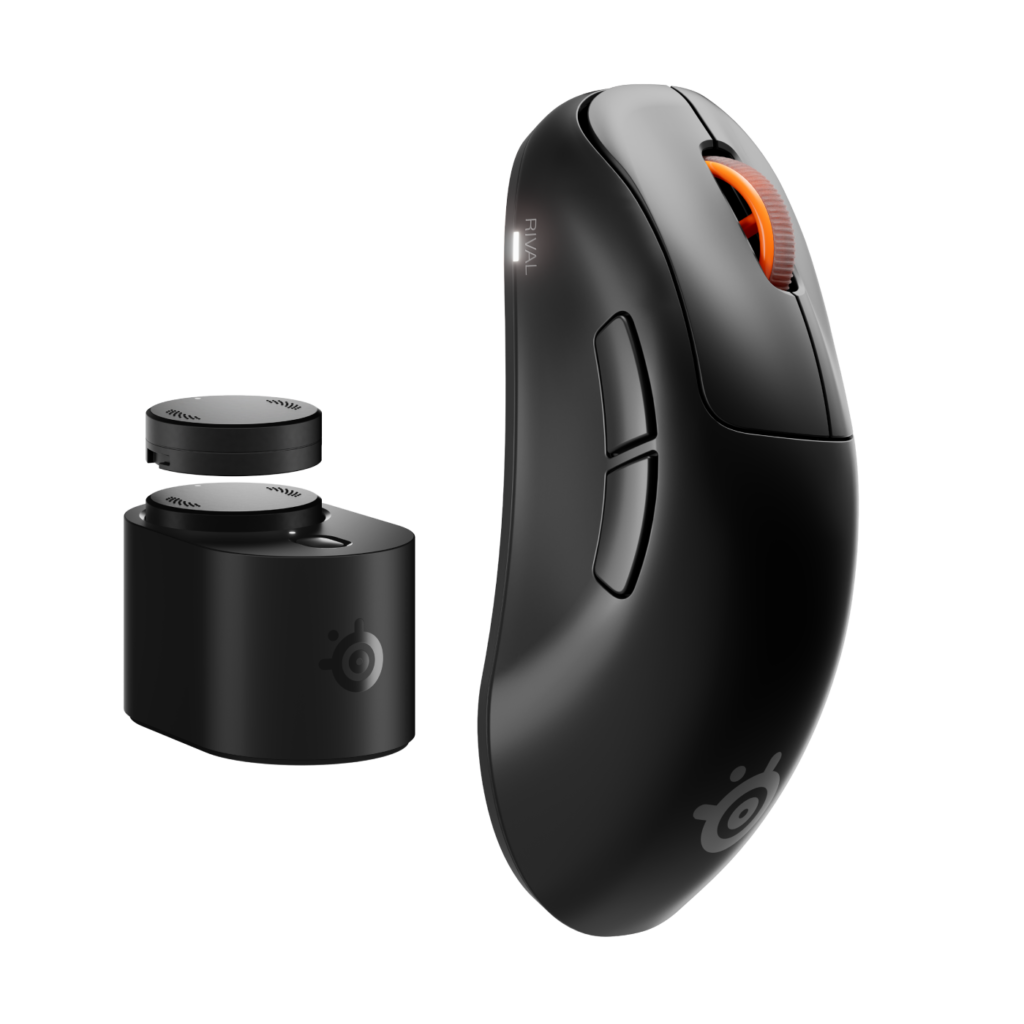
The Rival Pro Mini is the smaller of the two right-handed shells in SteelSeries' new Pro line, announced at the end of September 2026 and in stores since October 13. It shares the TrueMove 42K Pro sensor, the optical main switches and the 8,000 Hz polling of the other three, and the black version weighs 49 g. A setting SteelSeries calls SuperSync lets the sensor report at 1,000, 2,000 or 4,000 Hz while clicks still go out at 8,000 Hz, for games whose engines cannot use the full sensor rate.
SteelSeries skipped 2.4 GHz for Ultra Wideband, a link in the 6 GHz and higher range. The mouse talks to a base station that sits on the desk and plugs into the PC by cable. There is no Bluetooth. Away from that station it needs a travel receiver, which is sold separately and takes over automatically once paired.
A second battery charges in the base station while the first one runs the mouse, and the two trade places with a press and a twist. SteelSeries lists PlayStation and Xbox Series consoles next to Windows, with a warning that not every feature works on them.
Category strengths
Where the SteelSeries Rival Pro Mini beats the median
- A much higher polling rate ?8,000 Hz vs 1,000 Hz (median)
- A much higher wireless polling rate ?8,000 Hz vs 1,000 Hz (median)
- A much higher max sensitivity ?42,000 DPI vs 25,600 DPI (median)
- A lighter build ?49 g vs 89 g (median)
- More supported grip styles ?
- A higher max tracking speed ?800 IPS vs 650 IPS (median)
- A higher max acceleration ?70 G vs 50 G (median)
- A higher switch lifespan ?100 million clicks vs 80 million clicks (median)
Where the SteelSeries Rival Pro Mini trails the median
- Much shorter battery life ?60 h vs 130 h (median)
How this VS Score was computed
Score 74: each known spec is measured against the median of all mice (83 products), then weighted; 50 means level with that median. In classes of six or more, a value beyond the class’s 10th–90th percentile range counts as that limit, so one extreme product cannot set the scale. 62% of the scoreable weight could be used; unknown values, features not applicable to this class and proxies (battery capacity where a rated life exists) add or remove nothing.
| Specification | This product | Cohort median | Score weight | Points moved |
|---|---|---|---|---|
| Polling rate | 8,000 | 1,000 | 0.8 | +40.0 |
| Weight | 49 — capped at the class’s lower range (49.5) | 89 | 1 | +40.0 |
| Max sensitivity | 42,000 | 25,600 | 1 | +32.0 |
| Wireless polling rate | 8,000 | 1,000 | 0.5 | +25.0 |
| Battery life | 60 — capped at the class’s lower range (70) | 130 | 0.8 | −18.4 |
| Adjustable lift-off distance | Yes | 65% of the class have it | 0.3 | +15.0 |
| Grip styles | 3 | 2 | 0.4 | +10.0 |
| Max tracking speed | 800 | 650 | 0.8 | +9.6 |
| Max acceleration | 70 | 50 | 0.4 | +8.0 |
| Switch lifespan | 100 | 80 | 0.2 | +2.6 |
| Buttons | 6 | 6 | 0.6 | +0.0 |
Not scored: Horizontal scrolling (unknown: not scored); Free-spin scroll wheel (unknown: not scored); Click latency (too few comparable peers (2, need 3)); Debounce adjustment (unknown: not scored); Connection (unknown: not scored); USB-C charging (unknown: not scored); Battery capacity (unknown: not scored); Quick charge (unknown: not scored); Wireless charging (unknown: not scored); Onboard memory (standard for the class (88% have it)); Software customization (standard for the class (98% have it)); Adjustable weights (unknown: not scored); RGB lighting (unknown: not scored).
Editor’s note
Each battery lasts 16 hours at 8,000 Hz by SteelSeries' rating. Four hours of play a day means a swap every four days, a few seconds of work, and the spent battery goes straight onto the charger, so the cable never enters the routine. Razer's DeathAdder V4 Pro gets 22 hours at the same rate from one built-in battery and then has to be plugged in. For anyone who leaves 8,000 Hz on all the time, that makes the SteelSeries system the better design.
The price of that design is the base station. It is one more box on the desk with its own cable. The mouse speaks only Ultra Wideband, so using it on a work laptop means carrying the station along or buying the travel receiver. Anyone who moves one mouse between a gaming PC and an office machine should count that receiver as part of the cost from day one.
The full-size Rival Pro is only 5 mm longer and 4 g heavier than this Mini. SteelSeries steers fingertip and aggressive claw grips toward its Mini sizes, and palm grips toward the full-size shells. I would hesitate over this one for a palm grip, where the longer Rival Pro gives the hand more shell to rest on.
With a single profile stored on the mouse, a player who takes it to a LAN event and switches between games with different settings will redo them by hand or in SteelSeries' browser app.
Specifications
Quality bars show where each figure sits between the lowest and highest of the 83 mice this VS Score is measured against.
Sensor & tracking
Design & handling
Switches & latency
Connectivity
Battery
Features
Sources and verification
Where the specifications come from
- Official product pagesteelseries.com
Verification
- First published
- Specifications last checked
- Sheet completeness
- 24 of 34 specifications verified; the rest show as Unknown and are never estimated or scored
- Page type
- Product specification page — Compiled from the manufacturer’s published specifications and the cited sources; this is not a hands-on test.
- Basis
- Research-based: specifications and editorial text were compiled from the documents listed here and the manufacturer’s published data. We have not tested this unit ourselves; where independent measurements are mentioned they belong to the linked publication.
Where to buy
Prices and availability may change. Check the retailer before buying. We may earn a commission on purchases.
Price history
Mice with similar specs to the SteelSeries Rival Pro Mini
Ratings & reviews
No reviews yet. Be the first to share your experience.
The bottom line
The SteelSeries Rival Pro Mini earns a VS Score of 74, above the median of the 83 mice it is measured against (a score of 50 is level with that median).
- Who it’s for
- A right-handed fingertip or claw player with a small to medium hand who wants 8,000 Hz wireless and would rather swap a battery than plug in a cable.
- Who should look elsewhere
- Left-handers, anyone who needs Bluetooth for a work laptop, and anyone who carries one mouse between machines without buying the separate travel receiver should look elsewhere.
- The trade-off that matters
- The second battery and the radio both live in the base station, so the desk gains another box with its own cable, and the mouse stays tied to that box unless you pay for a second receiver.
- The main alternative
- Razer DeathAdder V4 Pro: a larger right-handed shell with one built-in battery and a cable mode, a better fit for bigger hands and palm grips.
The VS Score is calculated from the weighted specifications above, each measured against the median of comparable mice — a shortlisting guide, not a substitute for your own priorities. See how we score.