Corsair DARKSTAR WIRELESS: Specs, Features, Pros & Cons
Between an ordinary six-button mouse and a full MMO grid sits a gap that very few products try to fill. The DARKSTAR WIRELESS aims straight at it: more controls than a normal mouse, arranged so you do not have to memorize a numeric keypad under your thumb.
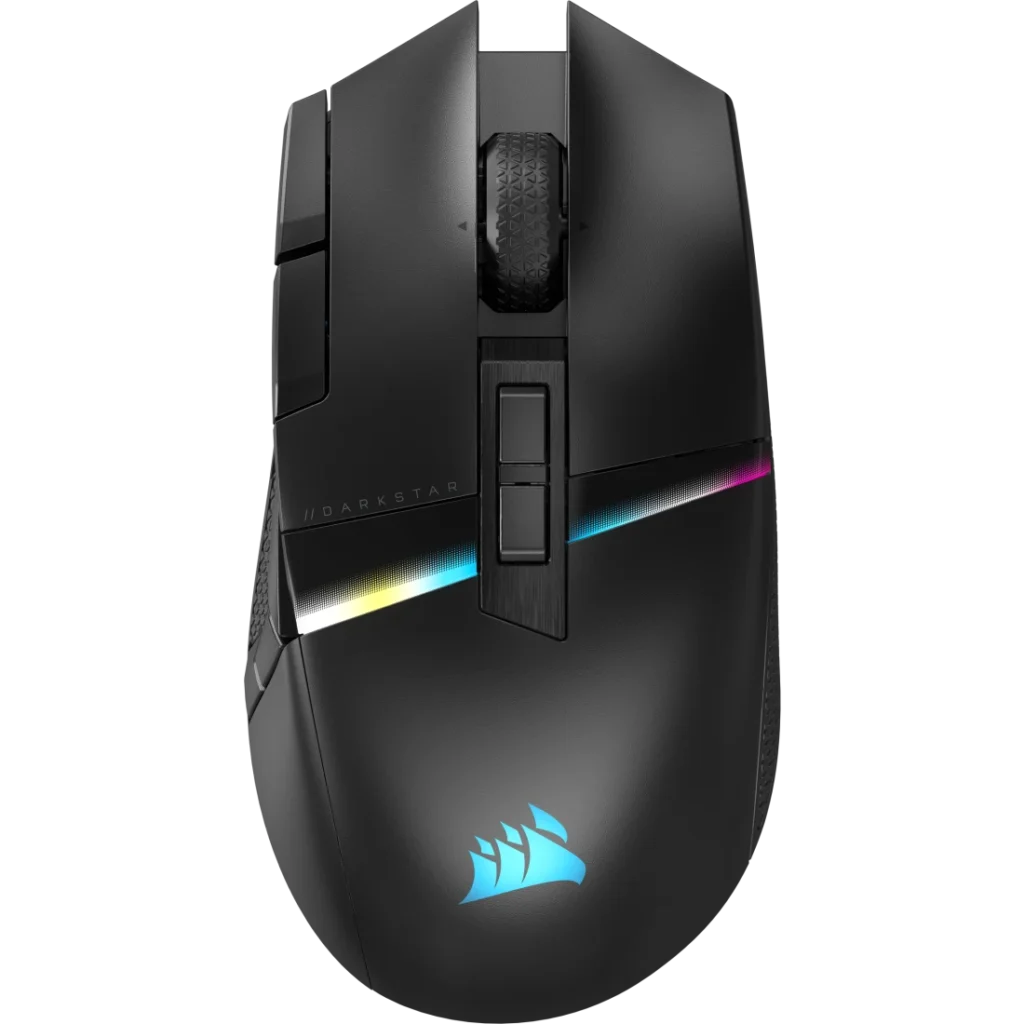
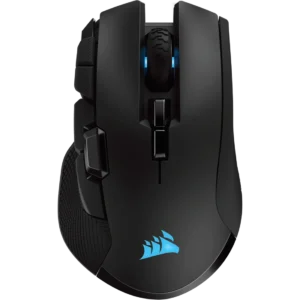
Rather than a flat rectangular grid, the thumb buttons are laid out on a curve around where the thumb naturally rests, in two rows meant to be told apart by feel. The intent is that you can find them without a training period, which is the usual complaint about traditional MMO layouts. Whether it works for you depends on thumb length and grip, and it is worth handling one in person if you get the chance.
The rest is unambiguously current. A recent Corsair sensor, optical primary switches, a high polling rate, PTFE feet, and three ways to connect: a low-latency dongle for games, Bluetooth for a laptop, and a USB-C cable for when the battery is flat. Moving one mouse between a gaming machine and a work one is a real use case here.
Two things should temper expectations. It is a broad right-handed shell built around palm and claw grips, so small hands and left-handers are excluded outright. And although it is lighter than most multi-button rivals, it is nowhere near the ultralight class, so nobody should buy it expecting a competitive shooter mouse that happens to carry extra keys.
The buyer this suits is someone who wants shortcuts, in an ability-heavy game or a video timeline or a design tool, and who has been put off before by how unusable a dense button grid feels in the first two weeks.
Category strengths
Where the Corsair DARKSTAR WIRELESS beats the median
- More buttons ?15 vs 6 (median)
- A much higher polling rate ?2,000 Hz vs 1,000 Hz (median)
- A much higher wireless polling rate ?2,000 Hz vs 1,000 Hz (median)
- More connection options ?
- Has RGB lighting ?
- A slightly higher max sensitivity ?26,000 DPI vs 25,600 DPI (median)
Where the Corsair DARKSTAR WIRELESS trails the median
- Much shorter battery life ?80 h vs 150 h (median)
- A slightly heavier build ?96 g vs 89 g (median)
How this VS Score was computed
Score 62: each known spec is measured against the median of all mice (81 products), then weighted; 50 means level with that median. In classes of six or more, a value beyond the class’s 10th–90th percentile range counts as that limit, so one extreme product cannot set the scale. 73% of the scoreable weight could be used; unknown values, features not applicable to this class and proxies (battery capacity where a rated life exists) add or remove nothing.
| Specification | This product | Cohort median | Score weight | Points moved |
|---|---|---|---|---|
| Polling rate | 2,000 | 1,000 | 0.8 | +40.0 |
| Buttons | 15 — capped at the class’s upper range (13) | 6 | 0.6 | +30.0 |
| Wireless polling rate | 2,000 | 1,000 | 0.5 | +25.0 |
| Connection | 3 | 2 | 0.8 | +20.0 |
| Battery life | 80 | 150 | 0.8 | −18.4 |
| USB-C charging | Yes | 67% of the class have it | 0.3 | +15.0 |
| RGB lighting | Yes | 46% of the class have it | 0.2 | +10.0 |
| Horizontal scrolling | No | 45% of the class have it | 0.2 | −9.6 |
| Free-spin scroll wheel | No | 34% of the class have it | 0.2 | −9.6 |
| Weight | 96 | 89 | 1 | −4.0 |
| Max sensitivity | 26,000 | 25,600 | 1 | +1.0 |
| Max tracking speed | 650 | 650 | 0.8 | +0.0 |
| Max acceleration | 50 | 50 | 0.4 | +0.0 |
| Grip styles | 2 | 2 | 0.4 | +0.0 |
Not scored: Adjustable lift-off distance (unknown: not scored); Click latency (unknown: not scored); Switch lifespan (unknown: not scored); Debounce adjustment (unknown: not scored); Battery capacity (unknown: not scored); Quick charge (unknown: not scored); Wireless charging (not applicable: only 14% of this class have it); Onboard memory (standard for the class (86% have it)); Software customization (standard for the class (97% have it)); Adjustable weights (not applicable: only 2% of this class have it).
Editor’s note
The DARKSTAR WIRELESS is built for people who want many programmable controls without the dense telephone-style grid of a traditional MMO mouse. Six buttons arranged around the left thumb sit within a total of fifteen programmable inputs, making it practical for ability-heavy games, video editing, and app shortcuts. The right-handed shell is broad and supportive, and at 96 grams it is lighter than many multi-button rivals, though still far from an ultralight FPS mouse.
Corsair's MARKSMAN 26K sensor, 2,000 Hz polling, optical primary switches, and PTFE feet are all current parts. Three connection modes (Slipstream 2.4 GHz, Bluetooth and wired USB-C) make it easy to share between a gaming PC and a work machine. Battery life reaches up to 80 hours over Bluetooth and about 65 hours on the dongle under stated conditions. Lighting the seven RGB zones shortens both.
The unusual thumb cluster needs an adjustment period. Buyers with small hands should test reach, while anyone who rests the thumb heavily may trigger commands until profiles are tuned. iCUE has deep customization and five onboard profiles, but it is a large software package and can feel excessive if only basic remapping is needed. There is no wireless charging.
It suits MMO, MOBA and simulation players, and shortcut-heavy work. It is not the first choice for minimal software, left-handed use, or the lowest possible weight. Compare the shape with Corsair's Scimitar before buying: the DARKSTAR's radial cluster is easier for some hands and worse for others. Confirm listings show the exact DARKSTAR model, as Corsair's NIGHTSABRE has a related silhouette but a different button layout.
Specifications
Quality bars show where each figure sits between the lowest and highest of the 81 mice this VS Score is measured against.
Sensor & tracking
Design & handling
Switches & latency
Connectivity
Battery
Features
Sources and verification
Where the specifications come from
- Official product pagecorsair.com
- Independent testingrtings.com
Verification
- First published
- Specifications last checked
- Sheet completeness
- 28 of 34 specifications verified; the rest show as Unknown and are never estimated or scored
- Page type
- Product specification page — Compiled from the manufacturer’s published specifications and the cited sources; this is not a hands-on test.
- Basis
- Research-based: specifications and editorial text were compiled from the documents listed here and the manufacturer’s published data. We have not tested this unit ourselves; where independent measurements are mentioned they belong to the linked publication.
Mice with similar specs to the Corsair DARKSTAR WIRELESS
Ratings & reviews
No reviews yet. Be the first to share your experience.
The bottom line
The Corsair DARKSTAR WIRELESS earns a VS Score of 62, above the median of the 81 mice it is measured against (a score of 50 is level with that median).
- Who it’s for
- A right-handed player or editor who wants a dozen-plus shortcuts under one hand and gave up on MMO grids that take weeks to learn.
- Who should look elsewhere
- Left-handers and small hands are shut out, and it is the wrong pick for anyone who wants long battery life or a light shooter mouse.
- The trade-off that matters
- The curved thumb cluster is the whole bet. If your thumb falls on it naturally, the extra keys earn their place, and if it does not, you are left with a heavy mouse and keys you press by accident.
- The main alternative
- Corsair SCIMITAR ELITE WIRELESS: a conventional thumb grid and longer battery life, for hands the radial layout does not suit
The VS Score is calculated from the weighted specifications above, each measured against the median of comparable mice — a shortlisting guide, not a substitute for your own priorities. See how we score.