Corsair K70 RGB TKL: Specs, Features, Pros & Cons
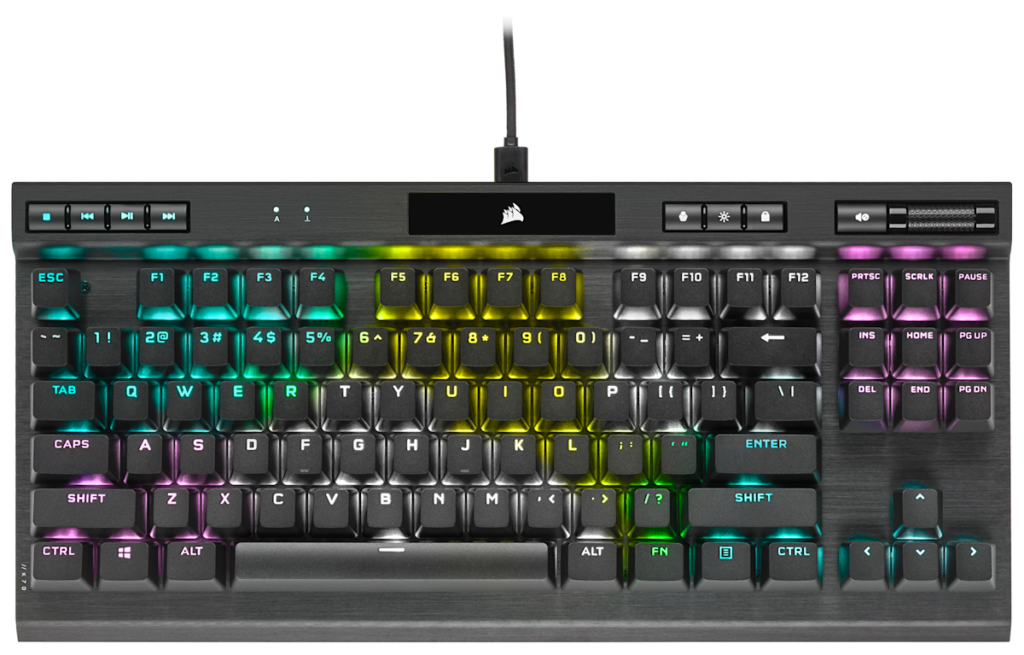
A hardware switch on the back of the K70 RGB TKL drops the lighting to a fixed setting and locks out macros, and that tournament mode is the thing Corsair designed this tenkeyless board around.
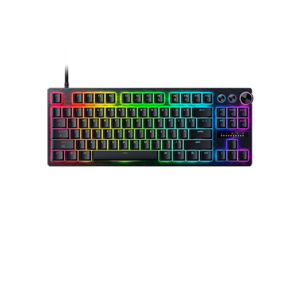
The layout keeps the function row, the arrow keys and the navigation block and leaves off the number pad, which frees room for the mouse and makes the board easier to carry to a LAN or a match. It predates Corsair's K70 PRO TKL, the later tenkeyless with magnetic switches and dampening layers, and it still sells beside that model. Programmable keys and RGB lighting come as standard, and full N-key rollover registers every press when several keys are held at once.
Over its cable it polls at 8,000 Hz, eight times the rate of an ordinary office keyboard. The keycaps are PBT, which holds its texture where ABS goes glossy, and there are dedicated media keys. Cherry MX Speed Silver switches are fitted to this version, one of several switch builds Corsair sold under the same name. Three things count against it. Its switches are soldered, so the build you buy is the build you keep. A cable is its only connection. And the case has no sound dampening, which leaves it louder and more hollow than boards packed with foam.
Its natural owner is a player who travels to events, wants a lock that stops a stray macro in a match, and would take a proven older board at a lower price over the newest one. Long documents call for a softer, deeper switch than the one fitted here.
Category strengths
Where the Corsair K70 RGB TKL beats the median
- A much higher polling rate ?8,000 Hz vs 1,000 Hz (median)
Where the Corsair K70 RGB TKL trails the median
- No hot-swappable switches ?
- Fewer connection options ?
- No sound dampening ?
How this VS Score was computed
Score 34: each known spec is measured against the median of all keyboards (101 products), then weighted; 50 means level with that median. In classes of six or more, a value beyond the class’s 10th–90th percentile range counts as that limit, so one extreme product cannot set the scale. 47% of the scoreable weight could be used; unknown values, features not applicable to this class and proxies (battery capacity where a rated life exists) add or remove nothing.
| Specification | This product | Cohort median | Score weight | Points moved |
|---|---|---|---|---|
| Polling rate | 8,000 | 1,000 | 0.7 | +35.0 |
| Hot-swappable | No | 61% of the class have it | 0.6 | −28.8 |
| Connection | 1 | 3 | 0.8 | −26.4 |
| Rapid trigger | No | 25% of the class have it | 0.5 | −24.0 |
| Adjustable actuation | No | 24% of the class have it | 0.4 | −19.2 |
| Sound dampening | No | 76% of the class have it | 0.3 | −14.4 |
| Switch technology | Mechanical | Mechanical | 1 | +0.0 |
| Keycap material | PBT | PBT | 0.4 | +0.0 |
| Backlight | RGB | RGB | 0.3 | +0.0 |
Not scored: Actuation force (unknown: not scored); N-key rollover (standard for the class (85% have it)); Analog input (not applicable: only 14% of this class have it); Wired latency (unknown: not scored); Wireless latency (unknown: not scored); Front height (unknown: not scored); Bluetooth devices (unknown: not scored); Battery life (unknown: not scored); Battery capacity (unknown: not scored); USB passthrough (not applicable: only 4% of this class have it); Programmable keys (standard for the class (99% have it)); Media controls (standard for the class (97% have it)); Rotary knob (unknown: not scored); Onboard profiles (standard for the class (89% have it)); Configuration software (standard for the class (95% have it)).
Editor’s note
The K70 RGB TKL is a few years old now, and that turns out to be the most useful thing to know about it. It has not aged badly, and it is still sold alongside newer boards at a much lower price.
It was built for tournaments and it shows. Its signature feature is the physical tournament switch on the back: flip it and the board drops to static lighting and locks out macros, so nothing you configured at home can fire at the wrong moment. Because it is a hardware switch, competitors trust it. The USB-C cable is detachable with a latch, and the aluminum frame and 900 g weight survive being carried around.
This particular version uses Cherry MX Speed Silver switches, and they deserve a warning. At 1.2 mm the actuation is shallow, excellent for fast repeated inputs but typo-prone if you rest your fingers on the keys while writing. Corsair sold the same board with MX Red, MX Silent and its own OPX optical switches, so check the switch line on any listing. The PBT double-shot keycaps are 1.5 mm thick and will not go shiny.
Where it shows its age is acoustics and flexibility. There is no sound-dampening foam, so it sounds harder and more hollow than the foam-stuffed boards Corsair sells today, and the switches are soldered, so there is no hot-swapping. There is no wrist rest in the box and no USB passthrough.
A buying note: Amazon's search results are dominated by the K70 CORE TKL, which is a different and later keyboard. Match the full name.
Buy it as a durable, tournament-ready board at a discount. Skip it if you care about typing sound or want to change switches.
Specifications
Quality bars show where each figure sits between the lowest and highest of the 101 keyboards this VS Score is measured against.
Switches & typing
Performance
Layout & size
Connectivity
Build & sound
Features
Sources and verification
Where the specifications come from
- Official product pagecorsair.com
- Independent testingrtings.com
Verification
- First published
- Specifications last checked
- Sheet completeness
- 23 of 34 specifications verified; the rest show as Unknown and are never estimated or scored
- Page type
- Product specification page — Compiled from the manufacturer’s published specifications and the cited sources; this is not a hands-on test.
- Basis
- Research-based: specifications and editorial text were compiled from the documents listed here and the manufacturer’s published data. We have not tested this unit ourselves; where independent measurements are mentioned they belong to the linked publication.
Keyboards with similar specs to the Corsair K70 RGB TKL
Ratings & reviews
No reviews yet. Be the first to share your experience.
The bottom line
The Corsair K70 RGB TKL earns a VS Score of 34, below the median of the 101 keyboards it is measured against (a score of 50 is level with that median).
- Who it’s for
- A tournament player who wants a durable, portable tenkeyless with a hardware lock-out switch, and can find it discounted.
- Who should look elsewhere
- Anyone who cares how typing sounds, or wants to change switches later, should look elsewhere. Writers will also fight the shallow switches.
- The trade-off that matters
- The shallow Speed Silver switches are quick for repeated inputs and typo-prone for writing, and since they are soldered you are keeping them.
- The main alternative
- Corsair K70 PRO TKL: Corsair's later tenkeyless with hot-swap magnetic switches, rapid trigger and dampening layers.
The VS Score is calculated from the weighted specifications above, each measured against the median of comparable keyboards — a shortlisting guide, not a substitute for your own priorities. See how we score.