Ducky One 2 Mini V2: Specs, Features, Pros & Cons
Ducky revised the One 2 Mini once, and this V2 is the second build: the same compact board as the original, with the stabilizers under the long keys and the lighting firmware fixed after owners of the first one complained.
It belongs to a range Ducky has since withdrawn, so a V2 today is an old-stock or second-hand purchase with no warranty. That puts it up against current compact boards, such as the Wooting 60HE v2 and Ducky's own One 3 Mini, which still have makers behind them and newer switch technology inside.
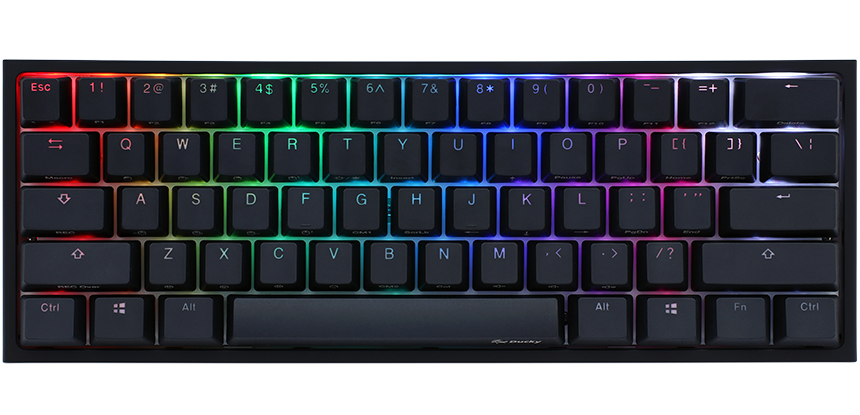
The layout drops the number pad, the function row, the arrow keys and the navigation block, and a function layer carries all of them. Inside the plain case are Cherry MX switches soldered to the board, doubleshot PBT keycaps, per-key RGB lighting and a detachable USB-C cable. Macros record straight into onboard profiles through key combinations, so nothing needs installing on any computer the board is plugged into. Media controls sit on the same layer, and full N-key rollover is standard. The limits are built in. Switches are soldered, so there is no hot-swapping. The only connection is a cable. And the case has no sound dampening, which gives it a higher, hollower sound than the gasket-mounted boards now sold at similar money.
Its buyer knows the small layout already, likes the look and feel of Ducky's classic keycaps, and wants it at a used price. What that buyer gives up is anything current: sockets for other switches, rapid trigger, a quieter case and a maker to call when something fails.
Category strengths
Where the Ducky One 2 Mini V2 trails the median
- No hot-swappable switches ?
- Fewer connection options ?
- No sound dampening ?
- No rotary knob ?
- No configuration software ?
How this VS Score was computed
Score 22: each known spec is measured against the median of all keyboards (101 products), then weighted; 50 means level with that median. In classes of six or more, a value beyond the class’s 10th–90th percentile range counts as that limit, so one extreme product cannot set the scale. 44% of the scoreable weight could be used; unknown values, features not applicable to this class and proxies (battery capacity where a rated life exists) add or remove nothing.
| Specification | This product | Cohort median | Score weight | Points moved |
|---|---|---|---|---|
| Hot-swappable | No | 61% of the class have it | 0.6 | −28.8 |
| Connection | 1 | 3 | 0.8 | −26.4 |
| Rapid trigger | No | 25% of the class have it | 0.5 | −24.0 |
| Adjustable actuation | No | 24% of the class have it | 0.4 | −19.2 |
| Sound dampening | No | 76% of the class have it | 0.3 | −14.4 |
| Rotary knob | No | 53% of the class have it | 0.2 | −9.6 |
| Configuration software | No | 95% of the class have it | 0.2 | −9.6 |
| Switch technology | Mechanical | Mechanical | 1 | +0.0 |
| Keycap material | PBT | PBT | 0.4 | +0.0 |
| Backlight | RGB | RGB | 0.3 | +0.0 |
Not scored: Actuation force (unknown: not scored); N-key rollover (standard for the class (85% have it)); Analog input (not applicable: only 14% of this class have it); Polling rate (unknown: not scored); Wired latency (unknown: not scored); Wireless latency (unknown: not scored); Front height (unknown: not scored); Bluetooth devices (unknown: not scored); Battery life (unknown: not scored); Battery capacity (unknown: not scored); USB passthrough (not applicable: only 4% of this class have it); Programmable keys (standard for the class (99% have it)); Media controls (standard for the class (97% have it)); Onboard profiles (standard for the class (89% have it)).
Editor’s note
The One 2 Mini V2 is the second revision of the keyboard that made 60% layouts mainstream, and the revision matters more than the name suggests.
The original had two irritations owners talked about constantly: inconsistent stabilizers on the longer keys, and firmware quirks around the RGB modes. V2 addressed both. Same 302 mm footprint, same 590 grams, same Cherry MX switches under doubleshot PBT keycaps, but a board that behaves better as shipped.
The layout is the whole proposition. Removing the number pad, function row, arrow keys and navigation cluster leaves something small enough to move the mouse where the numpad used to be, which is why competitive players adopted it. Everything removed still exists on the Fn layer, and after a week the arrows under I, J, K and L stop requiring thought. If that sounds unappealing, this is not a compromise you can meet halfway: buy a tenkeyless.
Ducky's usual strengths carry over. Six onboard profiles, hardware macro recording, per-key RGB with a large set of modes, a detachable USB-C cable, and no software of any kind.
The limitations are inherent rather than oversights. Switches are soldered, so no hot-swap. There is no case foam, so it sounds hollower and higher-pitched than modern gasket-mounted boards. And there is no wireless option anywhere in the range.
Availability is the real caveat: Ducky has delisted the One 2 line, so these are old stock or second-hand only.
Buy one if you want the classic 60 percent layout at a used price and can live with a soldered PCB. Look at the One 3 Mini or a modern gasket board if you want current support, hot-swap or a deeper sound.
Specifications
Quality bars show where each figure sits between the lowest and highest of the 101 keyboards this VS Score is measured against.
Switches & typing
Performance
Layout & size
Connectivity
Build & sound
Features
Sources and verification
Where the specifications come from
- Independent testingrtings.com
Verification
- First published
- Specifications last checked
- Sheet completeness
- 21 of 34 specifications verified; the rest show as Unknown and are never estimated or scored
- Page type
- Product specification page — Compiled from the manufacturer’s published specifications and the cited sources; this is not a hands-on test.
- Basis
- Research-based: specifications and editorial text were compiled from the documents listed here and the manufacturer’s published data. We have not tested this unit ourselves; where independent measurements are mentioned they belong to the linked publication.
Keyboards with similar specs to the Ducky One 2 Mini V2
Ratings & reviews
No reviews yet. Be the first to share your experience.
The bottom line
The Ducky One 2 Mini V2 earns a VS Score of 22, below the median of the 101 keyboards it is measured against (a score of 50 is level with that median).
- Who it’s for
- A player who wants Ducky's classic compact layout at a used price and has already learned to live on the function layer.
- Who should look elsewhere
- Skip it if you want hot-swap sockets, a deeper sound or a warranty. Anyone who dislikes layers should buy a tenkeyless instead.
- The trade-off that matters
- Soldered switches and a foamless case are fixed, so the feel and the hollow sound you get on day one are the ones you keep.
- The main alternative
- Wooting 60HE v2: a current board of the same size with hot-swap sockets, rapid trigger and a dampened case, with support behind it.
The VS Score is calculated from the weighted specifications above, each measured against the median of comparable keyboards — a shortlisting guide, not a substitute for your own priorities. See how we score.