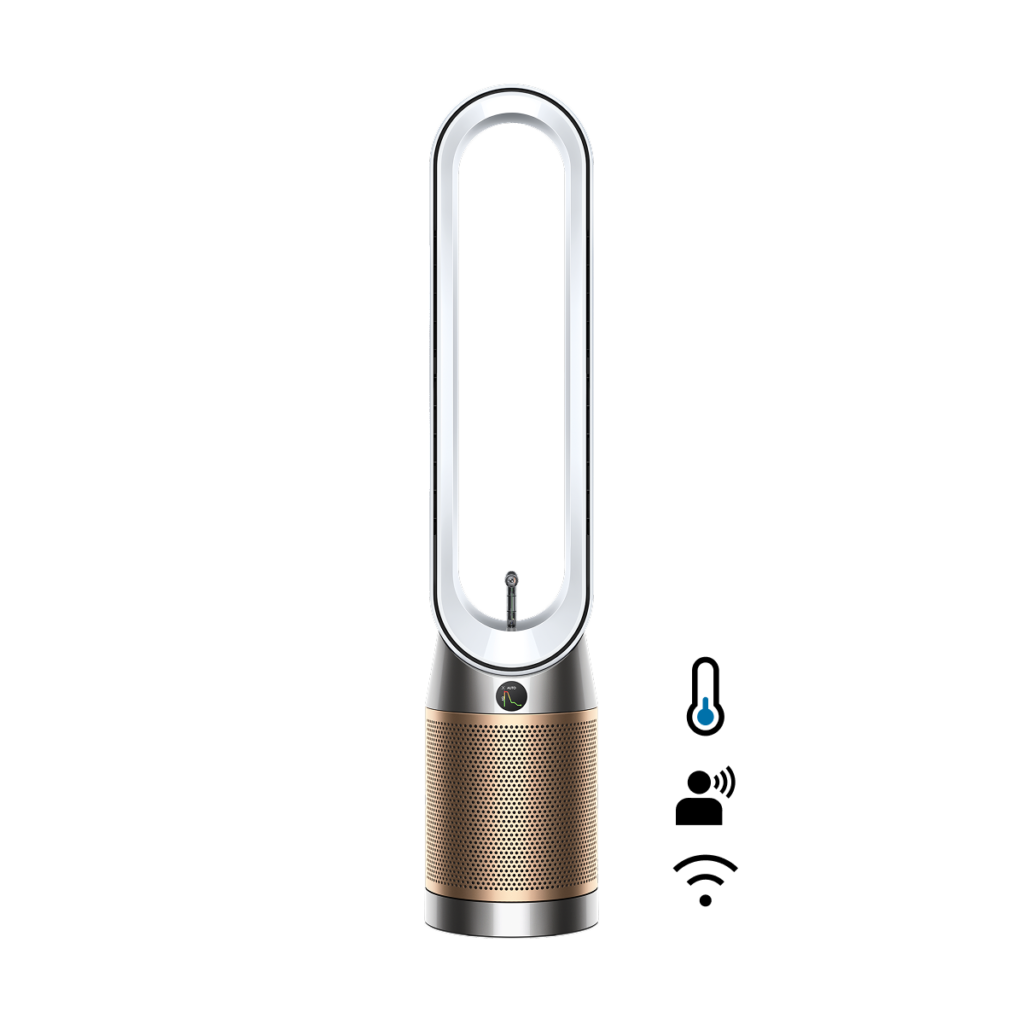
Dyson Find+Follow Purifier Cool: Specs, Pros & Cons
Strip away the headline and this is a purifying tower fan, Dyson's long-running format: a bladeless loop on a column that filters air and throws it across a room. What is new sits on top of that format without replacing it, and it is the reason the model exists at all, because the machine works out where people are and aims the airflow at them.
In Dyson's lineup it sits at the top of the cooling-only purifiers, above the plain Purifier Cool and beside the heating models that do the same job in winter. It does not heat. In a cold climate that single omission can decide the purchase outright, because Dyson's own heat-and-cool machines cost less than this one and cover both seasons.
Two things define it beyond the tracking. The filter is a sealed full-circumference cartridge combining particulate and carbon media in one yearly replacement, which is tidy but means the odor stage cannot be renewed on its own. And the pre-filter is not washable, so there is no free maintenance step in between cartridges.
What earns its keep day to day is the aiming, the oscillation and app scheduling. What does not is the specification sheet: Dyson publishes no airflow rating, no room-size figure, no noise table and no power draw, which makes an honest comparison against anything else in the category impossible. The empty cells below are Dyson's silence rather than a gap in our research.
It suits a warm-climate living room where one expensive object is expected to both cool and clean, and where the novelty is the point. Anyone shopping on measurable filtration should be looking at plainer machines.
Category strengths
Where the Dyson Find+Follow Purifier Cool trails the median
- No washable pre-filter ?
- A slightly heavier build ?5.36 kg vs 5.26 kg (median)
How this VS Score was computed
Score 70: each known spec is measured against the median of all air purifiers (41 products), then weighted; 50 means level with that median. In classes of six or more, a value beyond the class’s 10th–90th percentile range counts as that limit, so one extreme product cannot set the scale. 24% of the scoreable weight could be used; unknown values, features not applicable to this class and proxies (battery capacity where a rated life exists) add or remove nothing.
| Specification | This product | Cohort median | Score weight | Points moved |
|---|---|---|---|---|
| True HEPA filter | Yes | 61% of the class have it | 1.5 | +75.0 |
| App control | Yes | 70% of the class have it | 0.5 | +25.0 |
| Washable pre-filter | No | 54% of the class have it | 0.5 | −24.0 |
| Weight | 5.36 | 5.26 | 0.3 | −0.3 |
| Filter life | 12 | 12 | 1 | +0.0 |
Not scored: CADR (smoke) (unknown: not scored); Coverage area (unknown: not scored); Air changes per hour (unknown: not scored); Filtration stages (unknown: not scored); Activated carbon filter (standard for the class (100% have it)); Min noise level (unknown: not scored); Max noise level (unknown: not scored); Power consumption (unknown: not scored); Sleep mode (standard for the class (95% have it)); Air quality sensor (standard for the class (93% have it)); Auto mode (standard for the class (90% have it)); Voice assistant (unknown: not scored); Filter replacement indicator (standard for the class (97% have it)); Timer (standard for the class (88% have it)).
Editor’s note
The Find+Follow Purifier Cool is Dyson doing something no other purifier fan attempts: watching the room. An onboard camera and infrared sensing feed on-device AI that locates people (up to a claimed seventeen body key-points at a time) and steers the airflow at them, tilting and rotating a stepper-driven nozzle through up to 350 degrees. Two people in the room? It splits the oscillation between them. Everyone leaves? It stops oscillating, keeps purifying, and drops into auto mode until someone returns.
Dyson is emphatic that the vision processing is local-only: images are analyzed in real time and immediately discarded, never stored or uploaded. Privacy-cautious buyers will still want to know a camera is present at all, because it is the whole mechanism.
The purifier underneath is Dyson's current best practice: a fully sealed 360-degree combi filter pairing an H13-grade HEPA layer with the K-Carbon formulation, replaced yearly with the LCD and app tracking its life. This is, unusually for recent Dyson purifiers, a genuine certified-grade HEPA machine, and our specification table records the H13 class accordingly. The MyDyson app, sleep timer and remote round out control.
The usual Dyson silences apply. No CADR, no room-size rating, no decibel table, no wattage. At just over a meter tall and 5.4 kilograms, the machine's published spec sheet remains remarkably thin for something at this price, and our empty cells reflect that.
Who is this for? Someone furnishing a warm-climate living space who wants one beautiful object that cools the people in it (specifically them, wherever they sit) while quietly running H13 filtration. As pure purification per dollar, Blueair's 211i Max embarrasses it. As a piece of engineering theater that works, nothing else does this.
Specifications
Quality bars show where each figure sits between the lowest and highest of the 41 air purifiers this VS Score is measured against.
Performance
Filtration
Noise & power
Design
Smart features
Sources and verification
Where the specifications come from
- Official product pagedyson.com
- Independent testingrtings.com
Verification
- First published
- Specifications last checked
- Sheet completeness
- 14 of 22 specifications verified; the rest show as Unknown and are never estimated or scored
- Page type
- Product specification page — Compiled from the manufacturer’s published specifications and the cited sources; this is not a hands-on test.
- Basis
- Research-based: specifications and editorial text were compiled from the documents listed here and the manufacturer’s published data. We have not tested this unit ourselves; where independent measurements are mentioned they belong to the linked publication.
Air Purifiers with similar specs to the Dyson Find+Follow Purifier Cool
Ratings & reviews
No reviews yet. Be the first to share your experience.
The bottom line
The Dyson Find+Follow Purifier Cool earns a VS Score of 70 on the 24% of specifications we could compare like for like — an indication, not a ranking.
- Who it’s for
- Warm-climate living rooms wanting one premium object that actively cools the people in it. The AI-aimed airflow is a genuine, working novelty over H13 filtration.
- Who should look elsewhere
- Camera-averse households (the vision system IS the product, local-only or not) and anyone comparing purification per dollar, as Dyson publishes no CADR to compare.
- The trade-off that matters
- A top-of-range price buys engineering theater that works, documented by a spec sheet that remains almost empty. You buy the mechanism, not the numbers.
- The main alternative
- Dyson's own HP1 heats as well as cools for less. Blueair's Blue Pure 211i Max moves far more documented air for a third of the price.
The VS Score is calculated from the weighted specifications above, each measured against the median of comparable air purifiers — a shortlisting guide, not a substitute for your own priorities. See how we score.