Dyson Purifier Hot+Cool HP1: Specs, Features, Pros & Cons
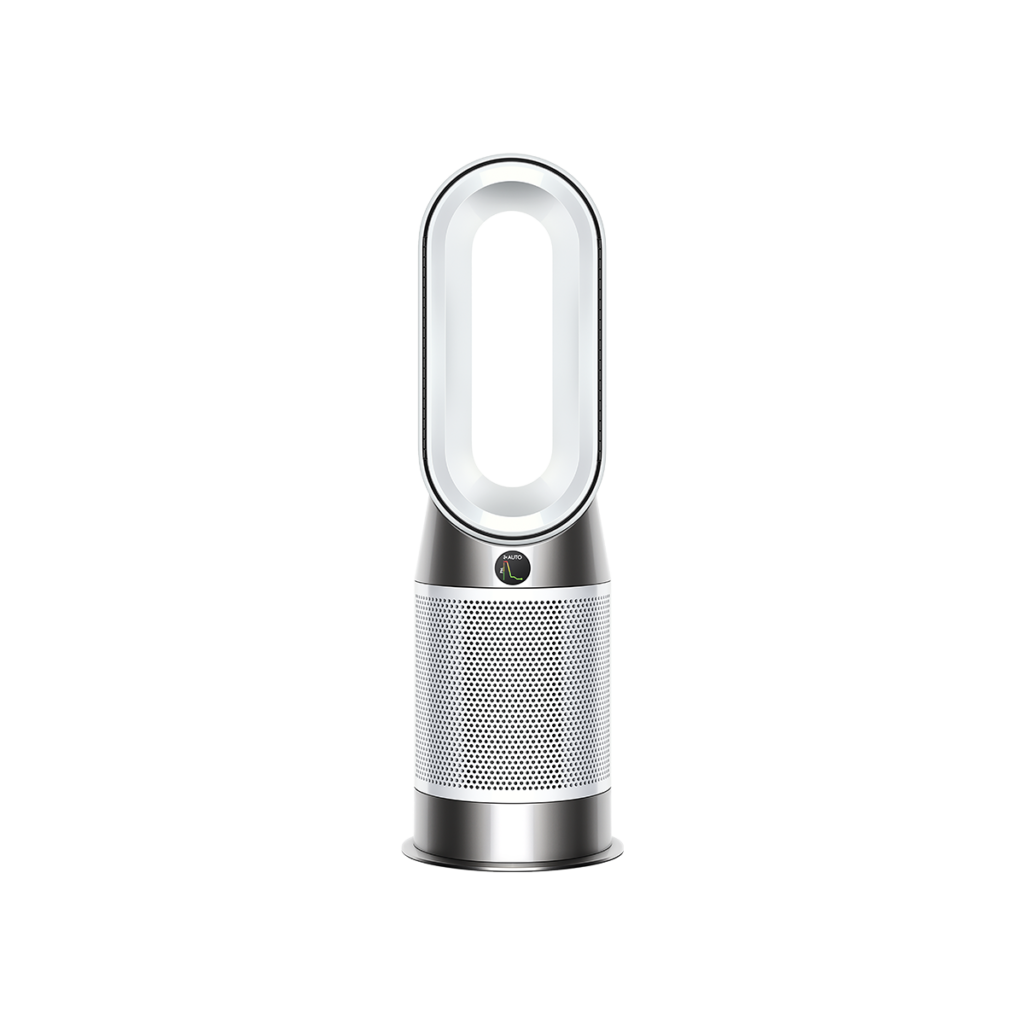
Standing 765 mm tall, the Dyson HP1 is a floor column that heats, cools and filters from the same stream of air. It is the way into Dyson's purifiers that also heat, and it wears all three jobs at once, so a buyer is choosing a winter heater and a summer fan as much as an air cleaner.
The purifier side is a sealed filter pack with a True HEPA layer and a sheet of activated carbon for smells, replaced together as one part. There is no washable pre-filter in front of it. A sensor runs the auto mode, the app and the small screen show air quality as it changes, and a filter replacement indicator, a timer and a sleep setting fill out the controls. Oscillation and Dyson's Air Multiplier projection spread the heat or the breeze across the room.
Dyson leaves the purifier numbers unpublished. There is no smoke CADR and no coverage area, so the HP1 cannot be compared with a Levoit or a Coway on clean air. The one figure Dyson does give for the air side is its noise at full fan, the highest in the category.
That shapes who should look at it. The owner it fits has a single bedroom, study or snug that runs cold in winter and stuffy in summer, and would rather have one column in the corner than a heater, a fan and a purifier each wanting a socket. At 5.31 kg it moves between rooms without a struggle. Anyone who wants the most clean air for the space is looking at a different kind of appliance, and the heater is the part that decides whether the HP1 belongs in the house at all.
Category strengths
Where the Dyson Purifier Hot+Cool HP1 trails the median
- No washable pre-filter ?
- A higher max noise level ?63 dB vs 52 dB (median)
- A slightly heavier build ?5.31 kg vs 5.26 kg (median)
How this VS Score was computed
Score 67: each known spec is measured against the median of all air purifiers (41 products), then weighted; 50 means level with that median. In classes of six or more, a value beyond the class’s 10th–90th percentile range counts as that limit, so one extreme product cannot set the scale. 27% of the scoreable weight could be used; unknown values, features not applicable to this class and proxies (battery capacity where a rated life exists) add or remove nothing.
| Specification | This product | Cohort median | Score weight | Points moved |
|---|---|---|---|---|
| True HEPA filter | Yes | 61% of the class have it | 1.5 | +75.0 |
| App control | Yes | 70% of the class have it | 0.5 | +25.0 |
| Washable pre-filter | No | 54% of the class have it | 0.5 | −24.0 |
| Max noise level | 63 — capped at the class’s upper range (55) | 52 | 0.5 | −1.5 |
| Weight | 5.31 | 5.26 | 0.3 | −0.3 |
| Filter life | 12 | 12 | 1 | +0.0 |
Not scored: CADR (smoke) (unknown: not scored); Coverage area (unknown: not scored); Air changes per hour (unknown: not scored); Filtration stages (unknown: not scored); Activated carbon filter (standard for the class (100% have it)); Min noise level (unknown: not scored); Power consumption (unknown: not scored); Sleep mode (standard for the class (95% have it)); Air quality sensor (standard for the class (93% have it)); Auto mode (standard for the class (90% have it)); Voice assistant (unknown: not scored); Filter replacement indicator (standard for the class (97% have it)); Timer (standard for the class (88% have it)).
Editor’s note
The HP1 is three appliances in one column of metal: a fan, a 1,500-watt-class space heater, and a purifier with a sealed Glass HEPA and carbon filter. It is Dyson's entry point into that 3-in-1 category, and judging it fairly means being clear about which of the three you are buying.
As a heater-fan it is excellent, and this is where the value hides. Air Multiplier projection moves a claimed 76 gallons of air a second across 350 degrees of oscillation, heating a room evenly in winter and cooling in summer, which are jobs a normal purifier cannot do. If you would otherwise buy a decent space heater and a decent fan, the arithmetic starts to make sense.
The purifier side is competent but under-documented. The fully sealed filter is a real HEPA (Dyson claims 99.97% capture at 0.3 microns), with an activated carbon layer for gases, replaced as one unit roughly yearly. Sensors drive an auto mode, the LCD and MyDyson app report air quality live, and a curved remote parks magnetically on top. But Dyson publishes no CADR and no coverage figure, so like-for-like comparison against dedicated purifiers is impossible by design. The one number it does publish is noise: 63 decibels at maximum, which is honest and audibly a fan at full tilt.
Two practical cautions. Heating draws serious power, as all electric heaters do, so running costs depend heavily on which mode you live in. And a purifier that doubles as a heater ends up placed where heat is wanted, which is not always where air cleaning is needed.
Buy the HP1 as a year-round comfort appliance that also cleans the air. As a pure purifier, dedicated machines at half the price move more air.
Specifications
Quality bars show where each figure sits between the lowest and highest of the 41 air purifiers this VS Score is measured against.
Performance
Filtration
Noise & power
Design
Smart features
Sources and verification
Where the specifications come from
- Official product pagedyson.com
- Independent testingrtings.com
Verification
- First published
- Specifications last checked
- Sheet completeness
- 14 of 22 specifications verified; the rest show as Unknown and are never estimated or scored
- Page type
- Product specification page — Compiled from the manufacturer’s published specifications and the cited sources; this is not a hands-on test.
- Basis
- Research-based: specifications and editorial text were compiled from the documents listed here and the manufacturer’s published data. We have not tested this unit ourselves; where independent measurements are mentioned they belong to the linked publication.
Air Purifiers with similar specs to the Dyson Purifier Hot+Cool HP1
Ratings & reviews
No reviews yet. Be the first to share your experience.
The bottom line
The Dyson Purifier Hot+Cool HP1 earns a VS Score of 67 on the 27% of specifications we could compare like for like — an indication, not a ranking.
- Who it’s for
- One room that needs heating in winter, cooling in summer and cleaner air year-round. The 3-in-1 arithmetic is where this machine makes sense.
- Who should look elsewhere
- Anyone buying purely for purification: no CADR or coverage figure is published, and dedicated purifiers at half the price move more documented air.
- The trade-off that matters
- Three appliances' worth of usefulness against one appliance's worth of purifier, and its full-fan noise figure is the loudest published in our purifier catalog.
- The main alternative
- Levoit Core 600S plus a basic space heater costs less combined and cleans a larger documented area, if the single-column form factor is not the point.
The VS Score is calculated from the weighted specifications above, each measured against the median of comparable air purifiers — a shortlisting guide, not a substitute for your own priorities. See how we score.