Winix C610: Specs, Features, Pros & Cons
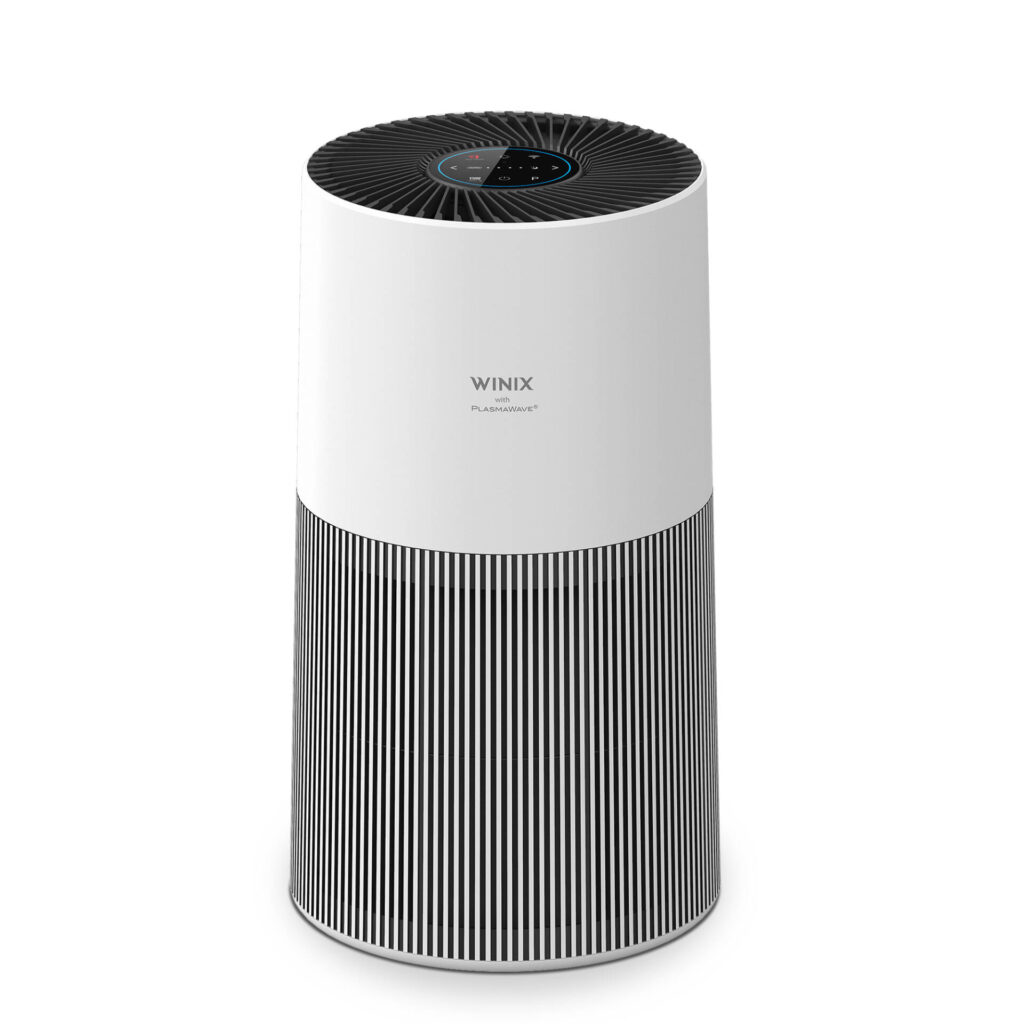
At 3.8 kg the Winix C610 is light for a purifier sized for a medium-to-large room, and it fits a lot into that small body: four filtration stages, an air quality sensor, auto and sleep modes, the Winix Smart App and voice assistant support. It is the connected, current-production end of the Winix range.
The filter is one all-in-one cartridge, Filter Z, with an activated carbon layer built in and no separate pre-filter to wash. That makes maintenance a single swap once a year, and Winix puts a spare cartridge in the box, so the first change costs nothing. A single part also means nothing to separate or rinse between changes. PlasmaWave ionization is part of the four-stage stack, and it can be turned off by anyone who would rather not run an ionizer at all.
At the quiet end of its range it measures 22 dB, low enough for a bedroom as well as a living room. The timer, though, lives only in the app. Nothing on the purifier's own panel sets it, so a switch-off time at bedtime means reaching for a phone, and a household without the app installed goes without one.
Its rated area is enough for a family lounge, a large bedroom or an open study, and the purifier is light enough to carry between floors when the season changes. Winix publishes the room size but no clean air delivery rate, which makes it harder to line up against rivals that print theirs. A buyer who values a light purifier, an app and a predictable yearly filter gets all three, and the gaps show up in the paperwork and the timer more than in the room.
Category strengths
Where the Winix C610 beats the median
- A slightly higher coverage area ?384 sq ft vs 354 sq ft (median)
- More filtration stages ?4 vs 3 (median)
- A lighter build ?3.8 kg vs 5.26 kg (median)
- A slightly lower min noise level ?22 dB vs 23 dB (median)
Where the Winix C610 trails the median
- No washable pre-filter ?
How this VS Score was computed
Score 62: each known spec is measured against the median of all air purifiers (41 products), then weighted; 50 means level with that median. In classes of six or more, a value beyond the class’s 10th–90th percentile range counts as that limit, so one extreme product cannot set the scale. 61% of the scoreable weight could be used; unknown values, features not applicable to this class and proxies (battery capacity where a rated life exists) add or remove nothing.
| Specification | This product | Cohort median | Score weight | Points moved |
|---|---|---|---|---|
| True HEPA filter | Yes | 61% of the class have it | 1.5 | +75.0 |
| App control | Yes | 70% of the class have it | 0.5 | +25.0 |
| Washable pre-filter | No | 54% of the class have it | 0.5 | −24.0 |
| Voice assistant | Yes | 64% of the class have it | 0.3 | +15.0 |
| Filtration stages | 4 | 3 | 0.5 | +8.5 |
| Coverage area | 384 | 354 | 2 | +8.0 |
| Weight | 3.8 | 5.26 | 0.3 | +5.7 |
| Min noise level | 22 | 23 | 1.5 | +3.0 |
| Air changes per hour | 4.8 | 4.8 | 1 | +0.0 |
| Filter life | 12 | 12 | 1 | +0.0 |
| Power consumption | 45 | 45 | 0.5 | +0.0 |
Not scored: CADR (smoke) (unknown: not scored); Activated carbon filter (standard for the class (100% have it)); Max noise level (unknown: not scored); Sleep mode (standard for the class (95% have it)); Air quality sensor (standard for the class (93% have it)); Auto mode (standard for the class (90% have it)); Filter replacement indicator (standard for the class (97% have it)); Timer (standard for the class (88% have it)).
Editor’s note
Two things set the C610 apart from the Levoit and Dreo units around it. The first is that Winix still makes a genuine True HEPA claim and backs it with a laboratory report: 99.99% of particles down to 0.01 micron, from a KCL test Winix cites by document number. Levoit has retreated to HEPA-grade across its current range, so if certification matters to you, this is a real difference rather than marketing noise.
The second is filter economics. The C610 uses a single all-in-one Filter Z rated for a year, and the retail box ships with two of them, so the first two years of filtration are already paid for. Against Levoit's roughly seven-month cycle on a sealed cartridge, that makes this a materially cheaper machine to own.
There are trade-offs. Winix publishes no CADR figure for this model at all, which is unusual and mildly annoying. The stated 384 square feet implies something near 248 CFM, but Winix never states it, so treat that as arithmetic and not a specification. The timer exists only inside the Winix Smart App, and there is no button for it on the unit. And the PlasmaWave ionizer produces trace ozone, which Winix quantifies at 0.33 ppbv over an eight-hour average. That is very low, but if you are ozone-averse, know that it can be switched off and that switching it off is the right call for you.
Four filtration stages, a real sensor, Auto mode, app and voice support round it out.
For a medium-to-large room where you want a certified filter and predictable yearly costs, this is a straightforwardly sensible machine.
Specifications
Quality bars show where each figure sits between the lowest and highest of the 41 air purifiers this VS Score is measured against.
Performance
Filtration
Noise & power
Design
Smart features
Sources and verification
Where the specifications come from
- Official product pagewinixamerica.com
- Datasheet or manualwinixamerica.com
- Independent testingrtings.com
Verification
- First published
- Specifications last checked
- Sheet completeness
- 19 of 22 specifications verified; the rest show as Unknown and are never estimated or scored
- Page type
- Product specification page — Compiled from the manufacturer’s published specifications and the cited sources; this is not a hands-on test.
- Basis
- Research-based: specifications and editorial text were compiled from the documents listed here and the manufacturer’s published data. We have not tested this unit ourselves; where independent measurements are mentioned they belong to the linked publication.
Air Purifiers with similar specs to the Winix C610
Ratings & reviews
No reviews yet. Be the first to share your experience.
The bottom line
The Winix C610 earns a VS Score of 62, above the median of the 41 air purifiers it is measured against (a score of 50 is level with that median).
- Who it’s for
- Buyers who want a certified True HEPA filter and predictable yearly costs: one filter a year, with two already included in the box.
- Who should look elsewhere
- Anyone who needs a published CADR figure to compare like with like, or who wants a timer on the unit itself rather than buried in an app.
- The trade-off that matters
- Certification and cheap, simple filter replacement, against a maker that documents performance loosely. No CADR is published anywhere for this model.
- The main alternative
- Coway Airmega Mighty AP-1512HH covers similar ground with a clearly published smoke CADR, but has no app and draws considerably more power.
The VS Score is calculated from the weighted specifications above, each measured against the median of comparable air purifiers — a shortlisting guide, not a substitute for your own priorities. See how we score.