Keychron K8 Ultra 8K: Specs, Features, Pros & Cons
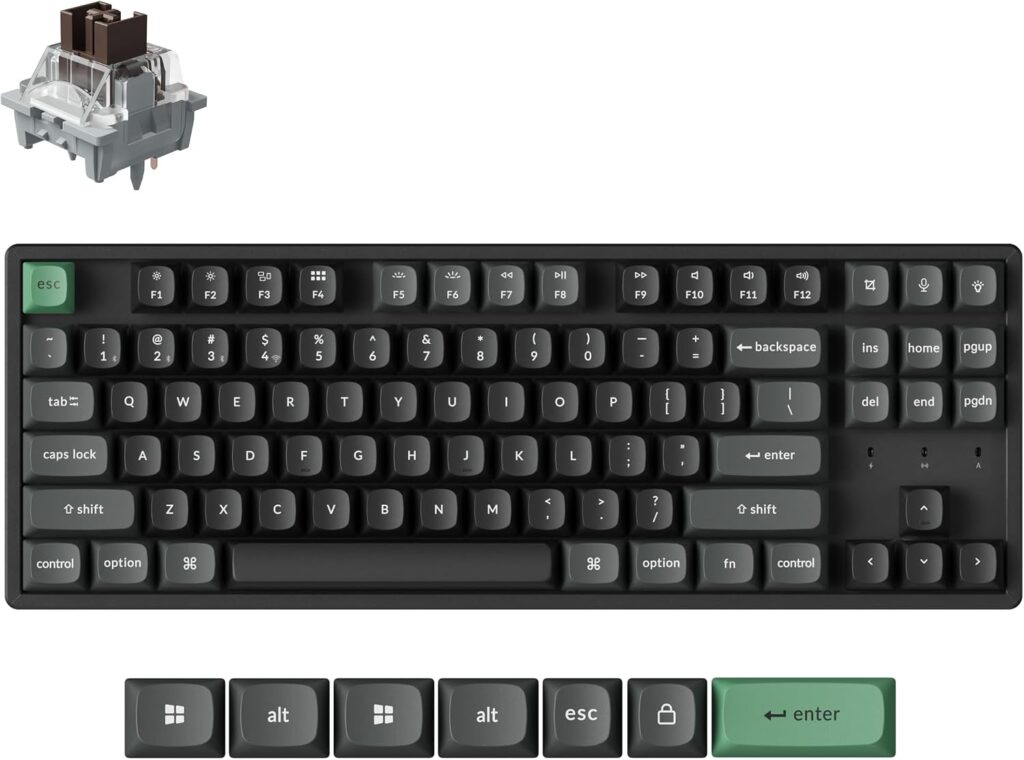
Tall, heavy and tenkeyless, the K8 Ultra 8K is the version of Keychron's K8 for someone who never meant to carry it anywhere. A machined aluminum frame sits over a plastic base, the front edge stands higher than most keyboards in the category, and the mass keeps it planted during a hectic game.
The eight thousand in the name is the headline, and the dongle holds that rate as well as the cable does. Everything else is an upgrade of a familiar board: a steel plate, screw-in stabilizers, a full foam stack, per-key lighting and OSA-profile double-shot PBT caps. Keychron's pre-lubed Apex switches come in Red, Brown or Banana and sit in hot-swap sockets that take three- or five-pin replacements.
The switches are also where it parts company with its closest relative. Keychron sells the same shape as the K8 HE, with magnetic switches, and that is the model with rapid trigger and adjustable actuation. The Ultra keeps a conventional contact switch, so its speed comes from the radio and the polling, and the feel under the finger stays that of an ordinary mechanical board.
Setup lives in a browser tab. The board runs ZMK firmware, and Keychron's Launcher web app handles remapping, macros and lighting with no program to install.
The buyer it suits plays on a wireless connection, types between matches and wants one well-damped board for both. Bluetooth is there for three devices, though it polls far slower than the dongle and is better kept for the laptop. There is no number pad, no knob and no screen, so anyone who wants dials or a numeric block will be shopping in a different size.
Category strengths
Where the Keychron K8 Ultra 8K beats the median
- A much higher polling rate ?8,000 Hz vs 1,000 Hz (median)
- Much longer battery life ?760 h vs 325 h (median)
Where the Keychron K8 Ultra 8K trails the median
- No rotary knob ?
- A higher front height ?25.55 mm vs 20.2 mm (median)
How this VS Score was computed
Score 59: each known spec is measured against the median of all keyboards (101 products), then weighted; 50 means level with that median. In classes of six or more, a value beyond the class’s 10th–90th percentile range counts as that limit, so one extreme product cannot set the scale. 59% of the scoreable weight could be used; unknown values, features not applicable to this class and proxies (battery capacity where a rated life exists) add or remove nothing.
| Specification | This product | Cohort median | Score weight | Points moved |
|---|---|---|---|---|
| Polling rate | 8,000 | 1,000 | 0.7 | +35.0 |
| Hot-swappable | Yes | 61% of the class have it | 0.6 | +30.0 |
| Battery life | 760 | 325 | 0.6 | +30.0 |
| Rapid trigger | No | 25% of the class have it | 0.5 | −24.0 |
| Adjustable actuation | No | 24% of the class have it | 0.4 | −19.2 |
| Sound dampening | Yes | 76% of the class have it | 0.3 | +15.0 |
| Rotary knob | No | 53% of the class have it | 0.2 | −9.6 |
| Front height | 25.55 — capped at the class’s upper range (22.85) | 20.2 | 0.2 | −1.2 |
| Switch technology | Mechanical | Mechanical | 1 | +0.0 |
| Connection | 3 | 3 | 0.8 | +0.0 |
| Bluetooth devices | 3 | 3 | 0.3 | +0.0 |
| Keycap material | PBT | PBT | 0.4 | +0.0 |
| Backlight | RGB | RGB | 0.3 | +0.0 |
Not scored: Actuation force (unknown: not scored); N-key rollover (standard for the class (85% have it)); Analog input (not applicable: only 14% of this class have it); Wired latency (unknown: not scored); Wireless latency (unknown: not scored); Battery capacity (capacity is a proxy; the rated battery life is scored instead); USB passthrough (not applicable: only 4% of this class have it); Programmable keys (standard for the class (99% have it)); Media controls (unknown: not scored); Onboard profiles (unknown: not scored); Configuration software (standard for the class (95% have it)).
Editor’s note
The K8 Ultra 8K takes Keychron's most popular tenkeyless shape and rebuilds it around the polling rate in its name, which holds over the wireless dongle as well as the cable. Wireless polling at that rate is still rare, and it undercuts most 8K boards that manage it only wired.
The other quiet upgrade is firmware. This is a ZMK board configured through Keychron's Launcher web app: open a browser tab, remap keys, build macros, tune the per-key RGB, done. Combined with a claimed 760 hours of battery in 8K mode with the backlight off (about 230 hours with RGB on low), the wireless story is unusually complete. Bluetooth 5.2 is aboard for up to three devices, though it polls at a pedestrian 125 Hz, so use the dongle for games.
Build quality punches up. The frame is CNC-machined 6063 aluminum over an ABS bottom case, with a steel plate, screw-in PCB stabilizers, and a full foam stack that keeps the sound clean and rattle-free. Pre-lubed Keychron Apex switches (Red, Brown, or Banana) sit in hot-swap sockets that take any 3- or 5-pin switch. Keycaps are OSA-profile double-shot PBT.
What you give up: there is no knob, no numpad, and no display gimmicks. This is a plain, serious TKL. At 1.3 kg it stays on the desk. And because the switches are conventional mechanicals, there is no rapid trigger or adjustable actuation. If that matters, Keychron's own K8 HE with magnetic switches is the sibling to cross-shop.
Buy it if you want fast wireless for gaming plus a premium typing feel in one board. Skip it if you need analog switch tricks or a number pad.
Specifications
Quality bars show where each figure sits between the lowest and highest of the 101 keyboards this VS Score is measured against.
Switches & typing
Performance
Layout & size
Connectivity
Build & sound
Features
Sources and verification
Where the specifications come from
- Official product pagekeychron.com
- Retailer listing (cross-check)amazon.com
Verification
- First published
- Specifications last checked
- Sheet completeness
- 27 of 34 specifications verified; the rest show as Unknown and are never estimated or scored
- Page type
- Product specification page — Compiled from the manufacturer’s published specifications and the cited sources; this is not a hands-on test.
- Basis
- Research-based: specifications and editorial text were compiled from the documents listed here and the manufacturer’s published data. We have not tested this unit ourselves; where independent measurements are mentioned they belong to the linked publication.
Keyboards with similar specs to the Keychron K8 Ultra 8K
Ratings & reviews
No reviews yet. Be the first to share your experience.
The bottom line
The Keychron K8 Ultra 8K earns a VS Score of 59, above the median of the 101 keyboards it is measured against (a score of 50 is level with that median).
- Who it’s for
- A gamer who wants fast wireless and a well-damped aluminum tenkeyless for typing, all set up from a browser tab.
- Who should look elsewhere
- Look elsewhere if you want rapid trigger or adjustable actuation, or if you need a number pad or a knob.
- The trade-off that matters
- Its speed is a conventional mechanical board's speed. Fast polling does not add the magnetic tricks that competitive players now expect.
- The main alternative
- Wooting 80HE: a tenkeyless magnetic board with rapid trigger and analog input, if those matter more than wireless.
The VS Score is calculated from the weighted specifications above, each measured against the median of comparable keyboards — a shortlisting guide, not a substitute for your own priorities. See how we score.