SteelSeries Rival 3 Wireless Gen 2: Specs, Pros & Cons
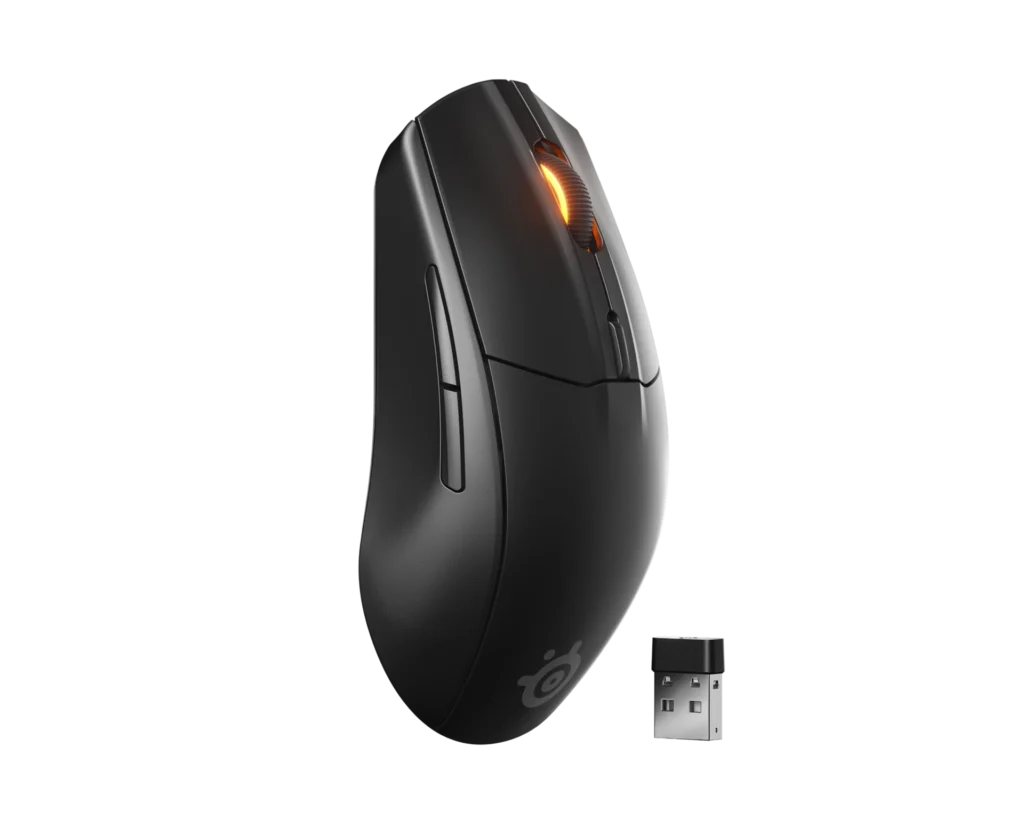
The Rival 3 family is SteelSeries' entry level, and this is its wireless member, refreshed as Gen 2 with a better sensor and longer rated runtimes than the first Rival 3 Wireless. It keeps the family's odd choice for a gaming mouse: it runs on disposable AAA cells instead of a sealed battery.
That choice defines who it suits. A student with a desktop and a laptop on the same desk, or a family sharing one mouse between machines, gets something that is never flat at the wrong moment for want of a cable, because a spare cell from the kitchen drawer fixes it in seconds. Replacing a worn rechargeable battery is never on the list either, which matters little in year one and more in year four.
Its sensor figures trail those of flagship mice that cost far more. That gap is real on paper and academic for this buyer, and the difference would show only in competitive play at a level where nobody is shopping in the Rival 3 range.
What it gives up is the direction the market has moved. Most gaming mice at and above this price have gone rechargeable, and SteelSeries' own Aerox and Prime families show what that buys in weight and convenience. The Rival 3 Gen 2 is for the buyer who looks at that trade and still prefers the batteries, usually because the mouse will spend as much time in a bag or on a laptop table as at a gaming desk. There, a dead cell is a thirty-second fix and a dead internal battery means hunting for a cable.
Category strengths
Where the SteelSeries Rival 3 Wireless Gen 2 beats the median
- Much longer battery life ?450 h vs 150 h (median)
- Has RGB lighting ?
Where the SteelSeries Rival 3 Wireless Gen 2 trails the median
- A lower max tracking speed ?400 IPS vs 650 IPS (median)
- No USB-C charging ?
- A lower max sensitivity ?18,000 DPI vs 25,600 DPI (median)
- A heavier build ?111.6 g vs 89 g (median)
- A lower switch lifespan ?60 million clicks vs 80 million clicks (median)
How this VS Score was computed
Score 46: each known spec is measured against the median of all mice (81 products), then weighted; 50 means level with that median. In classes of six or more, a value beyond the class’s 10th–90th percentile range counts as that limit, so one extreme product cannot set the scale. 59% of the scoreable weight could be used; unknown values, features not applicable to this class and proxies (battery capacity where a rated life exists) add or remove nothing.
| Specification | This product | Cohort median | Score weight | Points moved |
|---|---|---|---|---|
| Battery life | 450 | 150 | 0.8 | +40.0 |
| Max tracking speed | 400 | 650 | 0.8 | −15.2 |
| Max sensitivity | 18,000 | 25,600 | 1 | −15.0 |
| USB-C charging | No | 67% of the class have it | 0.3 | −14.4 |
| Weight | 111.6 | 89 | 1 | −10.0 |
| RGB lighting | Yes | 46% of the class have it | 0.2 | +10.0 |
| Horizontal scrolling | No | 45% of the class have it | 0.2 | −9.6 |
| Free-spin scroll wheel | No | 34% of the class have it | 0.2 | −9.6 |
| Switch lifespan | 60 | 80 | 0.2 | −2.4 |
| Buttons | 6 | 6 | 0.6 | +0.0 |
| Grip styles | 2 | 2 | 0.4 | +0.0 |
| Connection | 2 | 2 | 0.8 | +0.0 |
Not scored: Max acceleration (unknown: not scored); Polling rate (unknown: not scored); Adjustable lift-off distance (unknown: not scored); Click latency (unknown: not scored); Debounce adjustment (unknown: not scored); Wireless polling rate (unknown: not scored); Battery capacity (unknown: not scored); Quick charge (unknown: not scored); Wireless charging (not applicable: only 14% of this class have it); Onboard memory (unknown: not scored); Software customization (standard for the class (97% have it)); Adjustable weights (not applicable: only 2% of this class have it).
Editor’s note
The Rival 3 Wireless Gen 2 prioritizes long endurance and replaceable batteries over minimum weight. Its TrueMove Air sensor and 2.4 GHz link are responsive enough for everyday gaming, while Bluetooth lets the same mouse serve a laptop or tablet. SteelSeries quotes up to 175 hours on the dongle and as much as 450 hours on Bluetooth, although polling rate, battery brand, lighting, and usage will change the result.
Replaceable AAA power is convenient for travel because there is no aging internal battery or charging cable to remember. The tradeoff is mass: with batteries installed, the mouse is noticeably heavier than rechargeable ultralight alternatives, and balance changes depending on whether one or two cells are used. There is no USB-C charging or wired data mode. Keep a spare battery for the middle of a match.
The shell is symmetrical, but the left-side buttons make it right-handed. Medium hands using claw or fingertip grip are the natural fit, and large hands in a palm grip may want more height. Mechanical switches are rated for 60 million clicks, PTFE feet help movement, and SteelSeries GG handles remapping and settings. RGB is limited compared with showier designs, which helps battery life.
Choose the Rival 3 Gen 2 for a dependable wireless desktop or laptop mouse where months between battery changes matter more than low weight. It is a poor match for buyers who demand wired fallback, rechargeable power, or a true left-handed layout. Confirm that the listing says "Gen 2": the original Rival 3 Wireless has lower sensor and endurance specifications and should not be priced as the newer model.
Specifications
Quality bars show where each figure sits between the lowest and highest of the 81 mice this VS Score is measured against.
Sensor & tracking
Design & handling
Switches & latency
Connectivity
Battery
Features
Sources and verification
Where the specifications come from
- Official product pagesteelseries.com
- Independent testingrtings.com
Verification
- First published
- Specifications last checked
- Sheet completeness
- 21 of 34 specifications verified; the rest show as Unknown and are never estimated or scored
- Page type
- Product specification page — Compiled from the manufacturer’s published specifications and the cited sources; this is not a hands-on test.
- Basis
- Research-based: specifications and editorial text were compiled from the documents listed here and the manufacturer’s published data. We have not tested this unit ourselves; where independent measurements are mentioned they belong to the linked publication.
Where to buy
Prices and availability may change. Check the retailer before buying. We may earn a commission on purchases.
Price history
Mice with similar specs to the SteelSeries Rival 3 Wireless Gen 2
Ratings & reviews
No reviews yet. Be the first to share your experience.
The bottom line
The SteelSeries Rival 3 Wireless Gen 2 earns a VS Score of 46, below the median of the 81 mice it is measured against (a score of 50 is level with that median).
- Who it’s for
- Someone who wants a wireless mouse to live on a desk or in a laptop bag for months, swapping a cheap cell now and then instead of minding a charging cable.
- Who should look elsewhere
- Weight-conscious competitive players, left-handers and anyone who wants to plug in a cable when the cells run flat should look elsewhere.
- The trade-off that matters
- Endurance comes from AAA cells, and they add weight you feel on every lift. Running on one cell lightens it at the cost of runtime.
- The main alternative
- SteelSeries Aerox 3 Wireless Gen 2: rechargeable over USB-C with a wired mode and much less weight, if a perforated shell is acceptable
The VS Score is calculated from the weighted specifications above, each measured against the median of comparable mice — a shortlisting guide, not a substitute for your own priorities. See how we score.