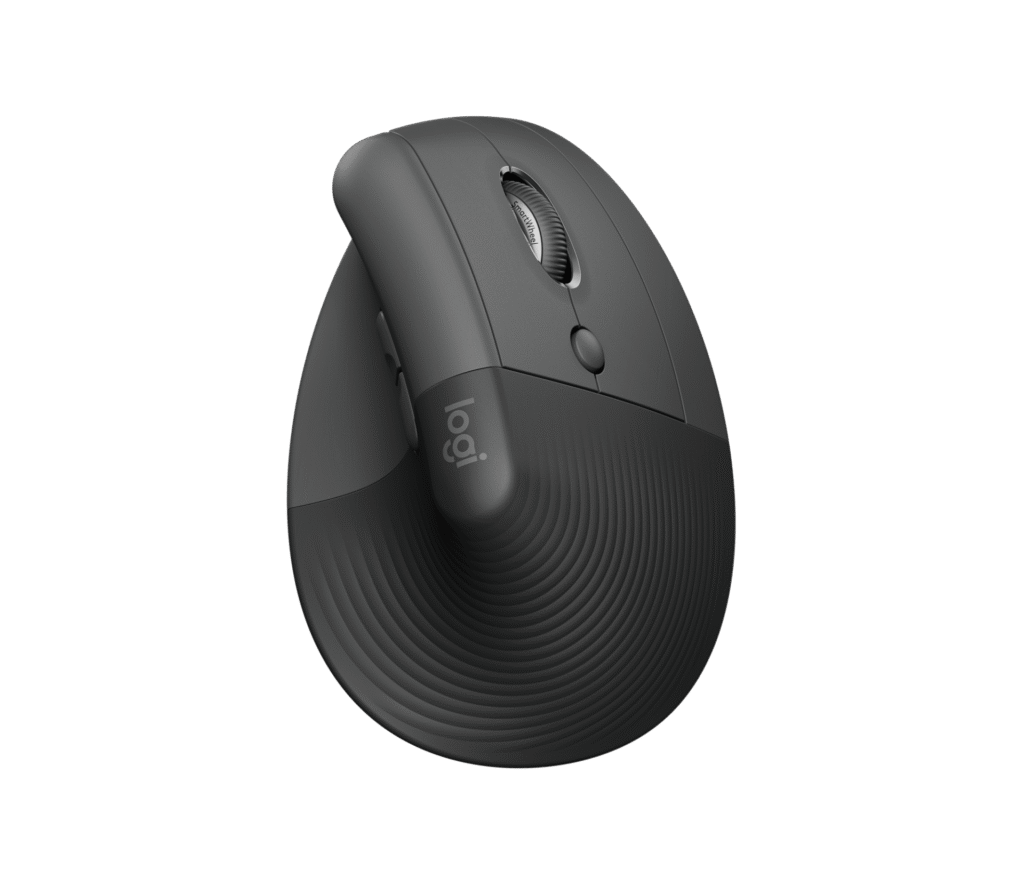
Logitech Lift: Specs, Price, Pros & Cons
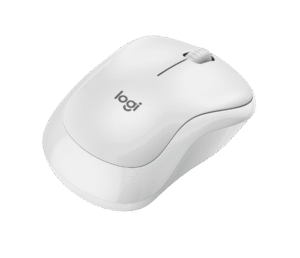
With most mice the shape is a detail. Here it is the entire product: the Lift is sold on the angle at which it holds your hand, and every other decision follows from that.
It is the smaller of Logitech's two vertical mice, and the distinction is the point rather than a question of tiers. The larger MX Vertical is built for big hands; the Lift is scaled for small and medium ones, and choosing between them on price rather than on hand size is the most common way to end up with the wrong one. Both are right-handed only, which is the first thing to check.
Everything else about it is ordinary office hardware, and deliberately so. It pairs over Bluetooth or a receiver, works across the operating systems anyone is likely to be running, and takes a replaceable cell rather than a built-in battery – so there is no charging routine and no capacity to degrade over the years, at the cost of keeping a spare in a drawer.
What it is not is a performance mouse, and the specification does not pretend otherwise. The sensitivity ceiling is set for documents rather than games, there is no onboard profile storage, and the wheel neither tilts nor free-spins. Buying one for anything fast-moving would be a mistake.
The honest caveat is that a vertical mouse is not immediately better. It feels wrong for the first week and precise work suffers while your hand learns a new grip, which is a real cost if you are busy. The reasoning behind the posture, and who should accept that adjustment, is set out below.
If you have no discomfort and no reason to expect any, a conventional mouse will serve you better for less. If your forearm aches by the evening, this addresses the cause rather than the symptom.
Category strengths
Where the Logitech Lift trails the average
- A much lower max sensitivity ?4,000 DPI vs 25,600 DPI (avg)
- A much heavier build ?133.4 g vs 89 g (avg)
- No USB-C charging ?
- No onboard memory ?
How this VS Score was computed
Score 25: each known spec is measured against the median of all mice (80 products, medians winsorised to the 10th–90th percentile), then weighted. 42% of the scoreable weight could be used; unknown values, features not applicable to this class and proxies (battery capacity where a rated life exists) add or remove nothing.
| Specification | This product | Cohort median | Score weight | Points moved |
|---|---|---|---|---|
| Max sensitivity | 4,000 | 25,600 | 1 | −42.0 |
| Weight | 133.4 | 89 | 1 | −17.0 |
| USB-C charging | 0 | 1 | 0.3 | −14.4 |
| Onboard memory | 0 | 1 | 0.3 | −14.4 |
| Horizontal scrolling | 0 | 0 | 0.2 | −9.6 |
| Free-spin scroll wheel | 0 | 0 | 0.2 | −9.6 |
| RGB lighting | 0 | 0 | 0.2 | −9.6 |
| Buttons | 6 | 6 | 0.6 | +0.0 |
| Connection | 2 | 2 | 0.8 | +0.0 |
Not scored: Max tracking speed (unknown: not scored); Max acceleration (unknown: not scored); Polling rate (unknown: not scored); Adjustable lift-off distance (unknown: not scored); Grip styles (unknown: not scored); Click latency (unknown: not scored); Switch lifespan (unknown: not scored); Debounce adjustment (unknown: not scored); Wireless polling rate (unknown: not scored); Battery life (unknown: not scored); Battery capacity (unknown: not scored); Quick charge (unknown: not scored); Wireless charging (not applicable: only 13% of this class have it); Software customisation (standard for the class (97% have it)); Adjustable weights (not applicable: only 2% of this class have it).
Editor’s note
The Lift is a vertical mouse, and the reason to consider one has nothing to do with performance.
Holding a conventional mouse rotates your forearm so the palm faces down, which twists two bones in the arm past each other and is the posture most associated with mousing discomfort. A vertical mouse holds the hand at roughly 57 degrees — closer to how it sits when relaxed at your side — so the forearm stays neutral. If your wrist or forearm aches at the end of a working day, this is the single most effective change you can make to a desk.
It is designed for smaller and medium hands, which is what separates it from Logitech's larger MX Vertical, and it is right-handed only. Connection is Bluetooth or the 2.4 GHz receiver, and it runs on a replaceable battery rather than a built-in cell — so there is nothing to degrade over years, though you keep a spare rather than plug it in.
The specification makes clear it is not a gaming device: 4,000 DPI, six buttons, no onboard memory, no free-spinning wheel and no horizontal scrolling.
Expect an adjustment period. The grip is different enough that fine work feels imprecise for the first week, then stops being a problem.
Buy it if mousing hurts, or you want to prevent that before it starts. Buy a conventional mouse for gaming, or the MX Vertical if your hands are large.
Specifications
Quality bars are generated automatically against 79 other mice.
Sensor & tracking
Design & handling
Switches & latency
Connectivity
Battery
Features
Sources and verification
Where the specifications come from
- Independent testingrtings.com
Verification
- First published
- Specifications last checked
- Sheet completeness
- 19 of 34 specifications verified; the rest show as Unknown and are never estimated or scored
- Page type
- Product specification page — Compiled from the manufacturer’s published specifications and the cited sources; this is not a hands-on test.
- Basis
- Research-based: specifications and editorial text were compiled from the documents listed here and the manufacturer’s published data. We have not tested this unit ourselves; where independent measurements are mentioned they belong to the linked publication.
Where to buy
Prices and availability may change. Check the retailer before buying. We may earn a commission on purchases.
Price history
Mice with similar specs to the Logitech Lift
Ratings & reviews
No reviews yet. Be the first to share your experience.
The bottom line
The Logitech Lift earns a VS Score of 25, trailing most of the 80 mice we compare here, at least on the spec sheet. Just be aware of a much lower max sensitivity and a much heavier build before you buy. Weigh those trade-offs against what matters most to you.
The VS Score is calculated from the weighted specifications above, compared with every other mouse we track — a shortlisting guide, not a substitute for your own priorities. See how we score.