Razer BlackWidow V4 75%: Specs, Price, Pros & Cons
Razer's V4 name covers several unrelated keyboards. The full-size V4 Pro, the V4 X and this compact board share a badge and very little else, with different switches, different mounting and different goals, and the compact one is the only member built the way an enthusiast board is built. Shopping the range by price alone gets you three unrelated keyboards.
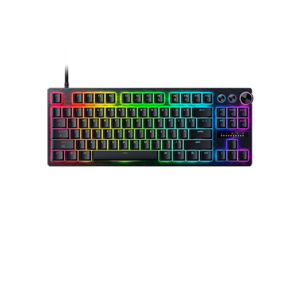
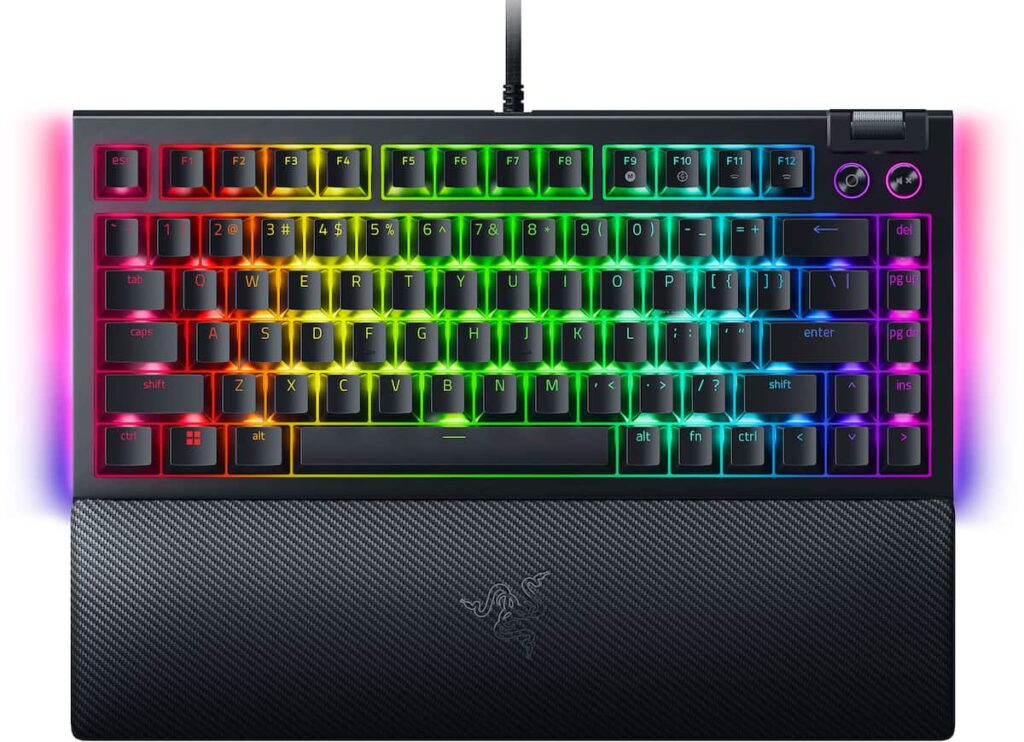
Among its V4 siblings it is the one meant to be opened, tuned and changed over the years. Its layout keeps the function row and the arrow cluster, drops the number pad, and adds a media roller in the top corner, so it fits a small desk without pushing shortcuts onto layers.
The switches are Razer's own tactile ones, sitting in hot-swap sockets that accept both common pin types. Inside, the gasket mount and several layers of foam are there to shape the sound, and the stabilizers arrive lubricated. It registers every key held at once, polls fast over the detachable cable, and stores profiles on the board. Some things stay fixed. There is no wireless mode of any kind, and the keycaps are ABS, the plastic that shows wear first on the keys you press most. The switches are ordinary mechanical ones, so none of the magnetic features (adjustable actuation, rapid trigger, analog travel) appears here at any setting.
A gamer upgrading from a basic membrane board, who wants a compact keyboard that sounds finished on arrival and suspects a switch or keycap habit is coming, is the obvious reader. Daily commuters between a desktop and a laptop need a board that can lose its cable, and this one cannot.
Category strengths
Where the Razer BlackWidow V4 75% beats the median
- A much higher polling rate ?8,000 Hz vs 1,000 Hz (median)
Where the Razer BlackWidow V4 75% trails the median
- Fewer connection options ?
- A heavier actuation force ?50 g vs 45 g (median)
How this VS Score was computed
Score 52: each known spec is measured against the median of all keyboards (101 products), then weighted; 50 means level with that median. In classes of six or more, a value beyond the class’s 10th–90th percentile range counts as that limit, so one extreme product cannot set the scale. 53% of the scoreable weight could be used; unknown values, features not applicable to this class and proxies (battery capacity where a rated life exists) add or remove nothing.
| Specification | This product | Cohort median | Score weight | Points moved |
|---|---|---|---|---|
| Polling rate | 8,000 | 1,000 | 0.7 | +35.0 |
| Hot-swappable | Yes | 61% of the class have it | 0.6 | +30.0 |
| Connection | 1 | 3 | 0.8 | −26.4 |
| Rapid trigger | No | 25% of the class have it | 0.5 | −24.0 |
| Adjustable actuation | No | 24% of the class have it | 0.4 | −19.2 |
| Sound dampening | Yes | 76% of the class have it | 0.3 | +15.0 |
| Keycap material | ABS | PBT | 0.4 | −10.0 |
| Rotary knob | Yes | 53% of the class have it | 0.2 | +10.0 |
| Actuation force | 50 | 45 | 0.4 | −2.0 |
| Switch technology | Mechanical | Mechanical | 1 | +0.0 |
| Backlight | RGB | RGB | 0.3 | +0.0 |
Not scored: N-key rollover (standard for the class (85% have it)); Analog input (not applicable: only 14% of this class have it); Wired latency (unknown: not scored); Wireless latency (unknown: not scored); Front height (unknown: not scored); Bluetooth devices (unknown: not scored); Battery life (unknown: not scored); Battery capacity (unknown: not scored); USB passthrough (not applicable: only 4% of this class have it); Programmable keys (standard for the class (99% have it)); Media controls (standard for the class (97% have it)); Onboard profiles (standard for the class (89% have it)); Configuration software (standard for the class (95% have it)).
Editor’s note
This is the BlackWidow that finally takes enthusiast keyboards seriously. Razer built it on a gasket mount with Poron gaskets, an FR4 plate, two layers of dampening foam and factory-lubricated plate-mount stabilizers, a specification that reads more like a boutique board than a mainstream gaming product. The result is a deeper and quieter sound than any previous BlackWidow managed.
The bigger news is that the circuit board is hot-swappable and accepts both three-pin and five-pin switches. The Orange Gen-3 tactile switches it ships with are pleasant enough at 50 g with a 2 mm actuation point, but the real value is that you can replace them later without touching a soldering iron. For many buyers this is the ideal first step into the hobby: a finished, warrantied keyboard that still leaves the door open.
Two things temper the enthusiasm. The keycaps are doubleshot ABS rather than PBT, and at this price that stings, because the most-used keys will develop a shine within a year or so and a replacement set is an extra cost. It is also wired only, which puts it behind several wireless rivals on flexibility for similar money.
The 8,000 Hz polling rate is available but optional. Leaving it at 1,000 Hz costs you nothing you can perceive and saves noticeable CPU overhead. The media roller and two dedicated buttons in the top-right corner are well placed and easy to find without looking, and five onboard profiles mean the keyboard behaves sensibly on a machine with no Razer software installed.
Buy it if you want a compact 75% layout that already sounds good as shipped and can be modified later. Skip it if you need wireless, or if you type enough that shiny keycaps would irritate you, in which case a board with PBT caps is the smarter buy at the same price.
Specifications
Quality bars show where each figure sits between the lowest and highest of the 101 keyboards this VS Score is measured against.
Switches & typing
Performance
Layout & size
Connectivity
Build & sound
Features
Sources and verification
Where the specifications come from
- Official product pagerazer.com
- Independent testingrtings.com
Verification
- First published
- Specifications last checked
- Sheet completeness
- 27 of 34 specifications verified; the rest show as Unknown and are never estimated or scored
- Page type
- Product specification page — Compiled from the manufacturer’s published specifications and the cited sources; this is not a hands-on test.
- Basis
- Research-based: specifications and editorial text were compiled from the documents listed here and the manufacturer’s published data. We have not tested this unit ourselves; where independent measurements are mentioned they belong to the linked publication.
Where to buy
Prices and availability may change. Check the retailer before buying. We may earn a commission on purchases.
Price history
Keyboards with similar specs to the Razer BlackWidow V4 75%
Ratings & reviews
No reviews yet. Be the first to share your experience.
The bottom line
The Razer BlackWidow V4 75% earns a VS Score of 52, above the median of the 101 keyboards it is measured against (a score of 50 is level with that median).
- Who it’s for
- A first step into the hobby: someone who wants a compact board that sounds good as shipped and may try other switches later.
- Who should look elsewhere
- Look elsewhere if the keyboard has to move between machines without a cable, or if you type enough for shiny keycaps to bother you.
- The trade-off that matters
- The ABS keycaps are the weak point on an otherwise enthusiast-grade build, so heavy typists should budget for a PBT set sooner or later.
- The main alternative
- Keychron Q1 Max: an aluminum gasket board of the same size, with PBT caps and tri-mode wireless, for buyers who need to lose the cable.
The VS Score is calculated from the weighted specifications above, each measured against the median of comparable keyboards — a shortlisting guide, not a substitute for your own priorities. See how we score.