Logitech G316 X 98: Specs, Features, Pros & Cons
Logitech sells this compact numpad layout twice, and the G316 X 98 is the version with ordinary mechanical switches. Its sibling, the G512 X 98, puts analog switches and rapid trigger into the same shape. This one skips the magnetic hardware and spends the effort on the build.
That build borrows from the enthusiast side of the hobby. A gasket mount carries the plate, the sockets are hot-swap, and the keycaps are PBT. Hot-swap means the switch picked at checkout is not a final decision. Logitech ships it with a light linear or a heavier tactile switch, and the linear needs a lighter press than most keyboard switches. G HUB handles the programming.
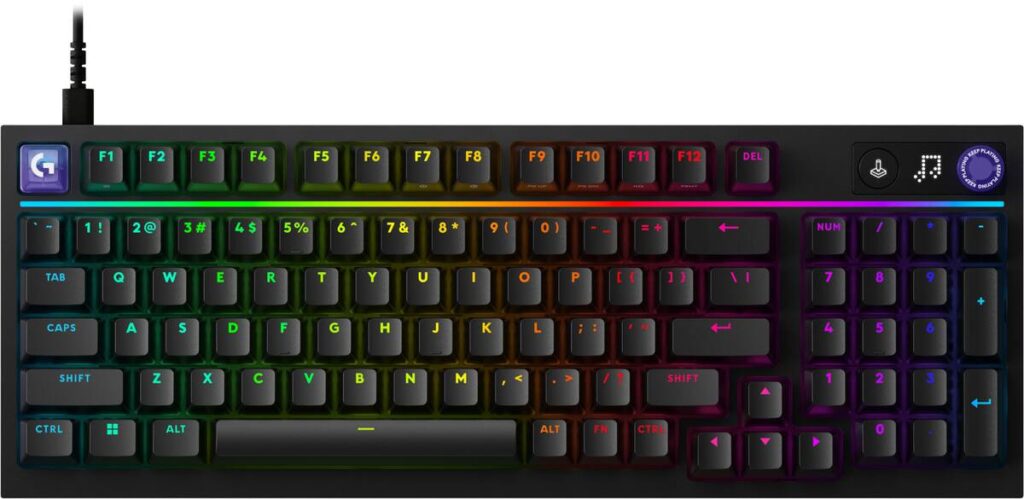
The layout keeps a full number pad and closes up the space around it, so the board comes out a few centimeters narrower than a traditional full-size keyboard. Home, End and the page keys leave their usual block and move into a tighter arrangement, which takes some getting used to. A player on a low mouse sensitivity gets that saved width back as swiping room.
On top sit a small dot-matrix display and a control dial, and they let you check status and change settings without opening software. Media controls and per-key RGB are there too, along with a light bar. Polling over the USB cable is much quicker than an ordinary keyboard's.
It is aimed at someone gaming at a fixed desktop who wants a numpad and a custom-keyboard feel without building one, and who already runs Logitech's software. The cable is the only connection, and the case has no USB passthrough for a mouse receiver, so the board never leaves that desk.
Category strengths
Where the Logitech G316 X 98 beats the median
- A much higher polling rate ?8,000 Hz vs 1,000 Hz (median)
- A lighter actuation force ?40 g vs 45 g (median)
Where the Logitech G316 X 98 trails the median
- Fewer connection options ?
How this VS Score was computed
Score 51: each known spec is measured against the median of all keyboards (101 products), then weighted; 50 means level with that median. In classes of six or more, a value beyond the class’s 10th–90th percentile range counts as that limit, so one extreme product cannot set the scale. 50% of the scoreable weight could be used; unknown values, features not applicable to this class and proxies (battery capacity where a rated life exists) add or remove nothing.
| Specification | This product | Cohort median | Score weight | Points moved |
|---|---|---|---|---|
| Polling rate | 8,000 | 1,000 | 0.7 | +35.0 |
| Hot-swappable | Yes | 61% of the class have it | 0.6 | +30.0 |
| Connection | 1 | 3 | 0.8 | −26.4 |
| Rapid trigger | No | 25% of the class have it | 0.5 | −24.0 |
| Adjustable actuation | No | 24% of the class have it | 0.4 | −19.2 |
| Rotary knob | Yes | 53% of the class have it | 0.2 | +10.0 |
| Actuation force | 40 | 45 | 0.4 | +2.4 |
| Switch technology | Mechanical | Mechanical | 1 | +0.0 |
| Keycap material | PBT | PBT | 0.4 | +0.0 |
| Backlight | RGB | RGB | 0.3 | +0.0 |
Not scored: N-key rollover (unknown: not scored); Analog input (not applicable: only 14% of this class have it); Wired latency (unknown: not scored); Wireless latency (unknown: not scored); Front height (unknown: not scored); Bluetooth devices (unknown: not scored); Battery life (unknown: not scored); Battery capacity (unknown: not scored); USB passthrough (not applicable: only 4% of this class have it); Sound dampening (unknown: not scored); Programmable keys (standard for the class (99% have it)); Media controls (standard for the class (97% have it)); Onboard profiles (unknown: not scored); Configuration software (standard for the class (95% have it)).
Editor’s note
The G316 X 98 is Logitech's attempt to sell an enthusiast-flavored keyboard without asking you to build one. Gasket mounting, hot-swappable sockets and PBT keycaps are the sort of specification list that normally belongs to a boutique board, and here they arrive assembled, wired and supported by G HUB.
The 98-key layout is the practical reason to choose it. You keep a full number pad but lose about four centimeters of width against a true full-size board, which is the difference between a comfortable mouse arc and a cramped one. The trade is a compressed navigation cluster: Home, End, Page Up and Page Down move out of their familiar block and take a couple of weeks to relearn.
Switches come as a 40-gram linear or a 55-gram tactile, and because the sockets are hot-swap neither choice is permanent. That matters more than the switch feel itself at this price: you can change your mind for the cost of a switch set rather than a new keyboard.
Logitech quotes an 8,000 Hz polling rate, which for most people is a specification rather than a benefit. Below very high frame rates the difference from 1,000 Hz is not perceptible, and the higher rate does add CPU overhead. Treat it as a bonus.
The extras are more useful day to day: a dot-matrix display and control dial in the top corner show status and adjust settings without opening software, and there is per-key RGB plus a 30-zone light bar. At 880 grams and wired only, this is a desk fixture.
Specifications
Quality bars show where each figure sits between the lowest and highest of the 101 keyboards this VS Score is measured against.
Switches & typing
Performance
Layout & size
Connectivity
Build & sound
Features
Sources and verification
Where the specifications come from
- Official product pagenews.logitech.com
- Independent testingrtings.com
Verification
- First published
- Specifications last checked
- Sheet completeness
- 22 of 34 specifications verified; the rest show as Unknown and are never estimated or scored
- Page type
- Product specification page — Compiled from the manufacturer’s published specifications and the cited sources; this is not a hands-on test.
- Basis
- Research-based: specifications and editorial text were compiled from the documents listed here and the manufacturer’s published data. We have not tested this unit ourselves; where independent measurements are mentioned they belong to the linked publication.
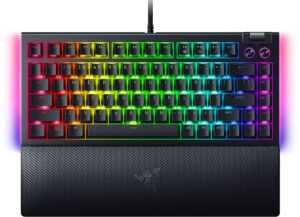
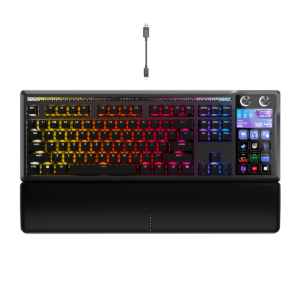
Keyboards with similar specs to the Logitech G316 X 98
Ratings & reviews
No reviews yet. Be the first to share your experience.
The bottom line
The Logitech G316 X 98 earns a VS Score of 51, above the median of the 101 keyboards it is measured against (a score of 50 is level with that median).
- Who it’s for
- A desktop gamer who wants a numpad, an enthusiast-style build and hot-swap sockets without assembling anything, and likes Logitech's software.
- Who should look elsewhere
- If you need wireless, or the rapid trigger and adjustable actuation competitive players now expect, this is the wrong board.
- The trade-off that matters
- It is wired only. The board stays a desk fixture, which suits a gaming PC and rules it out as a shared keyboard for a laptop.
- The main alternative
- Logitech G512 X 98: the same compact numpad layout with swappable analog switches for rapid trigger.
The VS Score is calculated from the weighted specifications above, each measured against the median of comparable keyboards — a shortlisting guide, not a substitute for your own priorities. See how we score.