Corsair VANGUARD 96: Specs, Features, Pros & Cons
Corsair builds this board in two forms, and the VANGUARD 96 is the one with conventional mechanical switches: Corsair's own linears, rated at 45 g, in sockets that accept other makers' three-pin and five-pin switches without solder.
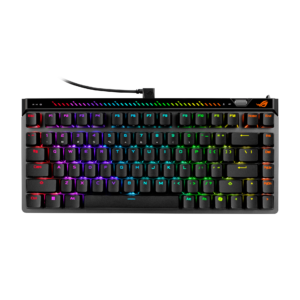
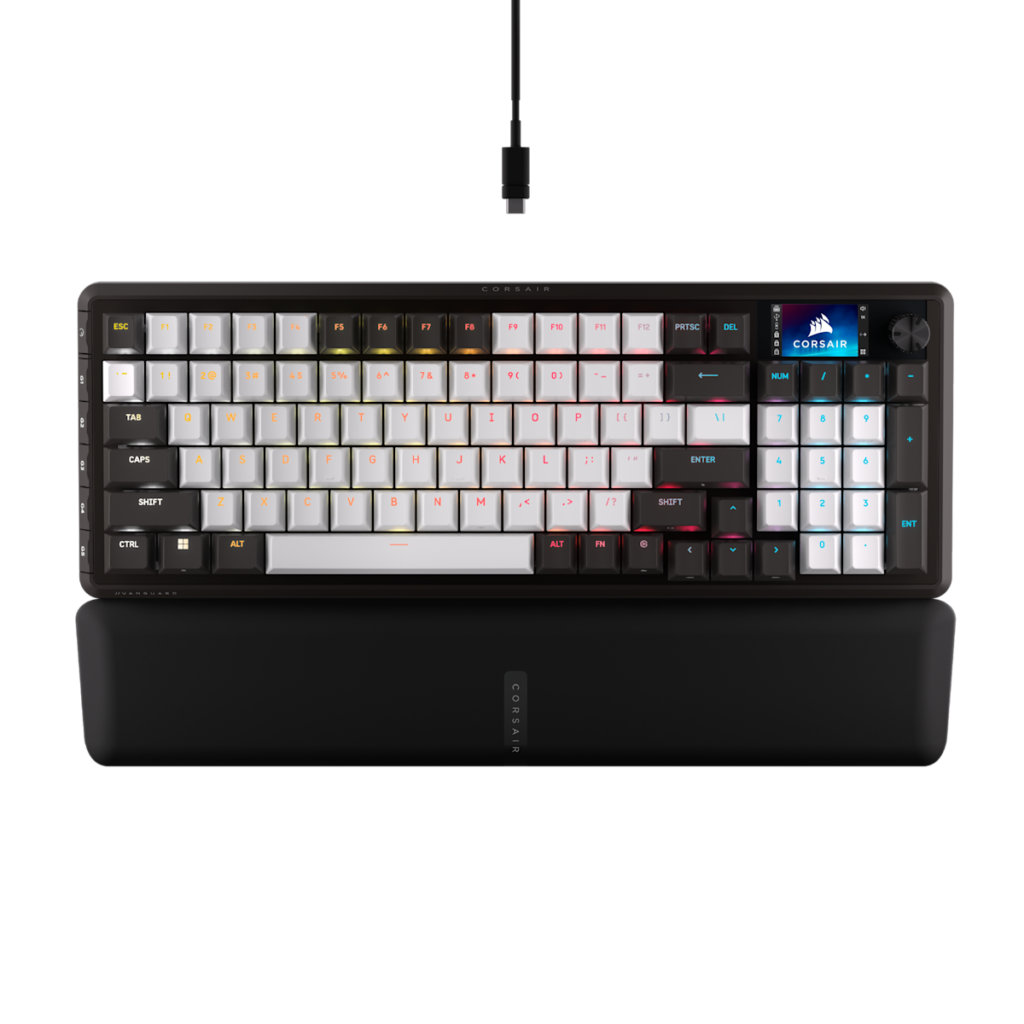
The layout is a compressed full-size one. Every key a standard board carries is present, the keypad, the arrows and the function row included, but packed closer together, so the board takes much less width and the mouse gets that space back. Macro keys, a dial and a little display line the edges for anyone who wants shortcuts or system readouts on the keyboard itself, and full N-key rollover means a burst of simultaneous presses all register.
Its polling rate is a gaming-flagship figure, well past what an ordinary keyboard reports. Its one recorded weakness is the connection, since this listing is the wired model. Corsair also sells a wireless VANGUARD 96, and the two look close to identical in photos, so read the product title with care. The same goes for the switch named on a listing, because retailers stock the board with more than one switch type. Build quality stands above the usual gaming board at this level, with a sculpted aluminum frame, layered foam inside and a magnetic wrist rest in the box. It is heavy, though, and meant to stay on one desk, and it will not travel well in a bag.
The buyer it was drawn up for needs a keypad for work, games in the evening, and may want to try a different switch feel in a year. The step up is the VANGUARD PRO 96, which keeps the chassis and swaps in magnetic switches with rapid trigger and a movable actuation point.
Category strengths
Where the Corsair VANGUARD 96 beats the median
- A much higher polling rate ?8,000 Hz vs 1,000 Hz (median)
Where the Corsair VANGUARD 96 trails the median
- Fewer connection options ?
How this VS Score was computed
Score 54: each known spec is measured against the median of all keyboards (101 products), then weighted; 50 means level with that median. In classes of six or more, a value beyond the class’s 10th–90th percentile range counts as that limit, so one extreme product cannot set the scale. 49% of the scoreable weight could be used; unknown values, features not applicable to this class and proxies (battery capacity where a rated life exists) add or remove nothing.
| Specification | This product | Cohort median | Score weight | Points moved |
|---|---|---|---|---|
| Polling rate | 8,000 | 1,000 | 0.7 | +35.0 |
| Hot-swappable | Yes | 61% of the class have it | 0.6 | +30.0 |
| Connection | 1 | 3 | 0.8 | −26.4 |
| Rapid trigger | No | 25% of the class have it | 0.5 | −24.0 |
| Adjustable actuation | No | 24% of the class have it | 0.4 | −19.2 |
| Sound dampening | Yes | 76% of the class have it | 0.3 | +15.0 |
| Rotary knob | Yes | 53% of the class have it | 0.2 | +10.0 |
| Switch technology | Mechanical | Mechanical | 1 | +0.0 |
| Actuation force | 45 | 45 | 0.4 | +0.0 |
| Backlight | RGB | RGB | 0.3 | +0.0 |
Not scored: N-key rollover (standard for the class (85% have it)); Analog input (not applicable: only 14% of this class have it); Wired latency (unknown: not scored); Wireless latency (unknown: not scored); Front height (unknown: not scored); Bluetooth devices (unknown: not scored); Battery life (unknown: not scored); Battery capacity (unknown: not scored); USB passthrough (not applicable: only 4% of this class have it); Keycap material (unknown: not scored); Programmable keys (standard for the class (99% have it)); Media controls (standard for the class (97% have it)); Onboard profiles (standard for the class (89% have it)); Configuration software (standard for the class (95% have it)).
Editor’s note
The VANGUARD 96 is built around one idea: you should not have to give up the numpad to get your mouse arm back. A 96% layout keeps every key of a full-size board (number pad, arrow cluster, function row) but strips out the gaps between them, so the whole thing occupies roughly the desk space of a tenkeyless.
The switches are Corsair's own MLX Quantum linears, pre-lubricated at the factory with a short 1.2 mm actuation. More interesting is that the board is hot-swappable: the PCB takes any compatible 3-pin or 5-pin switch, so Cherry, Gateron or Kailh alternatives drop in without soldering. That is unusual on a mainstream gaming keyboard and it meaningfully extends the board's life.
Build quality backs it up. The frame is sculpted aluminum, there are four layers of sound-dampening foam to kill the hollow ping cheaper boards have, and a magnetic leatherette wrist rest comes in the box. Polling runs at up to 8,000 Hz, there are six dedicated G-keys, a rotary dial, and a small LCD screen for stats or animations.
Two things to check before buying. First, this is the wired model. Corsair sells a separate wireless VANGUARD 96, and the two look nearly identical in listings. Second, and more easily missed, the board ships with several different switch options. Retailer listings frequently stock the MLX Fusion tactile or MLX Plasma linear versions rather than the MLX Quantum, so read the switch line, not just the model name.
There is also no USB passthrough, which the pricier GALLEON does have, and at 994 g this is not a keyboard you toss in a backpack.
Buy it if you want every full-size key on a crowded desk with room to tinker. Skip it if you need wireless or a lighter board.
Specifications
Quality bars show where each figure sits between the lowest and highest of the 101 keyboards this VS Score is measured against.
Switches & typing
Performance
Layout & size
Connectivity
Build & sound
Features
Sources and verification
Where the specifications come from
- Official product pagecorsair.com
- Independent testingrtings.com
Verification
- First published
- Specifications last checked
- Sheet completeness
- 21 of 34 specifications verified; the rest show as Unknown and are never estimated or scored
- Page type
- Product specification page — Compiled from the manufacturer’s published specifications and the cited sources; this is not a hands-on test.
- Basis
- Research-based: specifications and editorial text were compiled from the documents listed here and the manufacturer’s published data. We have not tested this unit ourselves; where independent measurements are mentioned they belong to the linked publication.
Keyboards with similar specs to the Corsair VANGUARD 96
Ratings & reviews
No reviews yet. Be the first to share your experience.
The bottom line
The Corsair VANGUARD 96 earns a VS Score of 54, above the median of the 101 keyboards it is measured against (a score of 50 is level with that median).
- Who it’s for
- A gamer who needs the number pad for work but wants a footprint close to a tenkeyless, and may want to try other switches later.
- Who should look elsewhere
- Look elsewhere if you need wireless or plan to carry the board around. This listing is the wired model only.
- The trade-off that matters
- It is wired and heavy, which suits a fixed gaming desk and rules it out for anyone who splits time between a desktop and a laptop.
- The main alternative
- Corsair VANGUARD PRO 96: the same chassis with Hall-effect switches, rapid trigger and adjustable actuation, for competitive shooter players.
The VS Score is calculated from the weighted specifications above, each measured against the median of comparable keyboards — a shortlisting guide, not a substitute for your own priorities. See how we score.