Wooting 60HE+: Specs, Features, Pros & Cons
A steel plate over a circuit board screwed straight into the case, the arrangement called a tray mount, is an old-fashioned way to build a keyboard, and on the 60HE+ it is the detail that separates this from its replacement more than any number does.
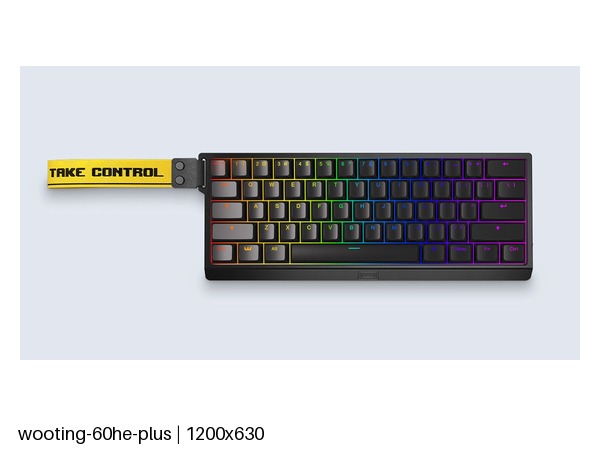
This is Wooting's earlier 60% magnetic board, still sold alongside the v2. The sensing hardware that made the range famous is present and unchanged in substance: Lekker L60 magnetic switches, actuation adjustable anywhere in the key travel, rapid trigger, and genuine analog output so movement keys can act as axes. Nothing about the way it reads your fingers has been cut down.
The differences sit around that core. Polling runs at a lower rate than on the newer board. The stabilizers are plate-mounted. And the tray mount gives a firmer, more traditional typing feel than the friction-fit assembly Wooting moved to afterwards, which is a matter of taste.
The shared ground is substantial, from hot-swap sockets and sound dampening to per-key lighting and onboard profiles, and like its successor it connects by cable only, deliberately so.
Because both boards remain on sale, this one exists mostly as a price decision. The features that change how the keyboard plays are identical. The ones that differ are the sort you notice on a specification sheet more than during a game.
It suits someone who wants magnetic switches and a 60% layout without paying the premium attached to the newer board's polling, and who is untroubled by losing arrows and a function row to a layer.
Category strengths
Where the Wooting 60HE+ beats the median
- Has rapid trigger ?
- Has adjustable actuation ?
- Has analog input ?
Where the Wooting 60HE+ trails the median
- Fewer connection options ?
- No rotary knob ?
How this VS Score was computed
Score 71: each known spec is measured against the median of all keyboards (101 products), then weighted; 50 means level with that median. In classes of six or more, a value beyond the class’s 10th–90th percentile range counts as that limit, so one extreme product cannot set the scale. 49% of the scoreable weight could be used; unknown values, features not applicable to this class and proxies (battery capacity where a rated life exists) add or remove nothing.
| Specification | This product | Cohort median | Score weight | Points moved |
|---|---|---|---|---|
| Switch technology | Hall effect | Mechanical | 1 | +33.0 |
| Hot-swappable | Yes | 61% of the class have it | 0.6 | +30.0 |
| Connection | 1 | 3 | 0.8 | −26.4 |
| Rapid trigger | Yes | 25% of the class have it | 0.5 | +25.0 |
| Adjustable actuation | Yes | 24% of the class have it | 0.4 | +20.0 |
| Analog input | Yes | 14% of the class have it | 0.4 | +20.0 |
| Sound dampening | Yes | 76% of the class have it | 0.3 | +15.0 |
| Rotary knob | No | 54% of the class have it | 0.2 | −9.6 |
| Polling rate | 1,000 | 1,000 | 0.7 | +0.0 |
| Backlight | RGB | RGB | 0.3 | +0.0 |
Not scored: Actuation force (unknown: not scored); N-key rollover (standard for the class (84% have it)); Wired latency (unknown: not scored); Wireless latency (unknown: not scored); Front height (unknown: not scored); Bluetooth devices (unknown: not scored); Battery life (unknown: not scored); Battery capacity (unknown: not scored); USB passthrough (unknown: not scored); Keycap material (unknown: not scored); Programmable keys (standard for the class (99% have it)); Media controls (unknown: not scored); Onboard profiles (standard for the class (89% have it)); Configuration software (standard for the class (95% have it)).
Editor’s note
The 60HE+ is the earlier of Wooting's two 60% boards, and knowing what changed in the v2 is the whole decision.
The sensing is the same in substance: Lekker L60 magnetic switches with actuation adjustable anywhere in the travel, rapid trigger, and true analog input for joystick-style axes. Those are the features that made these boards the default competitive recommendation, and this one has all of them.
Two differences matter. Polling here is 1,000 Hz against the v2's 8,000 Hz, a gap measured in fractions of a millisecond that almost nobody perceives, but which is precisely what a buyer at this level tends to be shopping for. And the construction differs: a steel plate on a tray mount with plate-mounted stabilizers, where the v2 moves to a friction-fit assembly with screw-in stabilizers. Tray mounting is the firmer, more traditional feel, and whether that is better is a matter of taste rather than quality.
Both are hot-swappable, and both have sound dampening, per-key RGB and onboard profiles. This one has 61 keys in an ABS case and weighs 605 g.
It is wired only, deliberately.
Buy it if you find it cheaper than the v2 and the lower polling rate does not trouble you. The sensing that matters is identical. Buy the v2 if you want the higher polling rate and the newer plate and stabilizer arrangement.
Specifications
Quality bars show where each figure sits between the lowest and highest of the 101 keyboards this VS Score is measured against.
Switches & typing
Performance
Layout & size
Connectivity
Build & sound
Features
Sources and verification
Where the specifications come from
- Official product pagewooting.io
Verification
- First published
- Specifications last checked
- Sheet completeness
- 24 of 34 specifications verified; the rest show as Unknown and are never estimated or scored
- Page type
- Product specification page — Compiled from the manufacturer’s published specifications and the cited sources; this is not a hands-on test.
- Basis
- Research-based: specifications and editorial text were compiled from the documents listed here and the manufacturer’s published data. We have not tested this unit ourselves; where independent measurements are mentioned they belong to the linked publication.
Keyboards with similar specs to the Wooting 60HE+

Ratings & reviews
No reviews yet. Be the first to share your experience.
The bottom line
The Wooting 60HE+ earns a VS Score of 71, above the median of the 101 keyboards it is measured against (a score of 50 is level with that median).
- Who it’s for
- A competitive player who wants Wooting's adjustable magnetic sensing and rapid trigger in a compact board, and finds this model cheaper than its successor.
- Who should look elsewhere
- Anyone who needs arrow keys and a function row without a layer, wants a wireless keyboard, or is specifically shopping for the highest polling rate available.
- The trade-off that matters
- You keep the sensing that changes how the keyboard plays and give up the newer polling and stabilizer design, a difference far easier to see on a spec sheet than in a match.
- The main alternative
- Wooting 60HE v2: the same magnetic sensing with faster polling and the newer friction-fit build, for buyers who want the current revision.
The VS Score is calculated from the weighted specifications above, each measured against the median of comparable keyboards — a shortlisting guide, not a substitute for your own priorities. See how we score.