Wooting 60HE v2: Specs, Features, Pros & Cons
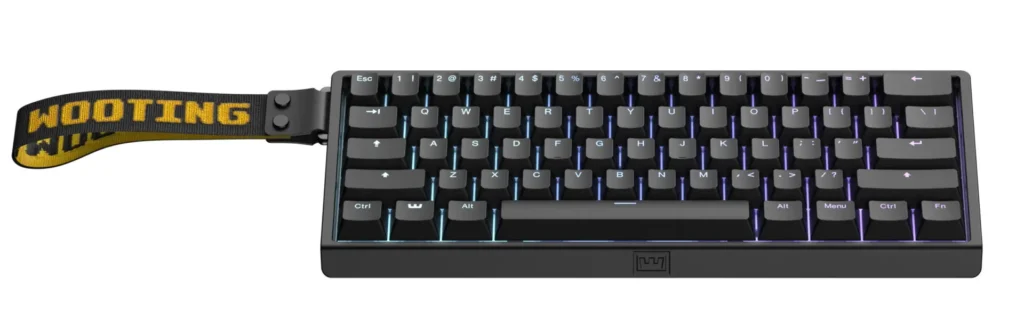
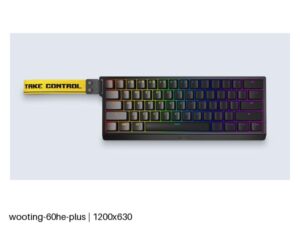
Sixty-one keys. No function row, no arrow cluster, no navigation block, no number pad. Everything above the letters lives on a layer you hold Fn to reach, and that is the first thing to settle about the 60HE v2, because it is not negotiable.
What you get for accepting it is a keyboard that senses differently from almost everything else. The Lekker switches are magnetic: a sensor reads how far each key has moved rather than registering a single closed contact. Three possibilities follow. Actuation can sit anywhere in the travel, from a hair trigger to something deliberate. Rapid trigger resets a key the moment it starts traveling back up. And because the board knows depth, keys can behave as analog axes, so WASD works like a stick in a driving or flight game.
Polling runs at 8,000 Hz and the connection is wired only, with no wireless option offered at any price. Wooting's position is that a radio link would work against the point of the product, which is at least consistent.
The construction is where the money did not go. The case is ABS plastic on an FR4 plate, where boards at this price often use milled aluminum, though the switches are hot-swappable, the stabilizers screw in, and there is foam inside. At 606 g it travels well, which an aluminum board does not.
The buyer this fits is narrow and obvious: someone whose keyboard purchase is driven by competitive shooters and who is comfortable losing a function row. For writing, spreadsheets or anything with heavy arrow-key use, the layout will fight you daily, and no amount of sensing sophistication makes up for that.
Category strengths
Where the Wooting 60HE v2 beats the median
- A much higher polling rate ?8,000 Hz vs 1,000 Hz (median)
- Has rapid trigger ?
- Has adjustable actuation ?
- Has analog input ?
- A slightly lighter actuation force ?42 g vs 45 g (median)
Where the Wooting 60HE v2 trails the median
- Fewer connection options ?
- No media controls ?
- No rotary knob ?
How this VS Score was computed
Score 71: each known spec is measured against the median of all keyboards (101 products), then weighted; 50 means level with that median. In classes of six or more, a value beyond the class’s 10th–90th percentile range counts as that limit, so one extreme product cannot set the scale. 59% of the scoreable weight could be used; unknown values, features not applicable to this class and proxies (battery capacity where a rated life exists) add or remove nothing.
| Specification | This product | Cohort median | Score weight | Points moved |
|---|---|---|---|---|
| Polling rate | 8,000 | 1,000 | 0.7 | +35.0 |
| Switch technology | Hall effect | Mechanical | 1 | +33.0 |
| Hot-swappable | Yes | 61% of the class have it | 0.6 | +30.0 |
| Connection | 1 | 3 | 0.8 | −26.4 |
| Rapid trigger | Yes | 25% of the class have it | 0.5 | +25.0 |
| Adjustable actuation | Yes | 24% of the class have it | 0.4 | +20.0 |
| Analog input | Yes | 14% of the class have it | 0.4 | +20.0 |
| Sound dampening | Yes | 76% of the class have it | 0.3 | +15.0 |
| Media controls | No | 97% of the class have it | 0.3 | −14.4 |
| Rotary knob | No | 53% of the class have it | 0.2 | −9.6 |
| Actuation force | 42 | 45 | 0.4 | +1.6 |
| Keycap material | PBT | PBT | 0.4 | +0.0 |
| Backlight | RGB | RGB | 0.3 | +0.0 |
Not scored: N-key rollover (standard for the class (85% have it)); Wired latency (unknown: not scored); Wireless latency (unknown: not scored); Front height (unknown: not scored); Bluetooth devices (unknown: not scored); Battery life (unknown: not scored); Battery capacity (unknown: not scored); USB passthrough (not applicable: only 4% of this class have it); Programmable keys (standard for the class (99% have it)); Onboard profiles (standard for the class (89% have it)); Configuration software (standard for the class (95% have it)).
Editor’s note
The 60HE v2 is the board that made Hall-effect keyboards mainstream, and it remains the reference against which the others are judged.
Its Lekker switches are magnetic, so the keyboard reads the depth of each key throughout its travel. Three things follow. You can set the actuation point anywhere in the travel. Rapid trigger resets a key the instant you begin lifting it, which materially changes counter-strafing in shooters. And analog input exposes keys as axes, so WASD behaves like a joystick in racing and flight games, a feature several rival Hall-effect boards omit.
The layout is a 61-key 60% with no function row, no arrows and no navigation cluster. Everything is on layers, which takes a week to internalize and then stops being a problem.
It is wired only, and that is deliberate: a wireless link adds latency that undermines the point of the board.
The build is the weak spot at this price. The case is ABS plastic and the plate FR4, where enthusiast boards use aluminum, though it is hot-swappable, has screw-in stabilizers and includes sound dampening, and it is light enough to carry.
Buy it if competitive shooters are the reason you are buying a keyboard, and a 60% layout suits you. Buy something larger if you type all day, or an aluminum board if the feel and sound of typing matter more than the sensing.
Specifications
Quality bars show where each figure sits between the lowest and highest of the 101 keyboards this VS Score is measured against.
Switches & typing
Performance
Layout & size
Connectivity
Build & sound
Features
Sources and verification
Where the specifications come from
- Official product pagewooting.io
- Independent testingrtings.com
Verification
- First published
- Specifications last checked
- Sheet completeness
- 28 of 34 specifications verified; the rest show as Unknown and are never estimated or scored
- Page type
- Product specification page — Compiled from the manufacturer’s published specifications and the cited sources; this is not a hands-on test.
- Basis
- Research-based: specifications and editorial text were compiled from the documents listed here and the manufacturer’s published data. We have not tested this unit ourselves; where independent measurements are mentioned they belong to the linked publication.
Keyboards with similar specs to the Wooting 60HE v2

Ratings & reviews
No reviews yet. Be the first to share your experience.
The bottom line
The Wooting 60HE v2 earns a VS Score of 71, above the median of the 101 keyboards it is measured against (a score of 50 is level with that median).
- Who it’s for
- A competitive shooter player who wants the reference magnetic board and is happy to reach the function row and arrows through a layer.
- Who should look elsewhere
- Anyone who writes, works in spreadsheets or leans on arrow keys should buy something bigger. The layout will slow them every day.
- The trade-off that matters
- The tiny layout frees the most room for the mouse, but everything above the number row and all navigation needs Fn, and that never suits heavy typing.
- The main alternative
- Wooting 80HE: the same magnetic features with a function row and arrow keys, and a softer gasket-mounted build.
The VS Score is calculated from the weighted specifications above, each measured against the median of comparable keyboards — a shortlisting guide, not a substitute for your own priorities. See how we score.