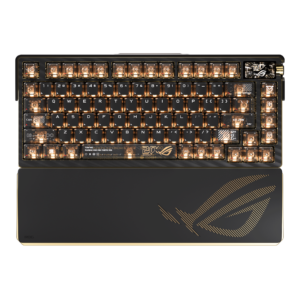

Wooting 80HE: Specs, Features, Pros & Cons
Wooting publishes a wired latency of around 0.125 ms for the 80HE, a figure almost no keyboard maker prints at all, and the board is designed around that number. It has no wireless mode of any kind, and the company has declined to put a radio between the switch and the computer.
The 80HE sits between the compact 60HE boards and the full-size Two HE in Wooting's range. It keeps the function row and gives the arrow keys their own cluster in a tenkeyless footprint, which is the main reason to choose it over the compact 60HE. The polling rate runs at 8,000 Hz over the cable, eight times the usual rate.
Its magnetic Lekker switches expose the full feature set. Actuation depth is yours to set, rapid trigger resets a key the moment it rises, and analog input lets a key act as a joystick axis in racing and flight games. The sockets are hot-swap as well, so switches can be changed later without soldering.
The build is a step up from Wooting's earlier boards. A gasket mount over a polycarbonate plate, screw-in stabilizers, PBT keycaps and internal dampening give a softer typing feel than the company's earlier tray-mounted boards, a difference you feel when the same machine is used for writing between matches. What you give up is mobility and a clear desk. The cable stays in, the board cannot pair with a second computer without being unplugged, and there is no receiver for a laptop. A single fixed gaming desk never notices the loss. Competitive players who want every magnetic feature, analog axes included, and a layout with real arrow keys are the people Wooting built it for.
Category strengths
Where the Wooting 80HE beats the median
- A much higher polling rate ?8,000 Hz vs 1,000 Hz (median)
- Has rapid trigger ?
- Has adjustable actuation ?
- Has analog input ?
- A slightly lower front height ?19.4 mm vs 20.25 mm (median)
Where the Wooting 80HE trails the median
- Fewer connection options ?
How this VS Score was computed
Score 74: each known spec is measured against the median of all keyboards (101 products), then weighted; 50 means level with that median. In classes of six or more, a value beyond the class’s 10th–90th percentile range counts as that limit, so one extreme product cannot set the scale. 60% of the scoreable weight could be used; unknown values, features not applicable to this class and proxies (battery capacity where a rated life exists) add or remove nothing.
| Specification | This product | Cohort median | Score weight | Points moved |
|---|---|---|---|---|
| Polling rate | 8,000 | 1,000 | 0.7 | +35.0 |
| Switch technology | Hall effect | Mechanical | 1 | +33.0 |
| Hot-swappable | Yes | 61% of the class have it | 0.6 | +30.0 |
| Connection | 1 | 3 | 0.8 | −26.4 |
| Rapid trigger | Yes | 25% of the class have it | 0.5 | +25.0 |
| Adjustable actuation | Yes | 24% of the class have it | 0.4 | +20.0 |
| Analog input | Yes | 14% of the class have it | 0.4 | +20.0 |
| Sound dampening | Yes | 76% of the class have it | 0.3 | +15.0 |
| Front height | 19.4 | 20.25 | 0.2 | +0.4 |
| Wired latency | 0.13 | 0.13 | 0.8 | +0.0 |
| Keycap material | PBT | PBT | 0.4 | +0.0 |
| Backlight | RGB | RGB | 0.3 | +0.0 |
Not scored: Actuation force (unknown: not scored); N-key rollover (standard for the class (84% have it)); Wireless latency (unknown: not scored); Bluetooth devices (unknown: not scored); Battery life (unknown: not scored); Battery capacity (unknown: not scored); USB passthrough (unknown: not scored); Programmable keys (standard for the class (99% have it)); Media controls (unknown: not scored); Rotary knob (unknown: not scored); Onboard profiles (standard for the class (89% have it)); Configuration software (standard for the class (95% have it)).
Editor’s note
The 80HE is the Wooting for people who found the 60% layout too small, and Wooting has since released a revised version, the 80HE+.
The magnetic Lekker L60 V2 switches give the full set: actuation adjustable anywhere in the travel, rapid trigger that resets a key the instant it starts rising, and true analog input so keys can act as joystick axes. Wooting also publishes a wired latency figure, a specification almost no manufacturer states, and a fair indication of what the board is engineered around.
The ANSI layout has 84 keys in a TKL footprint, so the function row and arrow keys have their own keys, which is the main practical reason to choose it over the 60HE.
The build has moved on from the older models too. This one uses a gasket mount with a polycarbonate plate and screw-in stabilizers, which gives a softer, quieter typing feel than the tray-mounted 60HE+, along with PBT keycaps and sound dampening. At 790 g it stays put without being a paperweight.
It is wired only. On a board sold on latency that is a coherent decision.
Buy it if you want Wooting's sensing with a normal layout and a typing feel that does not punish you between matches. Buy the 60HE if desk space is tight, or a tri-mode board if you need to move it between machines.
Specifications
Quality bars show where each figure sits between the lowest and highest of the 101 keyboards this VS Score is measured against.
Switches & typing
Performance
Layout & size
Connectivity
Build & sound
Features
Sources and verification
Where the specifications come from
- Official product pagewooting.io
Verification
- First published
- Specifications last checked
- Sheet completeness
- 26 of 34 specifications verified; the rest show as Unknown and are never estimated or scored
- Page type
- Product specification page — Compiled from the manufacturer’s published specifications and the cited sources; this is not a hands-on test.
- Basis
- Research-based: specifications and editorial text were compiled from the documents listed here and the manufacturer’s published data. We have not tested this unit ourselves; where independent measurements are mentioned they belong to the linked publication.
Keyboards with similar specs to the Wooting 80HE

Ratings & reviews
No reviews yet. Be the first to share your experience.
The bottom line
The Wooting 80HE earns a VS Score of 74, above the median of the 101 keyboards it is measured against (a score of 50 is level with that median).
- Who it’s for
- A competitive player who wants every magnetic-switch feature, analog axes included, and still needs a function row and real arrow keys.
- Who should look elsewhere
- Look elsewhere if the board has to move between a desk and a laptop bag, since Wooting offers no wireless mode at all.
- The trade-off that matters
- The cable is permanent. On a desk that never changes it costs nothing, but sharing the board with a second computer means unplugging and rerouting it every time.
- The main alternative
- Wooting 60HE v2: the same sensing in a narrower board, if the mouse needs the room more than the arrow keys do.
The VS Score is calculated from the weighted specifications above, each measured against the median of comparable keyboards — a shortlisting guide, not a substitute for your own priorities. See how we score.