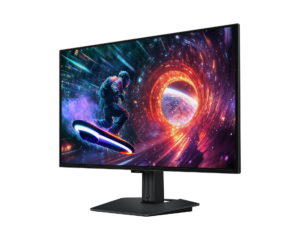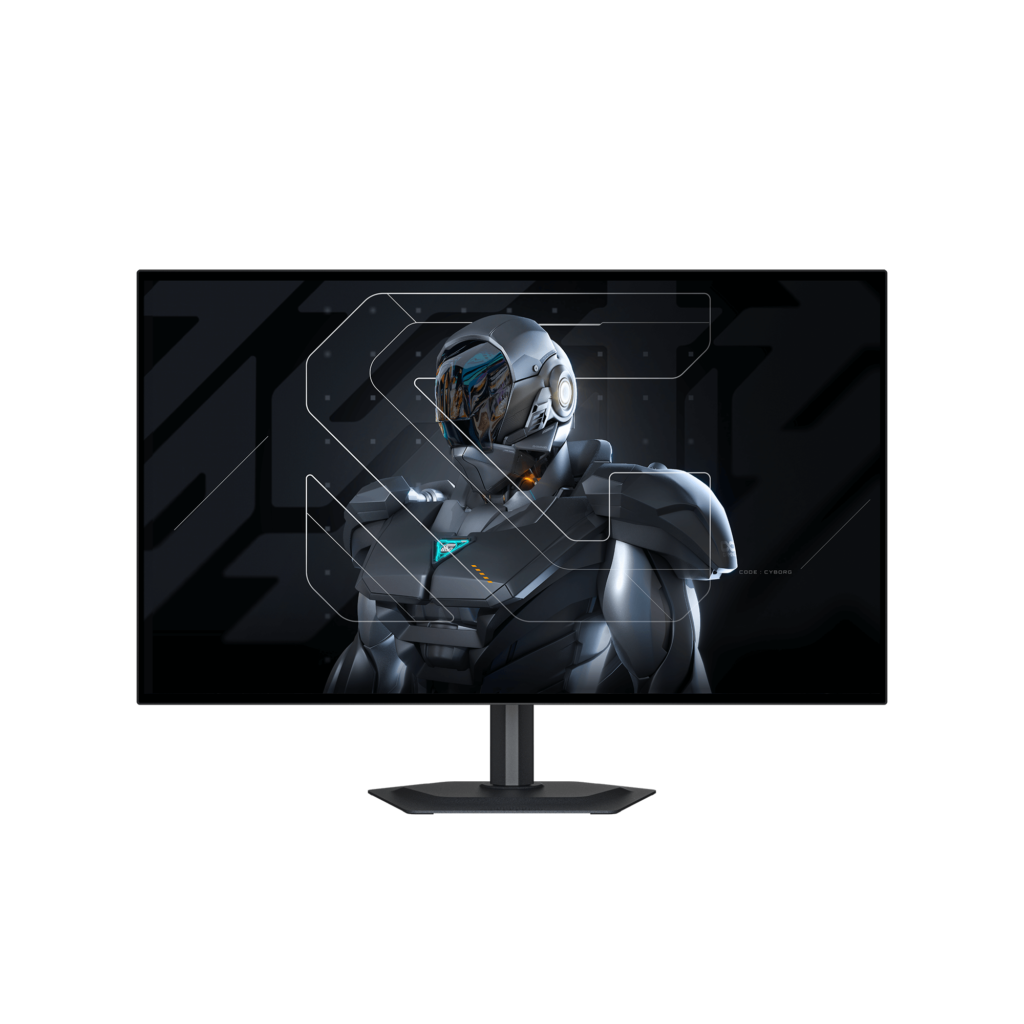
Gigabyte MO27Q28G: Specs, Features, Pros & Cons
OLED monitors used to lose their argument in a sunny room. The per-pixel blacks were superb, but the brightness sagged once a window was involved. This Gigabyte belongs to the newer tandem generation, where the panel stacks extra light-emitting layers, and the difference shows as highlights that hold up in daylight.
Gigabyte put that panel in a gaming monitor at QHD resolution, the step between everyday Full HD and demanding Ultra HD. That middle step keeps text clean at desk distance and lets a graphics card well short of the most expensive keep frame rates high. It also carries VESA's True Black 500 certification, the HDR tier written for OLED, which measures how deep the blacks go as well as how bright the highlights get.
What defines this particular model is the desk it expects. Gigabyte treated connectivity as the priority, with a single-cable link for a laptop and a built-in switch that moves the keyboard and mouse between two computers. Many OLED gaming screens skip both, so it suits a setup where a work laptop and a gaming PC take turns on the same screen.
The finish is glossy. That makes the image look deeper in a controlled room and turns a lamp behind your chair into a reflection. As with any OLED, static taskbars left on screen for hours carry a slow risk of retention, and the panel's care routines exist to manage it.
The budget went on ports, and the stand paid for it: it tilts and does little else. Plan on a monitor arm if the screen needs to sit higher or turn to portrait, and the standard VESA mount on the back takes one.
Category strengths
Where the Gigabyte MO27Q28G beats the median
- Has USB-C ?
- Much higher peak brightness ?1,500 nits vs 1,000 nits (median)
- A higher refresh rate ?280 Hz vs 240 Hz (median)
- Has KVM switch ?
Where the Gigabyte MO27Q28G trails the median
- No swivel adjustment ?
- Much slower USB-C charging ?18 W vs 54 W (median)
- No pivot adjustment ?
How this VS Score was computed
Score 56: each known spec is measured against the median of OLED gaming monitors, 27 to 31 inches (16 products), then weighted; 50 means level with that median. In classes of six or more, a value beyond the class’s 10th–90th percentile range counts as that limit, so one extreme product cannot set the scale. 70% of the scoreable weight could be used; unknown values, features not applicable to this class and proxies (battery capacity where a rated life exists) add or remove nothing.
| Specification | This product | Cohort median | Score weight | Points moved |
|---|---|---|---|---|
| USB-C | Yes | 33% of the class have it | 0.5 | +25.0 |
| Peak brightness | 1,500 | 1,000 | 0.8 | +20.0 |
| Headphone output | Yes | 75% of the class have it | 0.2 | +10.0 |
| Swivel | No | 88% of the class have it | 0.2 | −9.6 |
| Refresh rate | 280 | 240 | 1.2 | +9.6 |
| HDR | True Black 500 | True Black 400 | 0.5 | +5.0 |
| USB hub | Yes | 73% of the class have it | 0.05 | +2.3 |
| USB-C power delivery | 18 | 54 | 0.05 | −1.5 |
| KVM switch | Yes | 33% of the class have it | 0.02 | +1.0 |
| Pivot | No | 81% of the class have it | 0.02 | −1.0 |
| Screen size | 27 | 27 | 1.2 | +0.0 |
| Resolution | 1440p | 1440p | 1.2 | +0.0 |
| Panel type | OLED | OLED | 0.8 | +0.0 |
| Color depth | 10 | 10 | 0.3 | +0.0 |
| Response time | 0.03 | 0.03 | 0.8 | +0.0 |
| Contrast ratio | 1,500,000 | 1,500,000 | 0.6 | +0.0 |
| DCI-P3 coverage | 99.5 | 99 | 0.6 | +0.0 |
| Pixel density | 110 | 111 | 0.5 | +0.0 |
| Adaptive sync | G-Sync Compatible | G-Sync Compatible | 0.6 | +0.0 |
| HDMI ports | 2 | 2 | 0.4 | +0.0 |
| DisplayPort inputs | 1 | 1 | 0.4 | +0.0 |
Not scored: Local dimming (not applicable: only 0% of this class have it); Local dimming zones (unknown: not scored); Variable refresh rate (standard for the class (100% have it)); Motion blur reduction (unknown: not scored); Input lag (unknown: not scored); Height adjustment (standard for the class (94% have it)); Tilt (standard for the class (100% have it)); Built-in speakers (not applicable: only 0% of this class have it); Webcam (unknown: not scored); Microphone (unknown: not scored); Ethernet (unknown: not scored); Picture-by-picture (unknown: not scored).
Editor’s note
The MO27Q28G is the same Tandem WOLED panel as ASUS's XG27AQWMG (1440p, 1,500 nits, 99.5% DCI-P3, glossy, 0.03 ms), so the picture is not what separates them. The desk is.
Gigabyte spent the budget on connectivity. There is USB-C with a USB hub and a KVM switch, so one keyboard and mouse can drive two machines and a laptop can connect over a single cable. ASUS gives you neither. Read the USB-C power figure carefully though: 18 W, which is enough to keep a phone or a tablet topped up but nowhere near enough to charge a laptop, which still needs its own adapter. Two HDMI 2.1 ports and DisplayPort 1.4 complete the set.
What Gigabyte took back is the stand. It tilts and nothing else: no height adjustment listed beyond that, no swivel, no pivot. If your desk does not happen to put the screen at eye level you will want a VESA arm, and the 100 x 100 mount is there for one.
The panel deserves its own sentence regardless of badge. That peak is half again what a QD-OLED manages, and at 1440p a mid-range graphics card can feed 280 Hz, which is the point of buying this resolution in 2026 rather than 4K.
Buy it if a laptop and a desktop share the desk and you have or will buy a monitor arm. Buy the ASUS if you want a fully adjustable stand and only ever plug in one machine.
Specifications
Quality bars show where each figure sits between the lowest and highest of the 16 OLED gaming monitors, 27 to 31 inches this VS Score is measured against.
Picture
Gaming
Ergonomics & design
Connectivity
Features
Sources and verification
Where the specifications come from
- Official product pagegigabyte.com
- Independent testingrtings.com
Verification
- First published
- Specifications last checked
- Sheet completeness
- 33 of 42 specifications verified; the rest show as Unknown and are never estimated or scored
- Page type
- Product specification page — Compiled from the manufacturer’s published specifications and the cited sources; this is not a hands-on test.
- Basis
- Research-based: specifications and editorial text were compiled from the documents listed here and the manufacturer’s published data. We have not tested this unit ourselves; where independent measurements are mentioned they belong to the linked publication.
Monitors with similar specs to the Gigabyte MO27Q28G
Ratings & reviews
No reviews yet. Be the first to share your experience.
The bottom line
The Gigabyte MO27Q28G earns a VS Score of 56, above the median of the 16 OLED gaming monitors, 27 to 31 inches it is measured against (a score of 50 is level with that median).
- Who it’s for
- A desk shared by a laptop and a gaming PC, with a monitor arm already in place or on the shopping list.
- Who should look elsewhere
- Anyone relying on the stand to set height and angle, since it only tilts, and anyone hoping the USB-C port will charge a laptop.
- The trade-off that matters
- The connectivity comes at the expense of the stand, so the money saved on a dock may go on an arm instead.
- The main alternative
- ASUS ROG Strix OLED XG27AQWMG: the same panel on a fully adjustable stand, for a desk with only one machine to connect.
The VS Score is calculated from the weighted specifications above, each measured against the median of comparable OLED gaming monitors, 27 to 31 inches — a shortlisting guide, not a substitute for your own priorities. See how we score.