Razer Huntsman V3 Pro 8KHz: Specs, Features, Pros & Cons
Every key on the Huntsman V3 Pro 8KHz can behave as an analog control, reading how far it has traveled instead of only whether it has been pressed. That is the least discussed thing about Razer's esports flagship, and it is useful well beyond shooters, since racing and flight games can take throttle and steering from the keys.
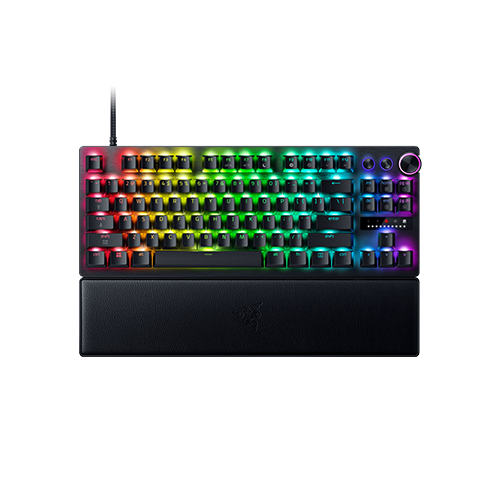
The headline features lie elsewhere. The analog optical switches let each key fire at a depth you choose and reset the instant it lifts, and the fast polling in the name cuts the gap between a press and the computer hearing it. The keycaps are textured PBT, the top case is brushed aluminum, and a media dial sits beside a few dedicated keys.
The tenkeyless layout places the board in the middle of the Huntsman V3 Pro family. It keeps the function row and arrows, drops the number pad, and leaves the mouse room to swing, which suits low-sensitivity aim. A full-size model with the keypad exists alongside it at the standard polling rate. Settings are stored in onboard profiles, so actuation and lighting travel to a tournament PC without the software. Configuration still runs through Synapse, which installs background services on the home machine. There is no wireless mode, since the board is sold on response time.
What you give up is the ability to change it later. The switches are soldered, so the feel is permanent and a failed key needs a repair. And the headline polling rate only helps if the rest of the system and the player can use it. This keyboard is for someone who competes, travels to play, and wants the quickest analog board Razer makes without assembling a custom one.
Category strengths
Where the Razer Huntsman V3 Pro 8KHz beats the median
- A much higher polling rate ?8,000 Hz vs 1,000 Hz (median)
- Has rapid trigger ?
- Has adjustable actuation ?
- Has analog input ?
- A lighter actuation force ?40 g vs 45 g (median)
Where the Razer Huntsman V3 Pro 8KHz trails the median
- No hot-swappable switches ?
- Fewer connection options ?
How this VS Score was computed
Score 63: each known spec is measured against the median of all keyboards (101 products), then weighted; 50 means level with that median. In classes of six or more, a value beyond the class’s 10th–90th percentile range counts as that limit, so one extreme product cannot set the scale. 54% of the scoreable weight could be used; unknown values, features not applicable to this class and proxies (battery capacity where a rated life exists) add or remove nothing.
| Specification | This product | Cohort median | Score weight | Points moved |
|---|---|---|---|---|
| Polling rate | 8,000 | 1,000 | 0.7 | +35.0 |
| Hot-swappable | No | 61% of the class have it | 0.6 | −28.8 |
| Connection | 1 | 3 | 0.8 | −26.4 |
| Rapid trigger | Yes | 25% of the class have it | 0.5 | +25.0 |
| Adjustable actuation | Yes | 24% of the class have it | 0.4 | +20.0 |
| Analog input | Yes | 14% of the class have it | 0.4 | +20.0 |
| Switch technology | Optical | Mechanical | 1 | +17.0 |
| Rotary knob | Yes | 53% of the class have it | 0.2 | +10.0 |
| Actuation force | 40 | 45 | 0.4 | +2.4 |
| Keycap material | PBT | PBT | 0.4 | +0.0 |
| Backlight | RGB | RGB | 0.3 | +0.0 |
Not scored: N-key rollover (unknown: not scored); Wired latency (unknown: not scored); Wireless latency (unknown: not scored); Front height (unknown: not scored); Bluetooth devices (unknown: not scored); Battery life (unknown: not scored); Battery capacity (unknown: not scored); USB passthrough (not applicable: only 4% of this class have it); Sound dampening (unknown: not scored); Programmable keys (standard for the class (99% have it)); Media controls (standard for the class (97% have it)); Onboard profiles (standard for the class (89% have it)); Configuration software (standard for the class (95% have it)).
Editor’s note
The Huntsman V3 Pro 8KHz is Razer's esports flagship, and the 8KHz in the name is the point: true 8,000 Hz HyperPolling, against the 1,000 Hz most keyboards still ship. That is a 0.125-millisecond report interval, and it is the specification the professional players Razer sponsors asked for.
Underneath it uses second-generation analog optical switches, reading light beams where rivals use magnets, with the same practical result. Actuation adjusts between 0.1 and 4 millimeters, Rapid Trigger is supported, and Snap Tap resolves opposing key presses by registering whichever came last, which matters for counter-strafing. Actuation force is 40 grams.
The build backs the price up. A 5052 brushed aluminum top case eliminates flex, the keycaps are textured double-shot PBT, and there is a proper media dial alongside dedicated keys. Six profiles store onboard, so your actuation and lighting settings follow the board to a LAN.
Two things to weigh. The switches are not hot-swappable, so a failure means a repair rather than a replacement part. That is less likely with optical switches rated at 100 million presses, but not impossible. And Synapse is a heavier piece of software than most competitors demand, running background services you may not want.
The tenkeyless layout is the right call for the audience. Removing the number pad lets you center the board on your desk and swing a mouse at low sensitivity without hitting your keyboard hand, which is why almost every competitive player uses one. If you need a keypad for work, buy a separate one.
This is a keyboard for someone who plays competitively and wants the fastest input available without assembling something bespoke. If you are not playing at a level where 0.125 milliseconds is distinguishable from one millisecond, a standard Huntsman costs considerably less and types identically.
Specifications
Quality bars show where each figure sits between the lowest and highest of the 101 keyboards this VS Score is measured against.
Switches & typing
Performance
Layout & size
Connectivity
Build & sound
Features
Sources and verification
Where the specifications come from
- Official product pagerazer.com
- Independent testingrtings.com
Verification
- First published
- Specifications last checked
- Sheet completeness
- 21 of 34 specifications verified; the rest show as Unknown and are never estimated or scored
- Page type
- Product specification page — Compiled from the manufacturer’s published specifications and the cited sources; this is not a hands-on test.
- Basis
- Research-based: specifications and editorial text were compiled from the documents listed here and the manufacturer’s published data. We have not tested this unit ourselves; where independent measurements are mentioned they belong to the linked publication.
Keyboards with similar specs to the Razer Huntsman V3 Pro 8KHz

Ratings & reviews
No reviews yet. Be the first to share your experience.
The bottom line
The Razer Huntsman V3 Pro 8KHz earns a VS Score of 63, above the median of the 101 keyboards it is measured against (a score of 50 is level with that median).
- Who it’s for
- LAN and tournament regulars who want Razer's quickest analog optical board with every setting stored on the keyboard itself.
- Who should look elsewhere
- Players below the level where a fraction of a millisecond shows up should skip it, and so should anyone who resents heavy background software.
- The trade-off that matters
- The switches are soldered in, so a dead key means a repair job where a hot-swap board would need a spare switch and two minutes.
- The main alternative
- Razer Huntsman V3 Pro: the same analog optical switches at the standard polling rate, with a keypad and dial for anyone who also works on it.
The VS Score is calculated from the weighted specifications above, each measured against the median of comparable keyboards — a shortlisting guide, not a substitute for your own priorities. See how we score.