Logitech G PRO X TKL RAPID: Specs, Features, Pros & Cons
Several spec listings credit Logitech's first magnetic tenkeyless board with hot-swap sockets and 8 kHz polling, and it has neither. Logitech's own specification gives a maximum report rate of 1 ms, and the company's comparison against the G512 X lists the PRO X TKL RAPID's switches as fixed. The faster polling arrived with the PRO X2 RAPID, which now sits above this board in the same range.
Each Hall effect switch measures how far its key has traveled, so the point at which a key fires can be set key by key, and rapid trigger re-arms a key the moment it starts to rise instead of waiting for a fixed reset point. Its sensitivity can be set per key or for the whole board. In a shooter, that lets a strafe key stop and reverse sooner. Logitech also lets a single key carry two actions that fire at different depths, and its KEYCONTROL layers stack combos on top of that.
Specialists such as Wooting opened this field, and Logitech's contribution is less invention than a large brand's software and support wrapped around the same idea. Settings live in three onboard memory slots, so a tournament machine picks up your profile with no G HUB installed. A Game Mode button switches off the Windows key, or any other keys you choose in the software, while you play.
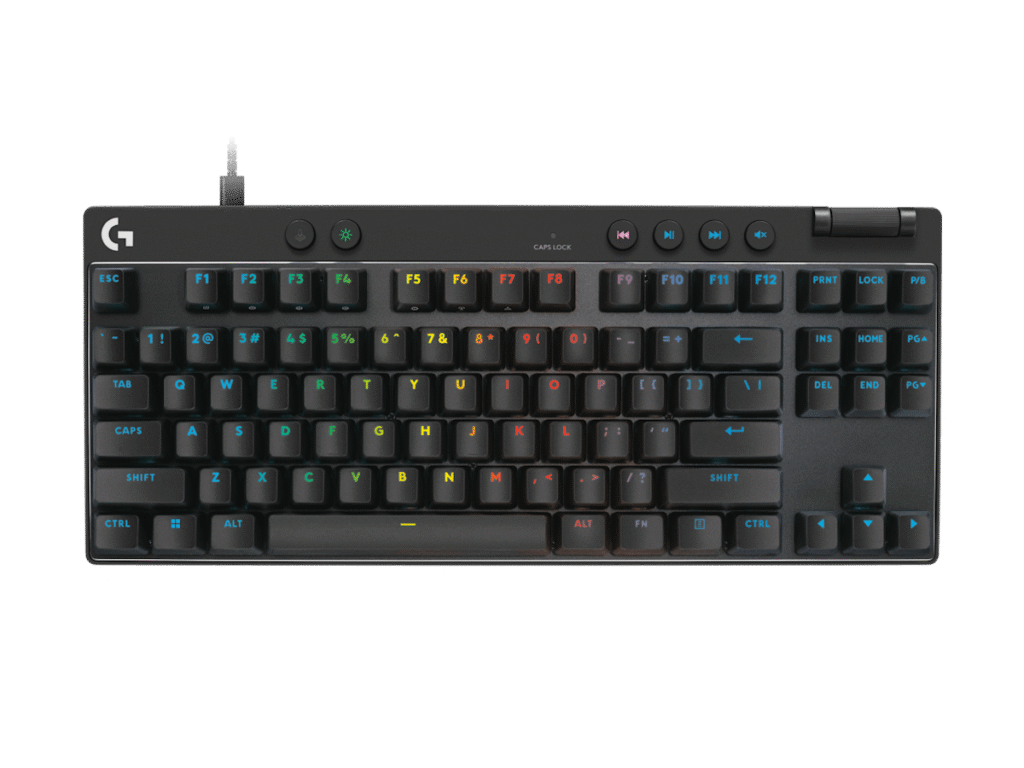
An aluminum top plate, LIGHTSYNC RGB lighting and a volume roller sit on a standard tenkeyless layout, and the one connection is a detachable USB cable. Logitech lists a PC with Windows 10 or later as the system requirement and names no Mac support.
Category strengths
Where the Logitech G PRO X TKL RAPID beats the median
- Has rapid trigger ?
- Has adjustable actuation ?
- A lighter actuation force ?35 g vs 45 g (median)
Where the Logitech G PRO X TKL RAPID trails the median
- No hot-swappable switches ?
- Fewer connection options ?
How this VS Score was computed
Score 55: each known spec is measured against the median of all keyboards (101 products), then weighted; 50 means level with that median. In classes of six or more, a value beyond the class’s 10th–90th percentile range counts as that limit, so one extreme product cannot set the scale. 44% of the scoreable weight could be used; unknown values, features not applicable to this class and proxies (battery capacity where a rated life exists) add or remove nothing.
| Specification | This product | Cohort median | Score weight | Points moved |
|---|---|---|---|---|
| Switch technology | Hall effect | Mechanical | 1 | +33.0 |
| Hot-swappable | No | 61% of the class have it | 0.6 | −28.8 |
| Connection | 1 | 3 | 0.8 | −26.4 |
| Rapid trigger | Yes | 25% of the class have it | 0.5 | +25.0 |
| Adjustable actuation | Yes | 24% of the class have it | 0.4 | +20.0 |
| Actuation force | 35 — capped at the class’s lower range (40) | 45 | 0.4 | +2.4 |
| Polling rate | 1,000 | 1,000 | 0.7 | +0.0 |
| Backlight | RGB | RGB | 0.3 | +0.0 |
Not scored: N-key rollover (unknown: not scored); Analog input (unknown: not scored); Wired latency (unknown: not scored); Wireless latency (unknown: not scored); Front height (unknown: not scored); Bluetooth devices (unknown: not scored); Battery life (unknown: not scored); Battery capacity (unknown: not scored); USB passthrough (unknown: not scored); Keycap material (unknown: not scored); Sound dampening (unknown: not scored); Programmable keys (standard for the class (99% have it)); Media controls (standard for the class (97% have it)); Rotary knob (unknown: not scored); Onboard profiles (standard for the class (89% have it)); Configuration software (standard for the class (95% have it)).
Editor’s note
Actuation runs from 0.1 to 4 millimeters on every key, and Logitech rates the switches to fire at 35 g. Its own support article suggests one to two millimeters for games and three for office work, so the shallowest settings belong on the movement keys and nowhere near the home row, where resting fingers would set them off.
Logitech says multi-actions work only on the base layer and only while rapid trigger is switched off. The strafe keys that gain most from rapid trigger therefore cannot also carry a second action, which narrows the two-stage feature to keys you press deliberately.
The every-key tuning is a real difference from SteelSeries' Apex Pro TKL Gen 3, which puts its magnetic switches only under the letter block and leaves the arrows and function row on mechanical Reds.
Fixed switches mean a failed switch goes back to Logitech under its two-year hardware warranty, instead of being pulled and replaced at the desk. On a board that spends its life being hammered in competitive play, that is the ownership cost to weigh.
Logitech now sells the PRO X2 RAPID above this board, with OLED controls and the faster polling that listings keep attributing to the original, and the G515 RAPID TKL beside it with the same switch idea on low-profile keys. Against those two, the first RAPID is the plain standard-height option. For me it earns its place only when the price gap to the X2 is wide, because the report rate is the one figure here a competitive player would notice.
Specifications
Quality bars show where each figure sits between the lowest and highest of the 101 keyboards this VS Score is measured against.
Switches & typing
Performance
Layout & size
Connectivity
Build & sound
Features
Sources and verification
Where the specifications come from
- Official product pagelogitechg.com
- Datasheet or manuallogitech.com
- Independent testingrtings.com
Verification
- First published
- Specifications last checked
- Sheet completeness
- 18 of 34 specifications verified; the rest show as Unknown and are never estimated or scored
- Page type
- Product specification page — Compiled from the manufacturer’s published specifications and the cited sources; this is not a hands-on test.
- Basis
- Research-based: specifications and editorial text were compiled from the documents listed here and the manufacturer’s published data. We have not tested this unit ourselves; where independent measurements are mentioned they belong to the linked publication.
Keyboards with similar specs to the Logitech G PRO X TKL RAPID
Ratings & reviews
No reviews yet. Be the first to share your experience.
The bottom line
The Logitech G PRO X TKL RAPID earns a VS Score of 55, above the median of the 101 keyboards it is measured against (a score of 50 is level with that median).
- Who it’s for
- Shooter players already on G HUB who want rapid trigger and per-key actuation on a standard-height tenkeyless board.
- Who should look elsewhere
- If you mostly write, look elsewhere. Light switches punish fingers that rest on the keys during long typing.
- The trade-off that matters
- It is tethered to a cable, which is fine at a fixed gaming desk and a nuisance if the same keyboard has to serve a sofa or a second machine.
- The main alternative
- Wooting 80HE: the specialist's magnetic board, with switches that pull out without soldering and the faster polling this Logitech lacks.
The VS Score is calculated from the weighted specifications above, each measured against the median of comparable keyboards — a shortlisting guide, not a substitute for your own priorities. See how we score.